
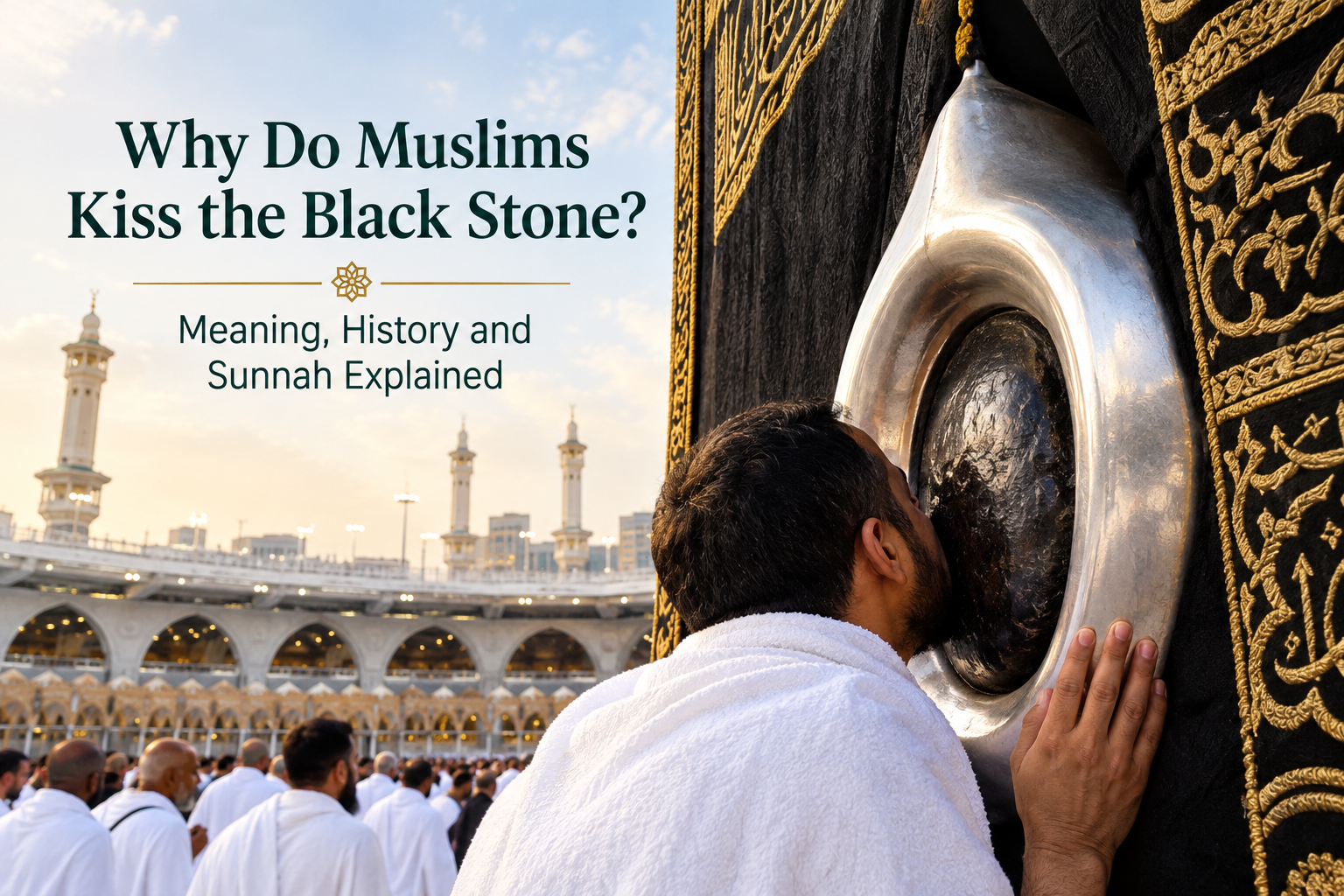
During Hajj and Umrah, millions of pilgrims gather at Al-Masjid al-Haram in Makkah to perform Tawaf—circumambulating the Holy Kaaba seven times. As believers circle this sacred shrine, many try to reach, touch, or kiss the smooth dark stone set into its eastern corner.
Known in Arabic as Hajr-e-Aswad (الحجر الأسود), the Black Stone holds a special place in the hearts of believers. But why do Muslims kiss the Black Stone? Is it an act of worship, or a tribute to Islamic history and tradition?
Understanding the spiritual meaning, rich history, and prophetic Sunnah behind the Black Stone reveals why this sacred ritual remains one of the most emotional moments of the pilgrimage.
What Is Hajr-e-Aswad (The Black Stone)?
The Hajr-e-Aswad is a sacred relic encased in a protective pure silver frame on the eastern corner of the Kaaba, known as Rukn al-Aswad (the Corner of the Black Stone).
Rather than a single large boulder, the stone consists of several small fragments bound together by protective resin and frankincense within the silver encasement due to historical damages over the centuries. It marks the official starting and ending line for each circuit of Tawaf.
[ NORTH ]
+——————–+
| |
[ WEST ]| HOLY KAABA |[ EAST ]
| | <– Hajr-e-Aswad (Starting point of Tawaf)
+——————–+
[ SOUTH ]
The Heavenly Origins & History of the Black Stone
Islamic tradition records that Hajr-e-Aswad was brought down directly from Jannah (Paradise).
According to authentic narrations, the Prophet Muhammad (ﷺ) said:
“The Black Stone descended from Paradise, and it was whiter than milk, but the sins of the children of Adam made it black.”
— Jami` at-Tirmidhi (877)
Key Historical Milestones:
- Placed by Prophet Ibrahim (AS): When Prophet Ibrahim (Abraham) and his son Prophet Ismail (Ishmael) rebuilt the foundations of the Kaaba under Allah’s command, Angel Jibril (Gabriel) brought the stone to be set as the anchor corner.
- Re-set by Prophet Muhammad (ﷺ): Before his prophethood, during a major reconstruction of the Kaaba by the Quraysh, tribal leaders disputed over who had the honor of replacing the stone. Prophet Muhammad (ﷺ) placed the stone onto a cloth, asking leaders from each tribe to lift it together, demonstrating wisdom, peace, and unity.
- Preservation Through Time: Over the centuries, the stone endured floods, fires, and theft—most notably when stolen in 930 CE by the Qarmatians before being returned decades later—leading to its modern encasement in silver.
Why Do Pilgrims Kiss the Black Stone?
Muslims do not worship the Black Stone. Islam is strictly monotheistic, and worship (Ibadah) belongs exclusively to Allah (SWT).
The essential understanding of this ritual was best summarized by the second Caliph, Umar ibn al-Khattab (RA). Standing before Hajr-e-Aswad, he famously stated:
“I know that you are only a stone and can neither benefit nor harm. Had I not seen the Messenger of Allah (ﷺ) kiss you, I would not have kissed you.”
— Sahih al-Bukhari (1597)
How to Perform Istilam (Greeting the Stone) Correctly
In Islamic jurisprudence (Fiqh), greeting or touching the stone is called Istilam. Because the Mataf area can become intensely crowded, Islam provides clear options so pilgrims never harm others while trying to reach it.
1.Direct Kissing or Touching:When crowds are light.
If space permits without pushing or causing discomfort to fellow pilgrims, step forward, place your hands on the frame, gently touch or kiss the stone, and say “Bismillahi, Allahu Akbar”.
2.Touching with an Object or Hand:When closer access is restricted.
If you can reach near the stone but cannot lean down to kiss it, touch it with your right hand or a clean walking stick, and then kiss your hand or stick.
3.Pointing From a Distance (Most Common):When the area is crowded.
If the Mataf is packed, stand in line with the green indicator light on the mosque wall facing Hajr-e-Aswad. Raise your right hand towards the stone, say “Bismillahi, Allahu Akbar”, and proceed with your circuit without stopping or causing a bottleneck.
Important Reminder: Kissing the stone is a recommended Sunnah, but causing harm, pushing, or hurting fellow Muslims in a crowd is strictly forbidden (Haram). Pointing from a distance yields full spiritual reward when done with pure intention (Niyyah).
Connect with the Sacred Heritage at Kaaba Kiswa
The Black Stone serves as a physical bridge between Heaven and Earth, reminding pilgrims of the legacy of Prophet Ibrahim (AS) and Prophet Muhammad (ﷺ).
At Kaaba Kiswa, we help bring the beauty of these sacred traditions into your home. Explore our collection of authentic Islamic art, Kiswa-inspired framed fabrics, premium prayer mats, and spiritual keepsakes crafted to remind you of the Holy Sanctuaries of Makkah and Madinah.
Visit Kaaba Kiswa to explore our sacred collection today!