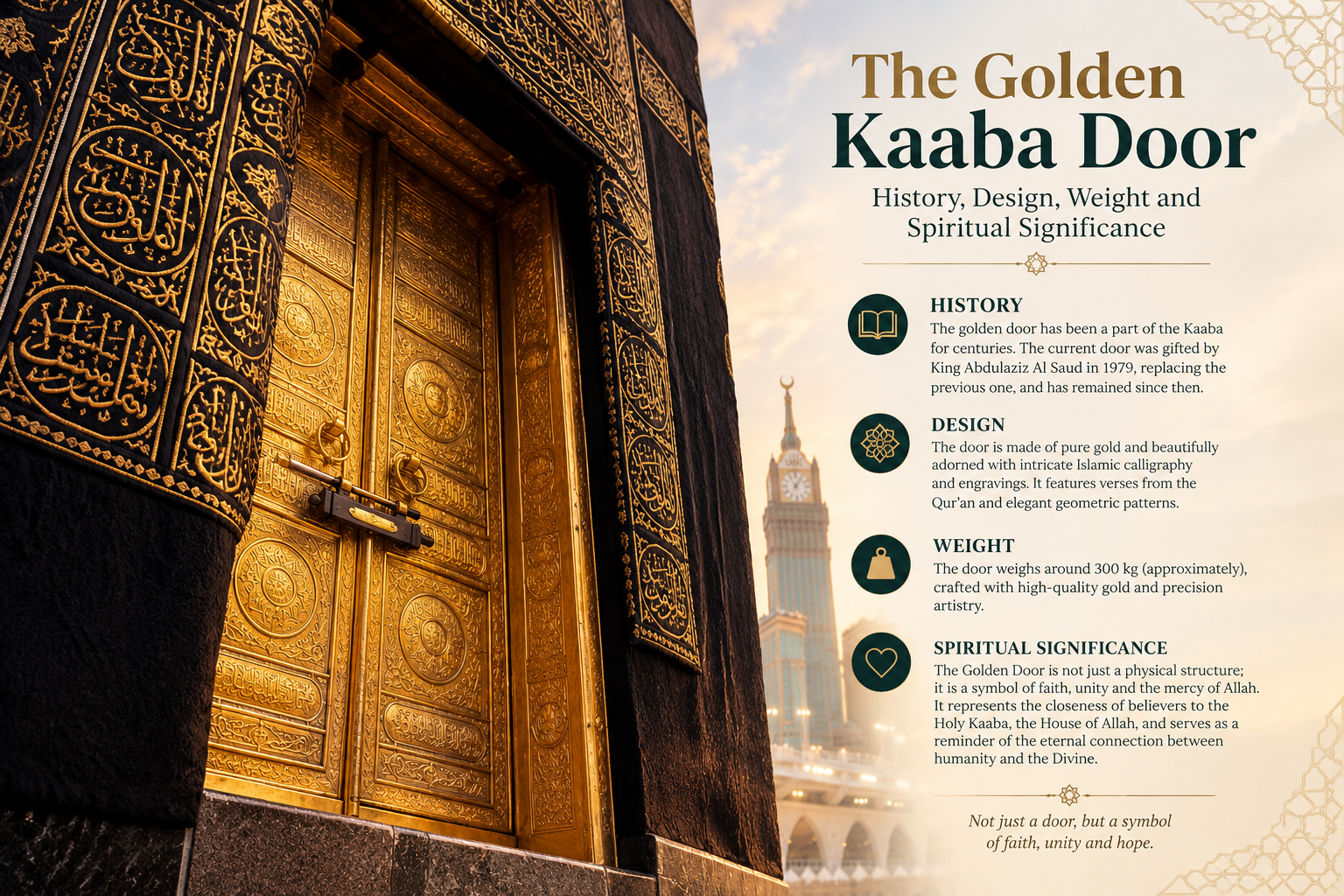
Golden Kaaba Door, also known as Bab al-Kaaba, stands 2.22 meters above the ground on the northeastern wall of Islam’s holiest site. Framed by the deep black silk of the embroidered Kiswah, the Golden Kaaba Door represents centuries of royal stewardship, master craftsmanship, and sacred symbolism.
Understanding the design, history, and physical composition of this monumental structure reveals how deep spiritual reverence and cutting-edge engineering converged to create one of the most famous architectural features in the world.
Materials and Technical Specifications
The current door of the Holy Kaaba—installed during the Saudi era—is an engineering triumph designed to endure extreme heat, desert winds, and harsh environmental conditions.
- Pure Gold Construction: The outer shell and calligraphic reliefs of the main door (along with its internal counterpart, Bab al-Tawbah) were crafted using 280 kilograms of 99.99% (24-karat) pure gold.
- Structural Core: Beneath its outer golden layer, the door utilizes high-grade heat-treated steel and titanium alloys to form a rigid structural core that prevents warping and sagging under the immense weight.
- Internal Framework: Seasoned, pest-resistant Teak wood forms the inner dampening frame, ensuring seamless movement on its heavy hinges.
- Cost of Manufacturing: The craftsmanship and structural development cost 13.42 million Saudi Riyals (excluding the value of the raw gold).
Key Dimensions Overview
| Attribute | Measurement |
| Height | 3.18 meters (10.4 feet) |
| Width | 1.71 meters (5.6 feet) |
| Depth / Thickness | ~0.50 meters (1.6 feet) |
| Elevation from Ground | 2.22 meters (7.3 feet) |
| Quantity of Gold Used | 280 kg (617 lbs) |
The Historical Evolution of Bab al-Kaaba
The Golden Kaaba Door has undergone several major architectural transformations throughout Islamic history.
1. Early Foundations & The Elevation
When Prophet Ibrahim (AS) built the Kaaba, the entrance sat directly at ground level. During later reconstructions prior to the advent of Islam, the Quraysh elevated the entrance above ground level to safeguard the interior from flash floods and control entry into the sanctuary.
2. The Ottoman Transformations
Over centuries of rule, Mamluk and Ottoman sultans enriched the door with precious metal overlays. In 1635 CE (1045 AH), Sultan Murad IV ordered the fabrication of a magnificent silver door coated in gold leaf after heavy rainfall caused structural damage to the Kaaba. This historic door served for over 300 years.
3. The Saudi Golden Era
- The 1944 Door: King Abdulaziz Al Saud (founder of modern Saudi Arabia) commissioned a new aluminum and wood-framed door wrapped in gold-plated silver.
- The 1979 Golden Door: After King Khalid bin Abdulaziz prayed inside the Kaaba in 1977 and noticed scratches on the previous door, he commanded the crafting of a door made entirely of pure solid gold.
Designed by Syrian architect Mounir Al-Jundi and handcrafted over 12 months by the Makkan goldsmith family of Ahmad bin Ibrahim Badr, the door was installed in 1979 (1399 AH) alongside Bab al-Tawbah—the internal door leading to the Kaaba’s roof.
Calligraphy, Inscriptions, and Spiritual Design
The door’s aesthetic beauty lies in its magnificent embossed Arabic calligraphy executed in the classical Thuluth script. Each section communicates profound Quranic theology and divine attributes:
- Upper Header Panel: Inscribed with the Basmala (“In the name of Allah, the Most Gracious, the Most Merciful”) alongside verses celebrating divine protection.
- Central Medallions: Embedded circular designs contain the Shahada—“There is no god but Allah, and Muhammad is the Messenger of Allah”—acting as the central spiritual seal.
- Lower Inscriptions: Intricate geometric borders house verses from Surah Al-Fatiha, alongside engravings honoring the divine attributes (Asma-ul-Husna) like Ya Hayyu Ya Qayyum (O Ever-Living, O Sustainer).
The Spiritual Significance of the Golden Kaaba Door
In Islamic spirituality, Bab al-Kaaba holds deep symbolic importance:
- Gateway to Divine Sanctuary: The door guards the inner sanctum of the Qibla—the physical direction toward which over 1.8 billion Muslims turn during daily prayers.
- Symbol of Reverence: The use of gold and meticulous calligraphy reflects the utmost honor (Ta’dheem) that Islamic tradition bestows upon Allah’s Sacred House.
- The Multazam Connection: The wall section between the Black Stone and the Golden Door is known as the Multazam—a highly blessed area where pilgrims press their hands and make fervent supplications during Hajj and Umrah.
Key Takeaways
- Golden Kaaba Door: The current door contains 280 kg of pure gold and features intricate Islamic calligraphy.
Pure Gold Construction: The door contains 280 kg of 99.99% pure 24K gold over a steel, titanium, and teakwood framework. - Dimensions: It stands 3.18 meters high and 1.71 meters wide, elevated 2.22 meters off the ground.
- Modern Masterpiece: Commissioned by King Khalid in 1977 and installed in 1979, it took one year of intensive handcrafting in Makkah to complete.
- Calligraphic Reliefs: Features prominent Quranic verses, the Shahada, and names of Allah rendered in relief Thuluth script.
The craftsmanship of the Golden Kaaba Door reflects a remarkable combination of Islamic artistry, detailed calligraphy, and advanced architectural techniques.
Bring the Heritage of the Sanctuary Into Your Home
The intricate beauty of the Golden Kaaba Door and the Holy Kiswah represents the highest peak of Islamic art and devotion. At Kaaba Kiswa, we help believers preserve this connection by providing authentic framed art, and historical Kiswah collectibles.
Explore our collection today at Kaaba Kiswa and bring a piece of holy history into your living space.