
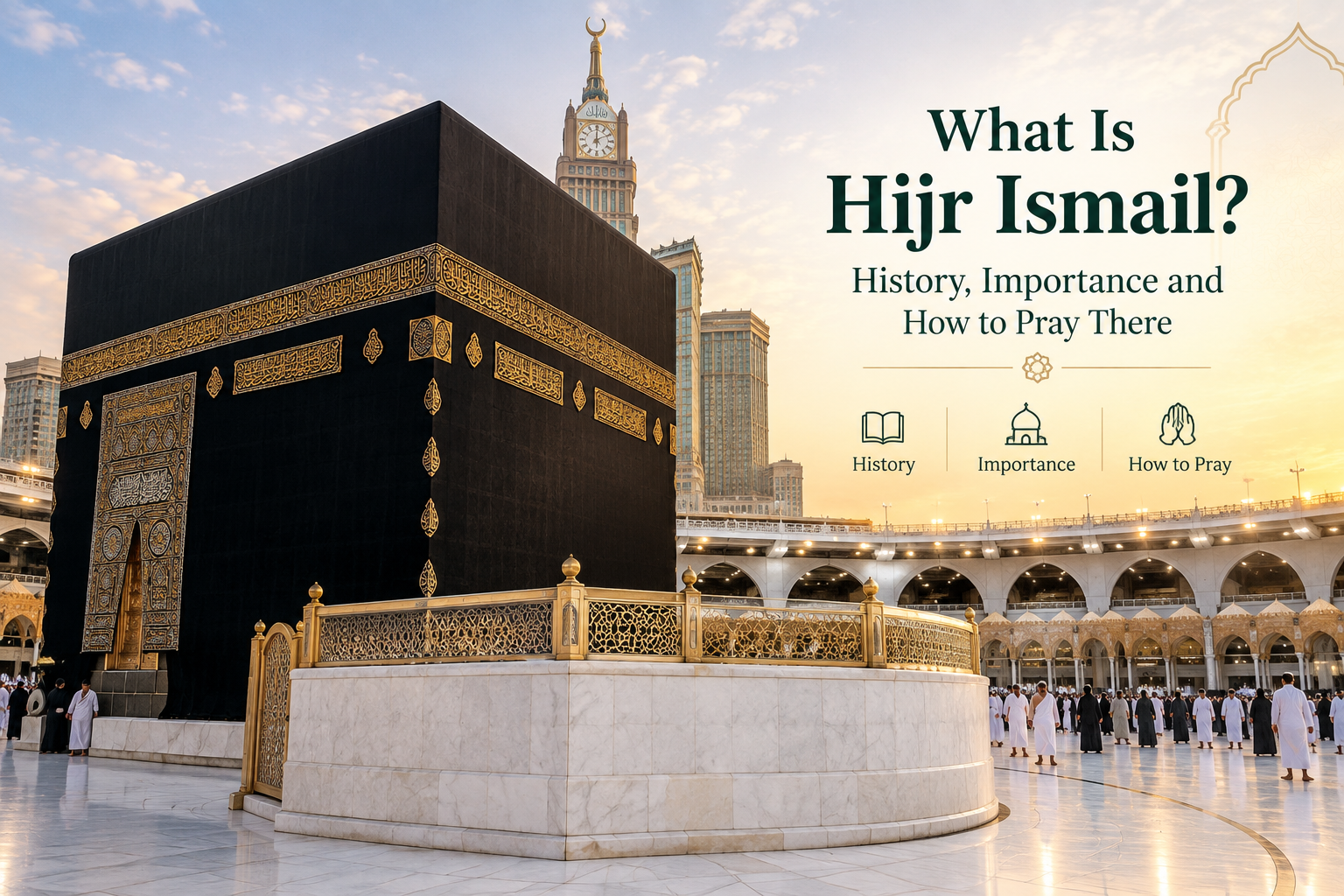
Every year, millions of Muslims walk around the Holy Kaaba during Hajj and Umrah. While circumambulating (Tawaf), pilgrims notice a low, semi-circular white marble wall attached to the northwestern side of the Kaaba.
This sacred space is known as Hijr Ismail (or Al-Hateem).
Many worshippers pass by this crescent-shaped area without realizing that it holds a unique status in Islam: praying inside Hijr Ismail is spiritually equivalent to praying inside the Kaaba itself.
Whether you are preparing for your upcoming pilgrimage or seeking deeper knowledge of Islamic history, here is your guide to understanding the meaning, history, importance, and prayer rules of Hijr Ismail.
What Is Hijr Ismail (Al-Hateem)?
Hijr Ismail (حجر إسماعيل), translated as the “Stone of Ismail,” is a 1.32-meter (4.3-foot) high semi-circular marble enclosure located on the northern wall of the Kaaba, directly under the Meezab al-Rahmah (the rainwater spout of mercy).
[ NORTH WALL ]
+———————–+
| (Meezab al-Rahmah) |
| =================== |
| | | |
| | HIJR ISMAIL | | <– Semi-circular area (Al-Hateem)
| | (HATEEM AREA) | | Included in original Kaaba foundation
| =================== |
[ WEST | |[ EAST
WALL]| HOLY KAABA | WALL]
| |
+———————–+
[ SOUTH WALL ]
Although it sits outside the main cubic structure today, Islamic jurisprudence (Fiqh) confirms that the space inside this marble arc is an integral part of the original Kaaba foundation built by Prophet Ibrahim (AS) and Prophet Ismail (AS).
History of Hijr Ismail: Why Is It Separate from the Kaaba?
The separation of Hijr Ismail from the main structure of the Kaaba carries a remarkable history involving financial integrity and divine wisdom.
1. The Original Construction by Prophet Ibrahim (AS)
When Prophet Ibrahim (AS) and his son Prophet Ismail (AS) constructed the Kaaba, the original rectangular floor plan included the entire semi-circular space of Hijr Ismail. Historically, it served as a shelter built by Ibrahim (AS) for his wife Hagar (RA) and infant son Ismail (AS).
2. The Reconstruction by the Quraysh
When Prophet Muhammad (ﷺ) was 35 years old—5 years before receiving prophecy—a major flood damaged the Kaaba. The leaders of the Quraysh decided to demolish and rebuild the structure.
To ensure the sacred house was built purely, the Quraysh made a strict vow: Only pure, halal money could be used for construction. They explicitly rejected money earned from usury (Riba), gambling, or theft.
Because their halal funds fell short during construction, they reduced the length of the building on the northern side, leaving the semi-circular area outside the cubic wall. To demarcate the original boundary, they built the low marble wall around it.
3. The Hadith of Aisha (RA)
Mother of the Believers, Aisha (RA), once expressed her desire to pray inside the Kaaba. The Prophet Muhammad (ﷺ) held her hand, led her into Hijr Ismail, and said:
“Pray in the Hijr if you wish to enter the House (the Kaaba), for it is part of the House. Your people ran out of funds when they rebuilt the Kaaba, so they left it outside.”
— Sunan Abu Dawud (2028)
Why Is Hijr Ismail So Important?
| Significance | Description |
| Equivalent to Praying Inside the Kaaba | Because it is part of the original building foundation, performing voluntary prayer (Nafl) inside Hijr Ismail carries the same spiritual reward as praying inside the Kaaba. |
| Tawaf Rules | Pilgrims must walk outside the semi-circular wall during Tawaf. Walking inside Hijr Ismail invalidates that circuit because you would be cutting through the Kaaba rather than encircling it. |
| Resting Place of Prophets | Historical narrations note that the area holds deep connections to Hagar (RA) and Prophet Ismail (AS), making it a site blessed by generations of monotheists. |
| Beneath the Spout of Mercy | The Meezab al-Rahmah pours rainwater from the roof of the Kaaba directly into the Hijr, making it a favored spot for heartfelt supplication (Dua). |
How to Pray in Hijr Ismail: Rules & Etiquette
Because space inside the crescent wall is limited, entry is managed by Haram security staff.
1.Check Entry Timings & Access Gates:Queue at designated gates.
The General Presidency for the Care of the Two Holy Mosques schedules separate time windows for men and women to enter Hijr Ismail (typically accessible via Al-Fath Gate / Gate 45). Check official announcements or ask mosque staff for current daily slots.
2.Offer Two Rakat of Nafl Prayer:Voluntary prayers only.
Once inside, offer 2 Rakat of voluntary prayer (Nafl). Note that Islamic scholars advise that obligatory prayers (Fard) should be performed outside the Kaaba structure facing the Qibla wall.
3.Make Continuous Dua:Make sincere supplications.
Praise Allah (SWT), send blessings upon the Prophet (ﷺ), and make personal supplications. This area is widely recognized as a place where prayers are answered.
4.Keep Your Visit Brief and Peaceful:Be mindful of fellow pilgrims.
Capacity inside Hijr Ismail is restricted. Complete your 2 Rakat and short Dua within 5 to 10 minutes so other waiting pilgrims can experience the blessing. Avoid pushing or rushing.
Bring the Beauty of Makkah into Your Life with Kaaba Kiswa
The history of Hijr Ismail teaches us about the sanctity, purity, and enduring heritage of the Sacred Mosque.
At Kaaba Kiswa, we honor this divine heritage by crafting high-quality Islamic art, framed Kiswa fabrics, luxury prayer mats, and spiritual decor inspired by the holy sanctuaries of Makkah and Madinah.
Explore our collection today at Kaaba Kiswa and keep the memories of your pilgrimage alive in your home!