For centuries, millions of pilgrims traveling to the sacred city of Makkah have turned their gaze toward the eastern corner of the Holy Kaaba. Embedded in a polished silver casing, Hajar al-Aswad—the Black Stone of the Kaaba—stands as one of the most revered symbols in Islamic history.
Whether you are preparing for Hajj or Umrah or simply exploring Islamic heritage, understanding the origin, significance, and history of Hajar al-Aswad enriches your connection to the House of Allah.
What Is Hajar al-Aswad?
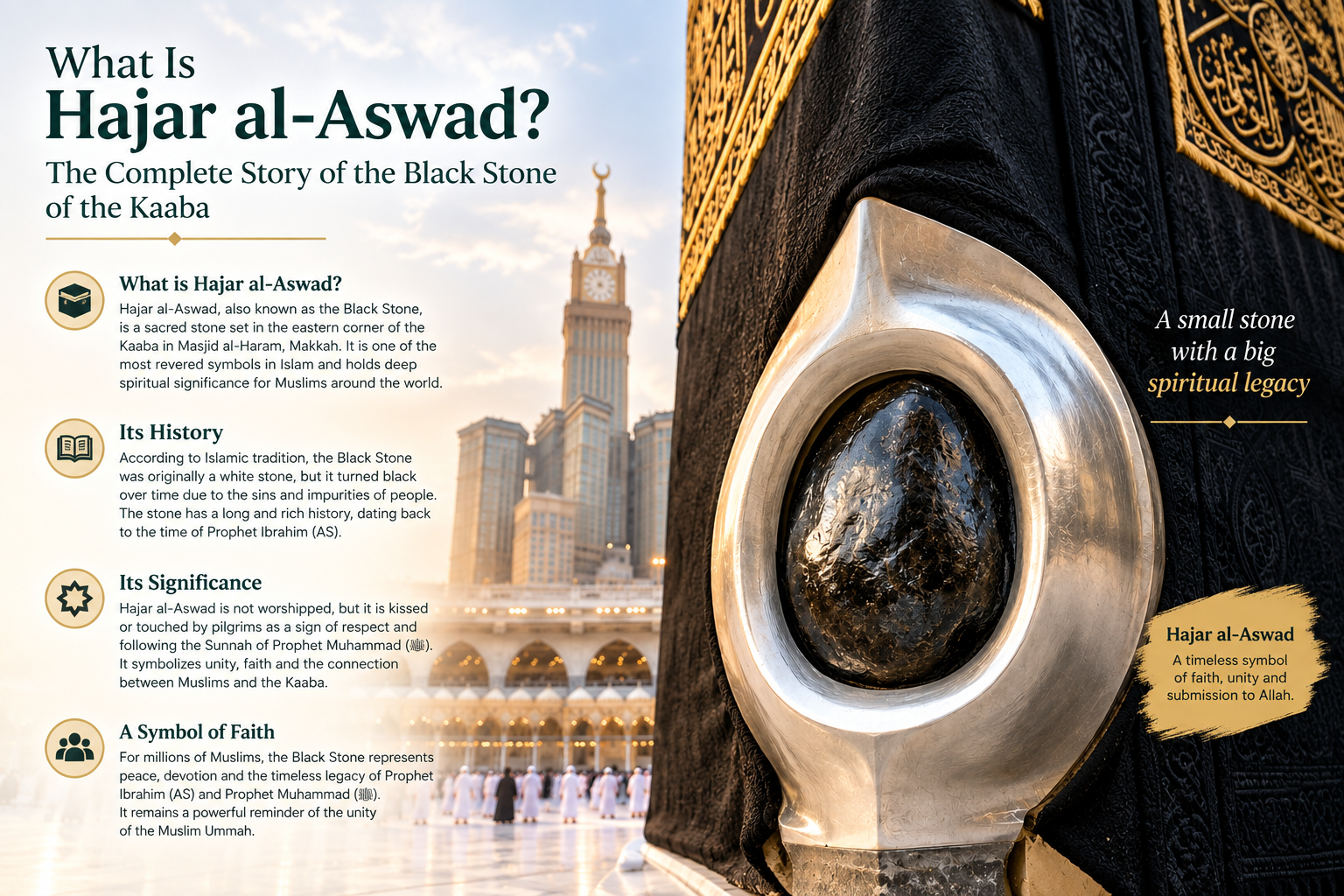
Hajar al-Aswad (Arabic: الحجر الأسود) translates directly to “The Black Stone.” Located in the eastern corner of the Holy Kaaba—known as Rukn al-Hajar (the Corner of the Stone)—it marks the starting and ending point for each circuit of Tawaf (circumambulation).
Physically, the visible part of the stone today consists of eight small fragments of dark, reddish-black stone joined together using a protective resin and encased in a pure silver frame.
The Heavenly Origin of the Black Stone
According to Islamic tradition, Hajar al-Aswad is not an ordinary earthly stone; it was brought down from Paradise (Jannah).
- Gift from Jannah: Islamic sources record that Angel Jibril (Gabriel) brought the stone down to Earth to assist Prophet Ibrahim (Abraham) and his son Prophet Isma’il (Ishmael) when they rebuilt the foundations of the Kaaba.
- Original Appearance: Hadith literature records that when the stone descended from Jannah, it was whiter than milk. Over generations, it absorbed the sins of humanity, causing its color to darken to the deep black seen today.
“The Black Stone came down from Paradise, and it was whiter than milk, but the sins of the sons of Adam turned it black.”
— Sunan al-Tirmidhi
Historical Milestones: The Journey of the Black Stone
Throughout history, Hajar al-Aswad has witnessed key historical events, reconstructions, and moments of preservation.
1. Prophet Muhammad’s (PBUH) Wise Intervention
Before receiving his prophetic mission, Prophet Muhammad (PBUH) played a crucial role in preventing civil strife among the tribes of Quraish. When rebuilding the Kaaba after flood damage, the tribal leaders disputed fiercely over who would hold the honor of placing Hajar al-Aswad back in its corner.
Prophet Muhammad (PBUH) spread his cloak, placed the Black Stone in the center, and invited a representative from each tribe to lift the cloak together. He then set the stone into its wall setting with his own hands, uniting the community and demonstrating profound wisdom.
2. Historical Damage & Protection
- Fire Damage: During historical sieges of Makkah in early centuries, intense fires caused the stone to crack into smaller fragments.
- The Qarmatian Incident: In 317 AH (930 CE), a group known as the Qarmatians removed the stone from the Kaaba and took it to Eastern Arabia. It remained away from Makkah for over two decades before being returned and restored to its original place in the Kaaba wall.
- The Silver Enclosure: To protect the remaining fragments, Islamic rulers crafted protective silver casings to keep the pieces intact within the structure of the Kaaba.
Spiritual Significance in Tawaf and Sunnah
While pilgrims hold deep reverence for Hajar al-Aswad, Islamic teachings emphasize that the stone itself possesses no independent divine power. Respect shown toward the stone follows the Sunnah of Prophet Muhammad (PBUH).
When Caliph Umar ibn al-Khattab (RA) approached Hajar al-Aswad, he famously stated:
“I know that you are only a stone that can neither cause harm nor bring benefit. Had I not seen the Messenger of Allah (PBUH) kiss you, I would not have kissed you.”
— Sahih al-Bukhari
Etiquettes During Tawaf:
- Istilam (Touch or Kiss): If crowd conditions allow without causing hardship or harm to others, touching or kissing Hajar al-Aswad is a recommended Sunnah.
- Pointing from a Distance: When the Mataf area is crowded, pilgrims point their right hand toward Hajar al-Aswad at the start of each Tawaf circuit, saying “Bismillahi, Allahu Akbar”, without causing physical congestion.
Connecting Heritage with Sacred Art
The deep reverence Muslims hold for Hajar al-Aswad, the Holy Kaaba, and its elegant black and gold embroidery (Kiswa) inspires Islamic art and heritage crafts around the world.
At Kaaba Kiswa, we honor this rich spiritual history by crafting authentic Islamic calligraphic art, Kiswa-inspired textiles, and sacred decor pieces that bring the atmosphere of Makkah and Madinah into your living spaces. Explore our collection at Kaaba Kiswa to celebrate timeless Islamic traditions in your home.