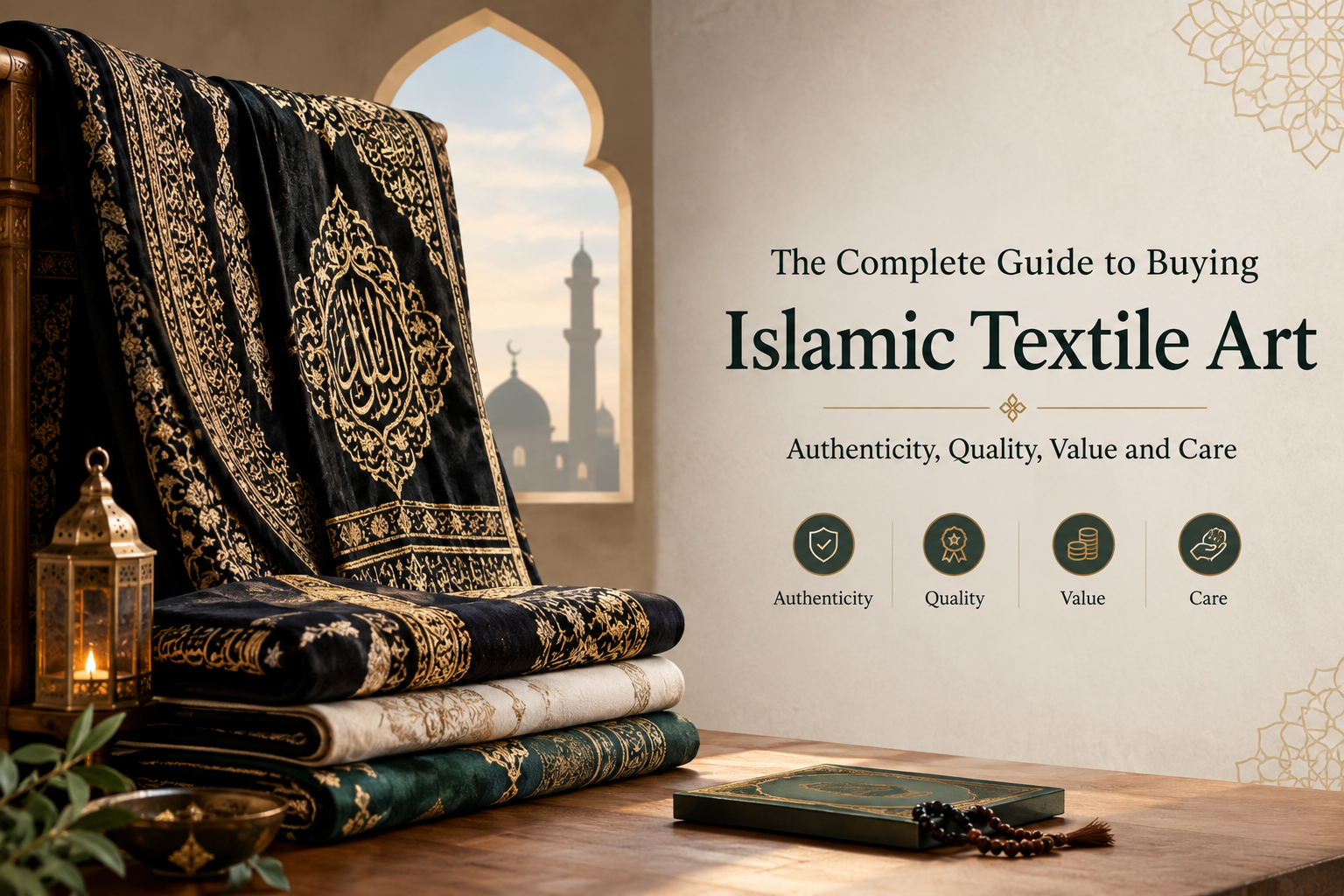
Islamic textile art brings together heritage, craftsmanship, spirituality, and timeless beauty. Among the most remarkable examples is the Kaaba Kiswa, the sacred covering of the Holy Kaaba in Makkah. Its black silk fabric, Quranic inscriptions, and intricate metallic embroidery have made it one of the world’s most recognizable Islamic textiles.
Buying a textile requires more than choosing an attractive design. You need to understand authenticity, materials, craftsmanship, provenance, value, and preservation. This guide explains what to check before purchasing Islamic textile art.
What Makes Islamic Textile Art Valuable?
The value of Islamic textile art comes from several elements working together. Material quality is important, but heritage, craftsmanship, rarity, condition, design, provenance, and cultural significance can be equally important.
The Kaaba Kiswa is an exceptional example. Current production involves carefully prepared silk, precision weaving, Quranic verses, embroidery, assembly, and strict quality inspection. In 2026, Saudi official reporting stated that producing one Kiswa requires approximately 825 kilograms of raw silk, 120 kilograms of gold-plated silver wire, 60 kilograms of pure silver, and 410 kilograms of raw cotton.
Authentic Kiswa-related textiles should therefore be viewed as heritage pieces, not ordinary decorative fabric.
Understanding the Kaaba Kiswa
The Kaaba Kiswa is the covering placed over the Holy Kaaba. It is traditionally produced at the King Abdulaziz Complex for Holy Kaaba Kiswa in Makkah and replaced annually. For collectors, Islamic textile art offers a unique way to appreciate traditional craftsmanship, Islamic heritage, and cultural history.
The modern Kiswa is made through controlled stages. Official Saudi information describes washing and dyeing, weaving, printing, embroidery, assembly, and final inspection as key stages. The fabric contains Quranic inscriptions and Islamic motifs, with gilded sections embroidered using silver and gold-plated silver threads.
The 2026 Kiswa was produced in 47 pieces of black silk and weighed approximately 1,410 kilograms, according to Saudi official reporting.
Why Is the Kiswa Kaaba So Expensive?
“Why is the kiswa kaaba so expensive?” is one of the common questions asked by people researching Islamic textiles.
The answer is the combination of premium materials, specialist craftsmanship, complex production, and the extraordinary scale of the covering. The Kiswa requires large quantities of silk and metallic embroidery materials, while Quranic calligraphy must be prepared and embroidered with exceptional precision.
Production also takes many months. A 2026 report citing the King Abdulaziz Complex stated that the process involves seven meticulous stages and substantial quantities of silk, gold-plated silver wire, pure silver, and cotton.
Its value is not determined simply by fabric. Craftsmanship, sacred association, and cultural heritage contribute to its importance.
What Does “Kaaba Kiswa for Sell” Actually Mean?
People often search online for “Kaaba kiswa for sell” when they want to own a piece connected with the Holy Kaaba. However, buyers should understand the difference between the complete covering used on the Kaaba, authentic sections or pieces associated with Kiswah, and decorative replicas inspired by its appearance.
A complete official Kiswa is not an ordinary retail product. Specialist sellers may offer textile pieces represented as authentic Kiswah material, but buyers should review the description, provenance, documentation, measurements, and condition before purchasing.
Never assume that black fabric with gold-colored Arabic calligraphy is genuine Kiswa. Appearance alone cannot establish authenticity.
How to Check Authenticity Before Buying
Before purchasing an Islamic textile, ask several practical questions. What is the material? What are the exact dimensions? Is the piece described as original, authentic, inspired, or replica? Is provenance available? Does the seller provide certification or supporting documentation? How was the textile obtained and preserved?
Clear answers are essential, especially when a seller uses terms such as “original,” “historic,” or “authentic.”
Also examine photographs carefully. Look for close-up views of embroidery, fabric texture, stitching, edges, and any identifying details. If the listing contains only generic photographs and vague claims, consider it a warning sign. When purchasing Islamic textile art, authenticity should always be verified before considering price or decorative appeal.
Understanding Original Kaaba Kiswah Price
Searching for the “original kaaba kiswah price” can be confusing because there is no single retail price that applies to every genuine Kiswah-related textile. Value depends on what exactly is being offered, its size, condition, provenance, rarity, embroidery, and documentation.
The production cost of the complete annual Kiswa is also different from the price of a collectible textile piece. These should never be treated as the same thing.
For collectors, a responsible purchase decision should focus on authenticity and documentation first, followed by condition, craftsmanship, size, and price.
How to Care for Islamic Textiles
Once you purchase valuable Islamic textile art, proper care becomes essential. Keep it away from direct sunlight, excessive humidity, smoke, dust, and sudden temperature changes. Avoid folding embroidered sections tightly because repeated creasing can stress delicate threads.
For framed pieces, use conservation-friendly materials and avoid placing the artwork where sunlight falls directly on it. Dust should be removed gently without rubbing the embroidery.
If the textile is particularly rare or valuable, consult a professional textile conservator before attempting cleaning, washing, restoration, or repairs.
Choose a Trusted Specialist
Buying Islamic textile art should be an informed experience. A trustworthy specialist should provide transparent product information, accurate measurements, clear photographs, and realistic descriptions of authenticity and provenance.
At Kaaba Kiswa, you can explore educational information about the Kaaba Kiswa and its remarkable history, craftsmanship, and cultural significance. If you are considering a Kiswah-related textile for your collection, take time to understand exactly what you are buying before making a decision.
Build a Meaningful Islamic Art Collection
Islamic textile art can become much more than an attractive addition to your home. It can preserve craftsmanship, connect generations with Islamic heritage, and create a meaningful visual reminder of sacred history.
Whether you are researching the Kaaba Kiswa, comparing collectible textile pieces, or looking for authentic Islamic decor, prioritize knowledge over impulse. Check provenance, study craftsmanship, understand the difference between an original textile and a replica, and choose a seller that communicates clearly.
Explore Kaaba Kiswa today to learn more about the history and artistry behind the Kiswah, discover Islamic textile inspiration, and make your next collecting decision with greater confidence.