
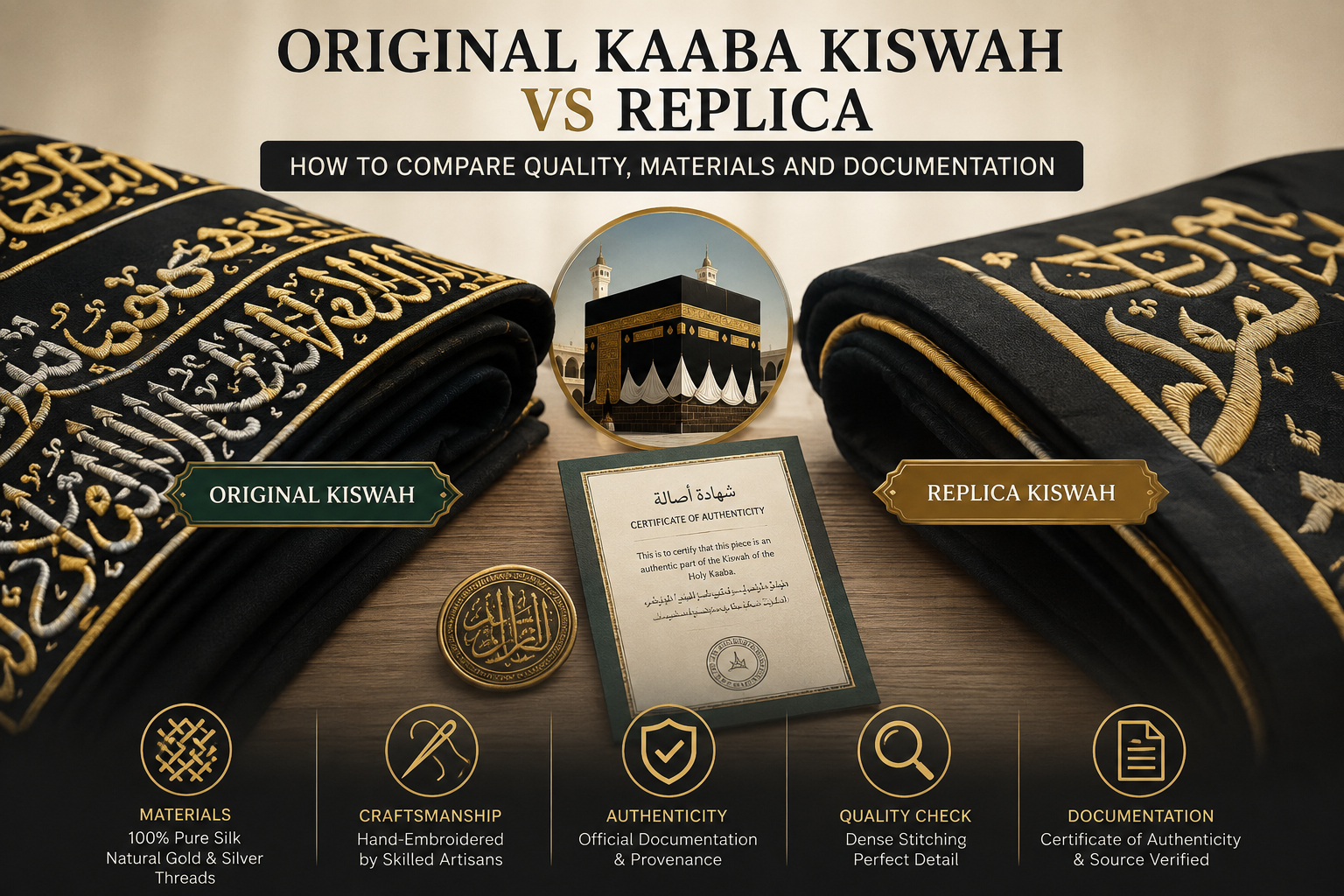
The Kaaba Kiswah is one of the most recognisable examples of Islamic textile craftsmanship. For buyers researching Original Kaaba Kiswah vs Replica UK, understanding the differences in materials, craftsmanship, provenance, and documentation is essential before making a purchase. Its black silk fabric, Arabic calligraphy, and detailed metallic embroidery give it a distinctive appearance that is difficult to reproduce convincingly.
However, replicas and Kaaba-inspired textiles are widely available. Some may be created as decorative artwork, while others may be presented in ways that cause buyers to believe they are genuine Kiswah material.
For collectors, understanding the difference between an original fragment and a replica requires more than looking at photographs. Materials, construction, provenance, documentation, condition, and seller information should all be considered together.
Original Kaaba Kiswah vs Replica UK
When comparing Original Kaaba Kiswa vs replica UK, the first question should be whether the textile is actually claimed to originate from the Kiswah.
A replica can reproduce the general appearance of the original, including black fabric, gold-coloured embroidery, Arabic calligraphy, and geometric motifs. It may even be beautifully made.
That does not make it an authentic fragment.
An original Kiswah fragment should have a credible explanation of its origin and, ideally, supporting documentation. Buyers should therefore separate two questions: “Does it look like a Kiswah?” and “Is there evidence that it came from the Kiswah?”
The second question is considerably more important for collectors.
How to Identify Original Kaaba Kiswah
Learning How to identify original Kaaba Kiswah is an important part of an Original Kaaba Kiswah vs Replica UK comparison. Authenticity should be assessed using both physical characteristics and reliable documentary evidence.
Start by requesting detailed photographs of the complete textile, including its front, reverse, edges, embroidery, stitching, and any backing.
Next, ask for precise measurements and information about the material.
Examine the embroidery carefully. Authentic Kiswah textiles are associated with specialised textile production and highly detailed calligraphic work. However, craftsmanship alone cannot establish provenance because skilled manufacturers can reproduce similar designs.
The strongest assessment combines physical characteristics with a documented history.
Compare Original Kaaba Kiswah vs Replica UK Fabric
When making an Original Kaaba Kiswah vs Replica UK comparison, fabric construction can provide useful clues, although material alone cannot prove authenticity.
Buyers should examine the weave, surface texture, thickness, stitching, and condition rather than judging authenticity from colour alone.
A replica may use synthetic material, modern decorative fabric, or another textile chosen to imitate the appearance of silk. An authentic fragment may display characteristics consistent with its claimed production period and manufacturing process.
However, material identification should not be treated as conclusive proof. Different textiles can share similar characteristics, and photographs cannot always reveal fibre composition accurately.
For valuable purchases, specialist examination can provide a more reliable assessment.
Weight and Fabric Weave : Original Kaaba Kiswah vs Replica UK
Weight and fabric weave can help buyers assess an Original Kaaba Kiswah vs Replica UK, but neither measurement should be treated as conclusive proof of authenticity.
The total weight depends on dimensions, fabric construction, embroidery, metallic threads, backing, and any later mounting or conservation.
Similarly, weave structure can vary depending on the textile section and production details.
Therefore, buyers should avoid claims such as “this weight proves it is genuine.” Measurements are evidence that should be considered alongside provenance and other characteristics.
Ask the seller to provide:
- Exact dimensions
- Approximate textile weight
- Fabric composition
- Weave information
- Embroidery details
- Backing information
- Condition report
These details provide a clearer picture of the object being purchased.
Examine the Embroidery
The embroidery is one of the most visually distinctive aspects of Kiswah material.
Look closely at the lettering, stitching, thread construction, raised surfaces, edges, and decorative patterns.
Metallic embroidery should receive particular attention. Gold-coloured thread does not automatically mean that an item contains solid gold.
Traditional textile production can involve different metallic-thread constructions, including silver-based threads with gold plating. Therefore, assumptions about precious-metal content should not be made from photographs.
If a seller makes specific claims about gold or silver content, ask what evidence supports those claims.
Original Kiswah Does Not Mean Every Detail Is Perfect
Collectors should also remember that genuine historic textiles can show wear.
An authentic fragment may have fading, small tears, loose fibres, staining, repairs, or other signs of age and handling.
A perfectly clean, recently manufactured-looking textile is not automatically fake, but condition should be considered alongside the claimed age and history.
Likewise, minor damage does not automatically make a fragment less authentic.
The important question is whether the condition is consistent with the object’s documented history.
Documentation for Original Kaaba Kiswah vs Replica UK
Documentation is especially important when making an Original Kaaba Kiswah vs Replica UK comparison because appearance alone cannot establish where a textile originated.
Documentation can provide information about where the piece came from, how it was acquired, who previously owned it, and what evidence supports its identification.
Useful records may include:
- Provenance information
- Purchase records
- Previous ownership details
- Authentication certificates
- Photographs
- Specialist assessments
- Detailed product records
- Information about the original Kiswah
The documentation should refer specifically to the item being offered.
How to Check Kaaba Kiswah Certificate of Authenticity UK
Understanding How to check Kaaba Kiswah certificate of authenticity UK documentation is essential before making a significant purchase. When comparing an Original Kaaba Kiswah vs Replica UK, buyers should carefully examine any certificate of authenticity provided by the seller.
First, examine who issued the certificate. The issuer should be identifiable, and the document should clearly describe the item.
Check whether the certificate includes:
- Item identification
- Dimensions
- Materials
- Claimed origin
- Date or period where available
- Authentication basis
- Issuing authority or specialist
- Certificate number where applicable
Compare the certificate with the actual textile. Measurements, photographs, descriptions, and other identifying details should be consistent.
A certificate should not automatically be considered definitive simply because it has an official-looking design.
For expensive acquisitions, independent professional assessment may provide additional confidence.
Original Kaaba Kiswah vs Replica UK: Provenance vs Appearance
Provenance is one of the most important factors in an Original Kaaba Kiswah vs Replica UK comparison because visual similarity does not establish historical origin.
A replica can have:
- Black silk-like fabric
- Gold-coloured embroidery
- Arabic calligraphy
- Hizam-inspired decoration
- Kaaba-related motifs
These features can make a textile visually convincing without establishing historical origin.
Provenance provides another layer of evidence. If a seller cannot explain where the fragment came from, buyers should be cautious about accepting claims of authenticity.
Questions to Ask the Seller
Before purchasing, ask:
Where did the fragment originate?
How was it acquired?
Is there documented provenance?
What are the exact dimensions and weight?
What is the fabric composition?
What type of embroidery thread is used?
Has the piece been repaired or restored?
Who issued the certificate?
Does the documentation relate specifically to this item?
Is there a return policy?
A transparent seller should be able to provide clear answers.
Be Careful With Price
Price should never be used as the only authentication test.
A very expensive textile is not automatically genuine, while an affordable piece is not automatically a replica.
Value can depend on provenance, size, embroidery, condition, historical context, documentation, rarity, and presentation.
Buyers should therefore evaluate the evidence supporting the asking price rather than assuming that a premium price guarantees authenticity.
Final Comparison
When evaluating an original Kiswah fragment against a replica, consider the complete picture.
Original fragment: credible provenance, appropriate documentation, identifiable materials, specialised craftsmanship, and a traceable history.
Replica: may reproduce the appearance, calligraphy, colours, and decorative elements but lacks credible evidence connecting it to the actual Kiswah.
This does not mean replicas have no artistic value. A high-quality reproduction can still be an attractive piece of Islamic-inspired artwork. Its value simply comes from craftsmanship and decoration rather than authentic historical origin.
Final Thoughts
Understanding the difference between an original Kiswah fragment and a replica requires careful investigation. Appearance can provide clues, but it should never be the sole basis for authentication.
Whether you are researching Original Kaaba Kiswa vs replica UK, learning How to identify original Kaaba Kiswah, comparing Kaaba Kiswah quality comparison UK, investigating the Weight and fabric weave of authentic Kaaba cloth, or learning How to check Kaaba Kiswah certificate of authenticity UK, focus on evidence as well as appearance.
For collectors, the most meaningful Kiswah purchase is one where the textile’s identity, history, materials, and documentation are clearly understood before the transaction takes place.