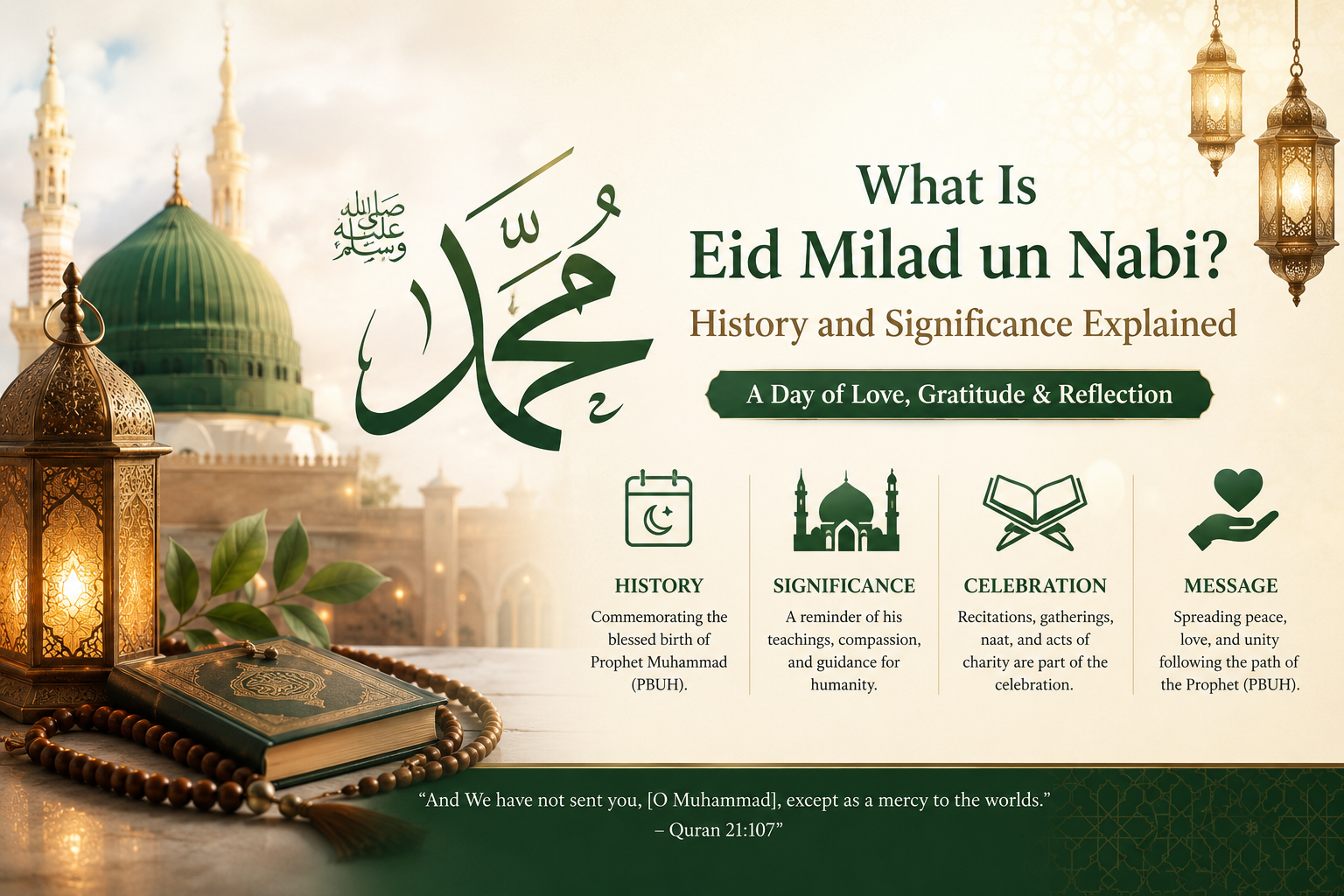
Eid Milad un Nabi, also known as Mawlid or Milad al Nabi, is a day observed by many Muslims to remember the birth of Prophet Muhammad ﷺ. Muslims observe it in different ways today, and some communities do not observe it as a religious occasion at all. Understanding this diversity is important when discussing its history and significance.
What is Eid Milad un Nabi?
If you ask, What is Eid Milad un Nabi, the simplest answer is that it is an observance commemorating the birth of Prophet Muhammad ﷺ. The word “Milad” means birth, while “Nabi” means prophet. The occasion is commonly associated with the month of Rabi al Awwal in the Islamic calendar.
The exact historical date of the Prophet’s birth is not established with complete certainty. Many Sunni communities traditionally associate it with 12 Rabi al Awwal, while some Shia communities associate it with 17 Rabi al Awwal. Because the Islamic calendar follows the lunar cycle, the corresponding date changes each year in the Gregorian calendar. For this reason, what is Eid Milad un Nabi can be understood both as a historical question and as an explanation of how different Muslim communities remember the Prophet ﷺ.
How Did Milad Develop Historically?
The earliest generations of Muslims did not celebrate the Prophet’s birthday in the same organised manner seen in some communities today. Public Mawlid gatherings developed later in Islamic history, with historical evidence of organised celebrations appearing centuries after the Prophet’s lifetime.
This history also explains why Muslim opinions differ. Some scholars and communities regard Milad gatherings as a permissible way to express love and gratitude when they remain within Islamic principles. Others do not consider an annual birthday observance part of established religious practice. Muslims can therefore approach the subject with knowledge, respect, and awareness of these differing views. Understanding what is Eid Milad un Nabi also requires looking at how the observance developed throughout Islamic history.
Significance of Milad un Nabi
The Significance of Milad un Nabi is often connected with remembering the Prophet’s character and message. For many Muslims, the occasion provides an opportunity to reflect on his mercy, honesty, patience, justice, compassion, and devotion to Allah. For many communities, understanding what is Eid Milad un Nabi also means understanding why the Prophet’s life and teachings continue to inspire Muslims today.
Rather than focusing only on celebration, families and communities may use the occasion to study Seerah, increase salutations upon the Prophet ﷺ, read Quran, give charity, feed others, and encourage good character.
The deeper lesson is that admiration for the Prophet should influence everyday behaviour. Kindness toward neighbours, honesty in business, care for family, forgiveness, and concern for people in need are practical ways of reflecting on his example.
Why Do Muslims Celebrate Eid Milad un Nabi?
The question why do Muslims celebrate Eid Milad un Nabi has different answers depending on the community, and understanding what is Eid Milad un Nabi helps explain the different perspectives. Muslims who observe Milad commonly see it as an opportunity to express love and gratitude for the Prophet Muhammad ﷺ and to remember the blessings associated with his arrival and message.
Gatherings may include speeches about Seerah, Quran recitation, Nasheeds, poetry, prayers, charity, and communal meals. In some places, homes, mosques, streets, and public buildings may be decorated, while other communities mark the occasion more quietly.
It is important not to assume that every Muslim celebrates Milad. The practice is accepted in some traditions and rejected or not observed in others. Respectful discussion should acknowledge this difference without turning a religious observance into a source of unnecessary division.
Difference Between Eid ul Fitr, Eid ul Adha and Milad
Understanding the Difference between Eid ul Fitr, Eid ul Adha and Milad requires recognising their different religious contexts.
Eid ul Fitr occurs at the end of Ramadan. It follows a month of fasting and is marked by congregational prayer, charity, family gatherings, and gratitude to Allah.
Eid ul Adha occurs during the period of Hajj and commemorates the devotion and sacrifice associated with Prophet Ibrahim (AS). Muslims perform the Eid prayer, give charity, and, where applicable, offer Qurbani.
Milad, by contrast, commemorates the birth of Prophet Muhammad ﷺ. Its observance varies among Muslim communities, and its status and practices are understood differently by scholars.
Therefore, Eid ul Fitr and Eid ul Adha have an established place among the two major Islamic festivals, while the term Eid for Milad reflects a different and debated usage in Muslim traditions. Knowing what is Eid Milad un Nabi also makes it easier to understand why its observance differs from Eid ul Fitr and Eid ul Adha in Islamic tradition.
How Is Eid Milad un Nabi Celebrated in the UK?
How is Eid Milad un Nabi celebrated in the UK? There is no single British style of observance. To understand what is Eid Milad un Nabi in the UK, it is important to recognise that Muslim communities follow different cultural and religious traditions. Muslim communities across the country have different cultural backgrounds and religious traditions.
Where Milad is observed, mosques and community organisations may arrange lectures, Seerah programmes, Quran recitation, Nasheeds, poetry, gatherings, meals, and charitable activities. Families may also organise private gatherings at home.
The UK’s diverse Muslim population means that Milad traditions can reflect South Asian, Middle Eastern, African, Turkish, and other cultural influences. The common theme among observing communities is remembrance of the Prophet ﷺ and appreciation of his teachings.
The Importance of Learning the Seerah
One of the most valuable ways to approach Milad is through learning the Seerah, the biography of Prophet Muhammad ﷺ. Studying his life provides context for understanding his patience in hardship, leadership, treatment of others, worship, family relationships, and commitment to justice. This is also an important part of understanding what is Eid Milad un Nabi, because the occasion is closely connected with remembering the Prophet’s life and character.
Milad and Islamic Heritage
Islamic heritage includes calligraphy, textiles, architecture, manuscripts, and many other forms of artistic expression. Studying these traditions can help readers understand the cultural world in which Islamic history developed. Exploring Islamic heritage can also help explain what is Eid Milad un Nabi within the wider cultural and historical traditions of Muslim communities.
Final Thoughts
Eid Milad un Nabi is understood differently across the Muslim world. For those who observe it, the occasion can be a time for gratitude, remembrance, Seerah education, charity, and expressing love for Prophet Muhammad ﷺ. For Muslims who do not observe it, the Prophet’s teachings and example remain central to faith throughout the year.
Understanding What is Eid Milad un Nabi, the Significance of Milad un Nabi, Why do Muslims celebrate Eid Milad un Nabi, the Difference between Eid ul Fitr, Eid ul Adha and Milad, and How is Eid Milad un Nabi celebrated in the UK helps readers approach the subject with greater historical awareness and respect.
Ultimately, the most important lesson is to learn from the Prophet’s character and teachings and allow that knowledge to inspire better conduct, compassion, and devotion in everyday life.