
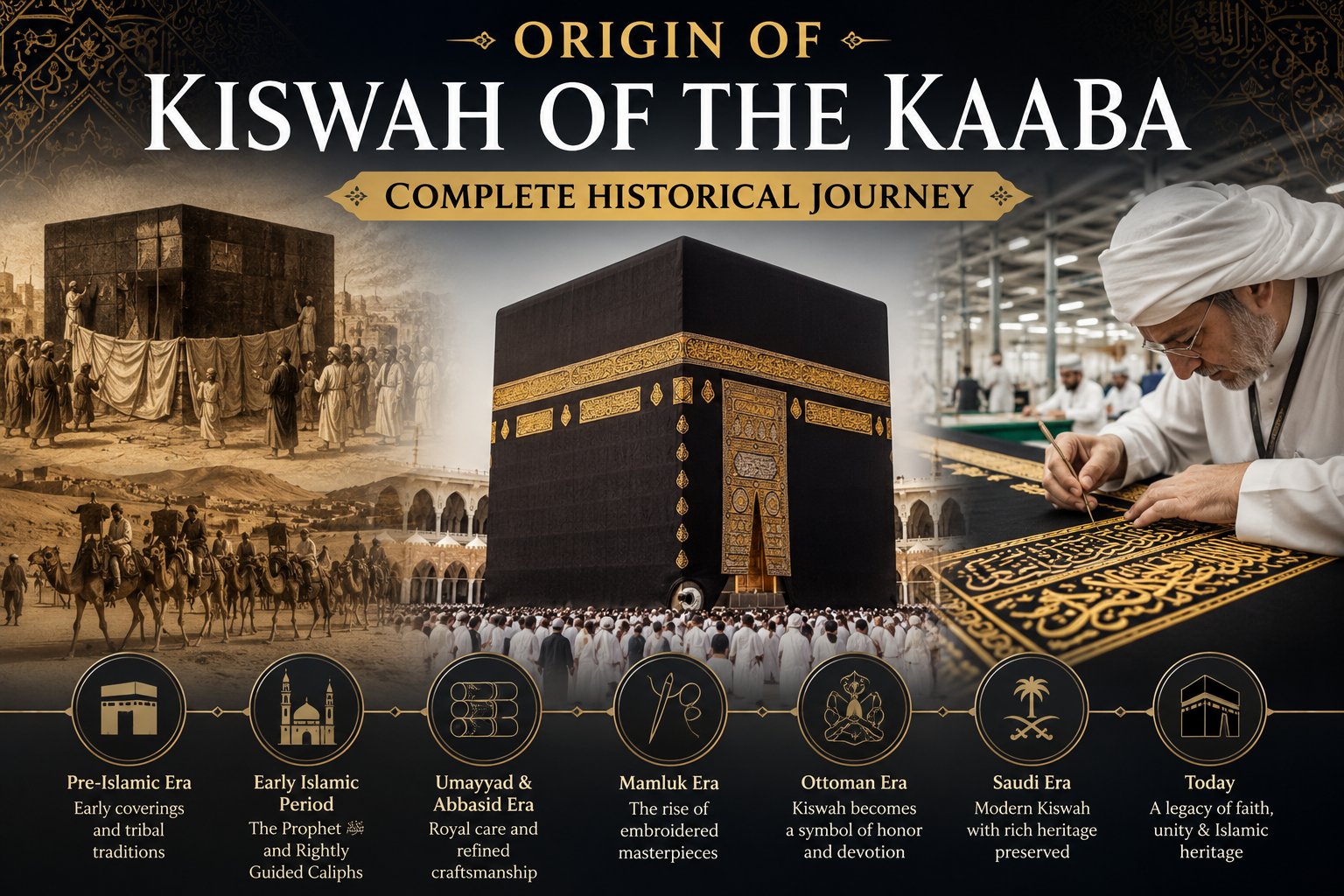
The Kaaba Kiswah is one of the most recognizable symbols of Islamic heritage. Every year, millions of Muslims witness the majestic black cloth covering the Holy Kaaba in Makkah, yet many are unaware of its remarkable history. The story of the Kiswah spans centuries, beginning long before Islam and evolving into one of the world’s most sacred traditions.
In this article, we explore the Origin of Kiswah of the Kaaba Complete History, from the History of Kaaba Kiswah from Pre Islamic Era to the modern-day production process, while explaining Who Covered the Kaaba First in Islam and Why Is the Kiswah Black Today History.
What Is the Kiswah?
The Kaaba Kiswah is the beautifully embroidered cloth that covers the Holy Kaaba at Masjid al-Haram in Makkah. Made from premium black silk and decorated with Quranic verses stitched in pure gold and silver-plated threads, it represents devotion, unity, and respect for Islam’s holiest site.
Today, replacing the Kiswah every year is a globally recognized Islamic tradition that reflects the importance of preserving the honor of the Kaaba.
Origin of Kiswah of the Kaaba Complete History
The Origin of Kiswah of the Kaaba Complete History begins thousands of years ago. Historical reports indicate that the Kaaba was respected by Arab tribes even before the arrival of Islam. As an expression of honor, rulers and tribal leaders would cover the Kaaba with different fabrics.
These coverings varied greatly depending on the wealth and customs of the time. Materials included woven cloth, striped textiles, leather, and Yemeni fabrics. There was no fixed color or design during those early centuries.
As Islam spread, the tradition continued but gradually became more organized under Muslim leadership, transforming the Kiswah into the magnificent covering known today.
History of Kaaba Kiswah from Pre Islamic Era
Understanding the History of Kaaba Kiswah from Pre Islamic Era helps explain how this sacred tradition evolved.
Before Islam:
- Arab rulers considered covering the Kaaba an act of great honor.
- Different tribes donated fabrics whenever they had the opportunity.
- There was no standard material, embroidery, or color.
- Cloth was replaced whenever it became worn.
- Several layers of fabric were sometimes placed over previous coverings.
Although these practices differed from today’s methods, they established the foundation of honoring the Kaaba through the Kiswah.
Who Covered the Kaaba First in Islam?
One of the most frequently asked questions is Who Covered the Kiswah First in Islam.
After the conquest of Makkah, Prophet Muhammad ﷺ preserved the noble tradition of covering the Kiswah while ensuring it reflected Islamic values. Historical narrations mention that after the earlier covering was damaged, the Kiswah was covered under the guidance of Prophet Muhammad ﷺ using Yemeni cloth.
Later, the Rightly Guided Caliphs continued this practice. During the caliphates of Abu Bakr (RA), Umar ibn Al-Khattab (RA), Uthman ibn Affan (RA), and Ali (RA), the Kiswah continued to be renewed regularly.
Over the centuries, Umayyad, Abbasid, Mamluk, and Ottoman rulers further enhanced the quality, craftsmanship, and beauty of the Kiswah.
How the Kiswah Evolved Through Islamic History
The Kiswah has undergone remarkable changes throughout Islamic history.
Early Islamic Period
Simple fabrics were used, focusing primarily on protecting and honoring the Kaaba.
Umayyad Era
The quality of textiles improved significantly, with more luxurious materials introduced.
Abbasid Period
Silk became increasingly popular, and Quranic inscriptions started appearing more consistently.
Mamluk and Ottoman Periods
Master artisans perfected embroidery techniques using gold and silver threads, creating highly detailed calligraphy and decorative borders.
Modern Saudi Era
Today, the Kiswah is produced using advanced craftsmanship while preserving centuries-old artistic traditions. Each piece is carefully woven, embroidered, inspected, and assembled by skilled artisans before being installed on the Kiswah.
Why Is the Kiswah Black Today History
Many people wonder, Why Is the Kiswah Black Today History.
The Kiswah was not always black. Historical records describe various colors being used throughout different periods, including white, green, yellow, and red.
The black color gradually became the preferred choice during the Abbasid era. It offered several advantages:
- Elegant and dignified appearance
- Better visual consistency
- Strong contrast with gold Quranic embroidery
- Long-lasting presentation throughout the year
Since then, black has remained the traditional color of the Kiswah, becoming instantly recognizable to Muslims worldwide.
How the Modern Kiswah Is Made
The production of the modern Kiswah is an extraordinary process involving exceptional craftsmanship.
The journey includes:
- Producing premium natural silk
- Dyeing the silk deep black
- Weaving high-quality fabric
- Embroidering Quranic verses with gold and silver-plated threads
- Sewing multiple large panels together
- Performing detailed quality inspections
- Installing the Kiswah on the Holy Kaaba
Every stage requires precision, dedication, and respect for one of Islam’s most sacred traditions.
Symbolism of the Kiswah
Beyond its physical beauty, the Kiswah symbolizes:
- Unity of the Muslim Ummah
- Respect for the House of Allah
- Islamic artistic excellence
- Preservation of centuries-old heritage
- Spiritual devotion and reverence
For Muslims, the Kiswah serves as a powerful reminder of faith and the enduring legacy of Islamic civilization.
The Annual Replacement Tradition
The Kiswah is replaced once every year as part of a long-established tradition.
The old Kiswah is carefully removed, while the new covering is installed with great care and respect. Portions of previous Kiswah coverings are sometimes preserved, gifted, or displayed by authorized institutions, allowing future generations to appreciate this remarkable Islamic heritage.
Conclusion
The Origin of Kiswah of the Kaaba Complete History reflects a journey that began before Islam and continued through every major era of Islamic civilization. From the History of Kiswah from Pre Islamic Era to understanding Who Covered the Kiswah First in Islam and learning Why Is the Kiswah Black Today History, the story of the Kaaba Kiswah is one of faith, craftsmanship, and continuity.
Today, the Kaaba Kiswah stands not only as the sacred covering of the House of Allah but also as a timeless symbol of Islamic history, devotion, and unity that inspires millions of Muslims across the world.