For over fourteen centuries, the Holy Kaaba has stood at the heart of Islam as the most sacred place on Earth. Every day, millions of Muslims face it during Salah, and every year, millions more travel to Makkah hoping to complete Hajj or Umrah. Yet despite its global significance, one mystery continues to capture people’s curiosity more than almost any other—what is inside the Kaaba?
Because access to the Kaaba’s interior is extremely limited, myths and misconceptions often circulate online. Some imagine hidden treasures, while others believe the interior contains priceless relics. In reality, the inside of the Kaaba reflects the Islamic values of humility, simplicity, and devotion to Allah.
This article explores inside the Kaaba today, explains who is allowed inside the Kaaba, examines the artistic beauty of Kaaba door calligraphy, and looks at how the Kaaba continues to inspire authentic Islamic wall art around the world.
Why the Kaaba Holds Such Importance
The Kaaba is located in the centre of Masjid al-Haram in Makkah and serves as the Qiblah for Muslims everywhere. Regardless of where they live, every Muslim turns toward the Kaaba while offering daily prayers.
Islamic tradition teaches that Prophet Ibrahim (AS) and Prophet Ismail (AS) rebuilt the Kaaba by Allah’s command, making it a place dedicated solely to His worship. For this reason, the Kaaba is not merely an architectural landmark—it is the spiritual heart of the Muslim Ummah.
Although its exterior is seen by millions of pilgrims, only a small number of individuals have ever witnessed its interior.
What Is Inside the Kaaba?
Many people expect the Kaaba to contain elaborate decorations or valuable historical objects. However, the reality is very different.
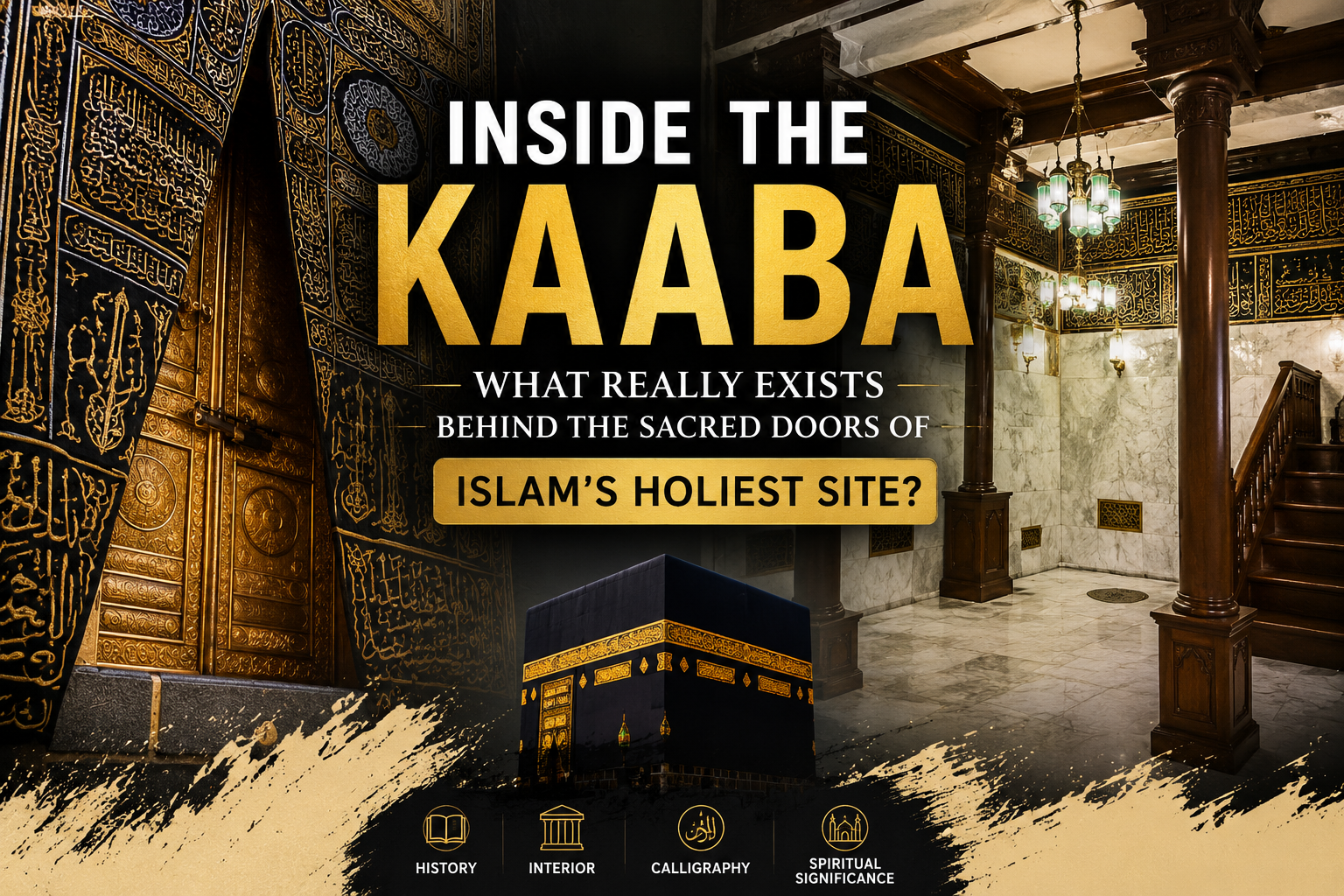
Those asking what is inside the Kaaba may be surprised to learn that its interior is intentionally modest. The simplicity reflects Islam’s emphasis on sincere worship rather than worldly display.
The interior generally features:
- Three sturdy wooden columns supporting the roof.
- Smooth marble flooring.
- Marble-covered interior walls.
- Elegant hanging lamps.
- A staircase leading to the rooftop.
- Fragrant perfumes used during ceremonial cleaning.
- Decorative Qur’anic inscriptions on selected surfaces.
There are no permanent prayer halls, museums, or collections of sacred relics inside. Every element serves a practical or symbolic purpose while preserving the sanctity of the structure.
Inside the Kaaba Today
When discussing inside the Kaaba today, it is important to understand that the building receives exceptional care.
The interior is regularly maintained to preserve both its beauty and historical integrity. The marble is cleaned with great attention, precious fragrances such as oud are used during ceremonial washing, and any necessary restoration work is carried out without altering the Kaaba’s essential character.
Although construction techniques have improved over time, the peaceful simplicity of the interior has remained remarkably consistent for generations.
Who Is Allowed Inside the Kaaba?
A question frequently asked by visitors to Makkah is who is allowed inside the Kaaba.
Unlike other areas of Masjid al-Haram, the Kaaba itself is not open to the public.
Entry is limited to special circumstances and may include:
- Members of the Kaaba’s custodial family.
- Officials responsible for its maintenance.
- Religious leaders invited for specific ceremonies.
- Distinguished guests formally invited by the Saudi authorities.
Even Muslims who perform Hajj or Umrah many times may never have the opportunity to enter. Access is regarded as an exceptional privilege rather than a part of the pilgrimage.
The Beauty of the Kaaba Door Calligraphy
Among the most admired features of the Kaaba is its magnificent golden entrance.
The Kaaba door calligraphy showcases expertly engraved Qur’anic verses and traditional Arabic inscriptions. Crafted with remarkable precision, the calligraphy represents centuries of Islamic artistic excellence.
Every line reflects the beauty of Arabic script while reminding believers of the sacred nature of the House of Allah.
This timeless craftsmanship has inspired architects, artists, and calligraphers across the Muslim world.
A Lesson in Simplicity
One of the greatest lessons offered by the Kaaba’s interior is that true greatness does not depend on luxury.
The modest surroundings remind Muslims that:
- Allah alone deserves worship.
- Humility is a central Islamic value.
- Faith is measured through sincerity rather than appearance.
- Unity is more valuable than worldly status.
The absence of extravagant decoration reinforces the Islamic understanding that spiritual richness outweighs material wealth.
Authentic Islamic Wall Art Inspired by the Kaaba
The Kaaba’s beauty has inspired generations of Islamic artists and craftsmen.
Today, collectors often choose authentic Islamic wall art influenced by the sacred architecture of Makkah. Popular styles include:
- Kaaba-inspired canvas prints.
- Arabic calligraphy featuring Qur’anic verses.
- Kiswah-inspired textile artwork.
- Gold-foil Islamic calligraphy.
- Elegant framed Islamic décor.
- Architectural illustrations of Masjid al-Haram.
These decorative pieces allow Muslims to create peaceful living spaces while celebrating the beauty of Islamic heritage.
Lesser-Known Facts About the Kaaba Interior
Although the Kaaba has been studied for centuries, many fascinating details remain unfamiliar to most people.
Some interesting facts include:
- The structure has undergone restoration several times throughout history following natural damage.
- The interior is supported by three large wooden columns.
- An internal staircase provides access to the roof.
- The ceremonial washing of the Kaaba uses Zamzam water combined with premium fragrances.
- Only a very limited number of people enter the Kaaba during official occasions.
These details highlight both the careful preservation of the building and the respect shown towards Islam’s holiest sanctuary.
A Living Symbol of Islamic Heritage
The Kaaba continues to unite Muslims regardless of nationality, language, or culture.
Every year, believers from every continent gather around the sacred structure with one purpose—to worship Allah together. Whether viewed from outside or understood through authentic historical accounts, the Kaaba remains one of the greatest symbols of Islamic unity.
Its architecture, sacred Kiswah, remarkable calligraphy, and carefully preserved interior continue to inspire Muslims and encourage deeper appreciation of Islamic history.
Conclusion
The answer to what is inside the Kaaba is far more meaningful than many people expect. Instead of treasures or elaborate chambers, the Kaaba contains a simple and dignified interior designed to honour the worship of Allah.
Understanding inside the Kaaba today, learning who is allowed inside the Kaaba, and appreciating the beauty of Kaaba door calligraphy helps believers better understand the spiritual significance of Islam’s holiest site.
For those who wish to keep that inspiration close in their homes, authentic Islamic wall art inspired by the Kaaba offers a beautiful reminder of faith, history, and devotion that can be cherished every day.