
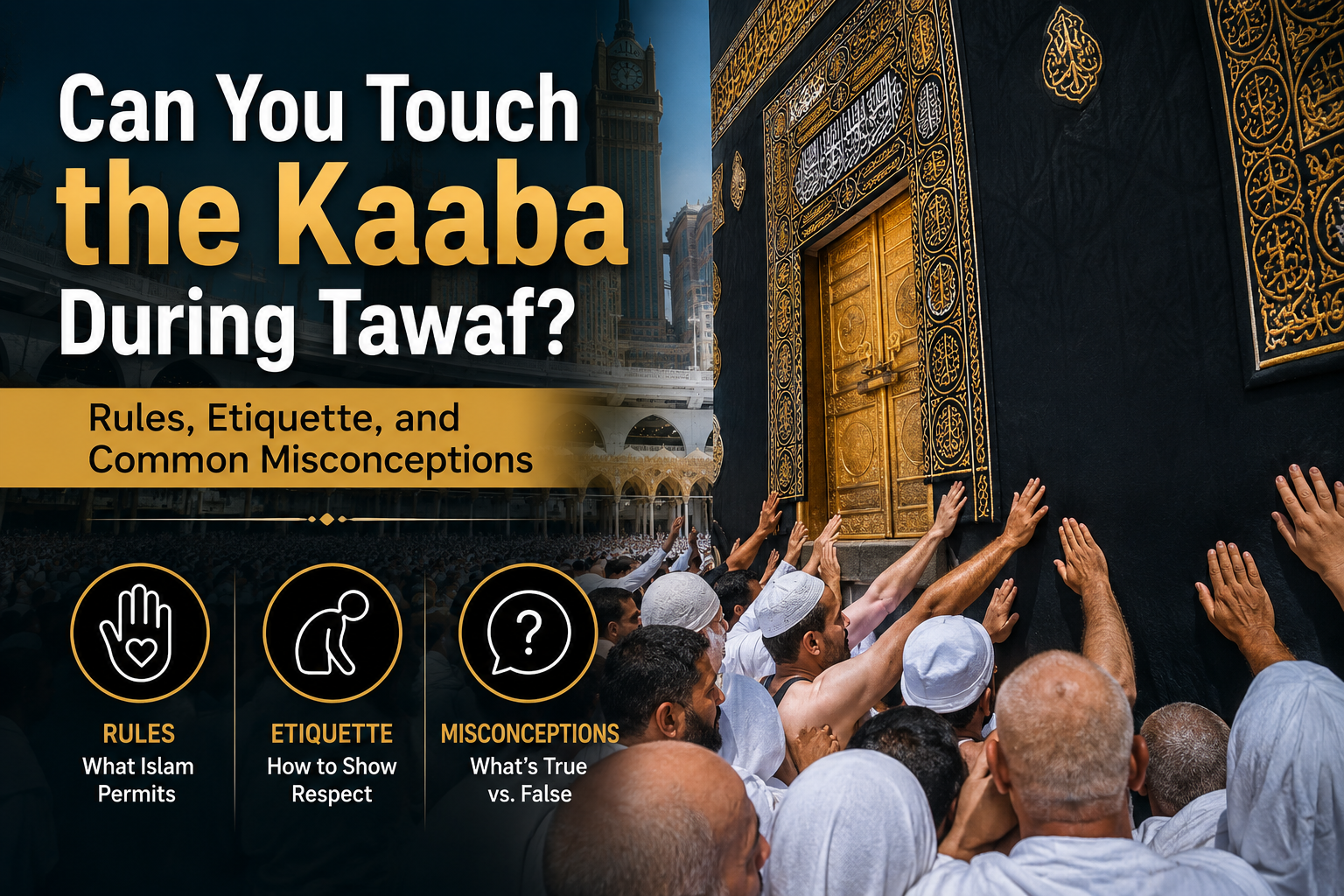
For many Muslims, seeing the Holy Kaaba for the first time is an unforgettable moment. After years of making du’a and longing to visit Makkah, pilgrims naturally hope to get as close to the Sacred House as possible. One question that often arises before Hajj or Umrah is: Can you touch the Kaaba during Tawaf?
The answer requires an understanding of Islamic teachings, practical considerations, and proper etiquette. While touching the Kaaba is not prohibited in itself, Islam places great importance on preserving the safety, dignity, and comfort of fellow pilgrims. This guide explains is touching the Kaaba Sunnah, addresses concerns about touching Kaaba in Ihram penalty, discusses Multazam etiquette, and highlights the spiritual lessons behind these practices.
Understanding Tawaf
Tawaf is the act of circling the Holy Kaaba seven times in an anti-clockwise direction as part of Hajj or Umrah. Every circuit begins from the corner of the Black Stone and ends at the same point.
During Tawaf, pilgrims focus on remembering Allah, making du’a, and completing the act of worship with sincerity. The objective is not to reach the walls of the Kaaba but to perform the ritual correctly while maintaining humility and consideration for others.
Can You Touch the Kaaba During Tawaf?
Many pilgrims ask, Can you touch the Kaaba during Tawaf?
If a person reaches the Kaaba naturally without pushing, harming, or disturbing others, touching its wall is generally permissible. However, touching the Kaaba is not a requirement for a valid Tawaf and should never become the main goal of the pilgrimage.
Because the area around the Kaaba is often extremely crowded, attempting to force your way through can create unnecessary hardship for fellow worshippers. Islamic teachings emphasise kindness and avoiding harm, making respectful behaviour more important than physical contact with the Kaaba.
Is Touching the Kaaba Sunnah?
Another common question is touching the Kaaba Sunnah.
There is no general Sunnah requiring pilgrims to touch every part of the Kaaba during Tawaf. The authentic practice of the Prophet Muhammad ﷺ specifically relates to the Black Stone and, on some occasions, the Yemeni Corner (Rukn al-Yamani).
Touching the walls of the Kaaba outside these practices is not an established ritual that every pilgrim should try to perform.
Therefore, a Muslim who completes Tawaf without touching the Kaaba has fulfilled the rite correctly.
Touching Kaaba in Ihram Penalty
Some people worry about touching Kaaba in Ihram penalty.
Simply touching the Kaaba while wearing Ihram does not carry a penalty. There is no Islamic ruling stating that contact with the Kaaba invalidates Ihram or requires compensation.
Problems arise only if someone behaves inappropriately—for example by pushing, fighting, or causing injury while trying to reach the Kaaba. Such actions contradict the spirit of Hajj and Umrah, which are founded on patience, humility, and respect for fellow pilgrims.
Understanding Multazam Etiquette
The area between the Black Stone and the Kaaba’s door is known as the Multazam. Many pilgrims hope to stand there to make heartfelt supplications.
Good Multazam etiquette includes:
- Waiting patiently if the area is crowded.
- Avoiding pushing or forcing your way forward.
- Respecting the personal space of others.
- Making sincere du’a with humility.
- Leaving the area if your presence prevents others from worshipping comfortably.
If access to the Multazam is not possible, a pilgrim can make du’a anywhere within Masjid al-Haram. Allah hears every sincere prayer regardless of location.
The Purpose of Tawaf
It is easy to become focused on reaching the Kaaba itself, but the essence of Tawaf lies elsewhere.
The ritual teaches Muslims:
- Complete devotion to Allah.
- Unity among believers.
- Patience during worship.
- Humility before the Creator.
- Equality regardless of nationality or status.
Whether a pilgrim touches the Kaaba or remains several metres away does not change the sincerity of their worship.
Common Misconceptions
Several misunderstandings surround touching the Kaaba.
Misconception 1: Tawaf Is Incomplete Without Touching the Kaaba
This is incorrect. Tawaf remains valid without touching the Kaaba.
Misconception 2: Everyone Should Reach the Multazam
The Multazam is a respected place for supplication, but not every pilgrim will have the opportunity to stand there safely.
Misconception 3: Touching the Kaaba Brings Special Blessings by Itself
Islam teaches that blessings come from Allah alone. Respecting the Kaaba should never be confused with believing that the building itself possesses independent power.
Misconception 4: There Is a Penalty for Touching the Kaaba During Ihram
There is no specific touching Kaaba in Ihram penalty simply for touching the Kaaba. Pilgrims should instead focus on observing the rules of Ihram and maintaining good conduct.
Respecting Fellow Pilgrims
One of the greatest acts of worship during Hajj and Umrah is showing consideration to others.
Helping fellow pilgrims, avoiding arguments, remaining patient in crowded conditions, and maintaining good manners reflect the true spirit of pilgrimage far more than trying to reach a particular spot.
Islam consistently teaches that preserving the well-being of others is an essential part of sincere worship.
Authentic Islamic Artifacts Inspired by the Kaaba
The Holy Kaaba continues to inspire Muslims across the world. Many believers choose to preserve memories of their pilgrimage through authentic Islamic artifacts that reflect the beauty and significance of the Sacred House.
Popular choices include:
- Framed Kaaba Kiswah displays.
- Arabic calligraphy artwork.
- Certified Kiswah fragments.
- Islamic wall decor.
- Heritage-inspired handcrafted gifts.
These meaningful pieces celebrate Islamic history while reminding families of the spiritual lessons associated with Makkah.
Conclusion
The answer to Can you touch the Kaaba during Tawaf is straightforward: it is permissible if it happens naturally and without harming others, but it is not an essential part of Tawaf. Understanding is touching the Kaaba Sunnah, recognising that there is no general touching Kaaba in Ihram penalty, and following proper Multazam etiquette help pilgrims approach this sacred journey with knowledge and balance.
The greatest achievement during Hajj or Umrah is not physical closeness to the Kaaba but spiritual closeness to Allah. By performing Tawaf with sincerity, patience, and respect for fellow worshippers, every pilgrim fulfills the true purpose of this blessed act of worship.