
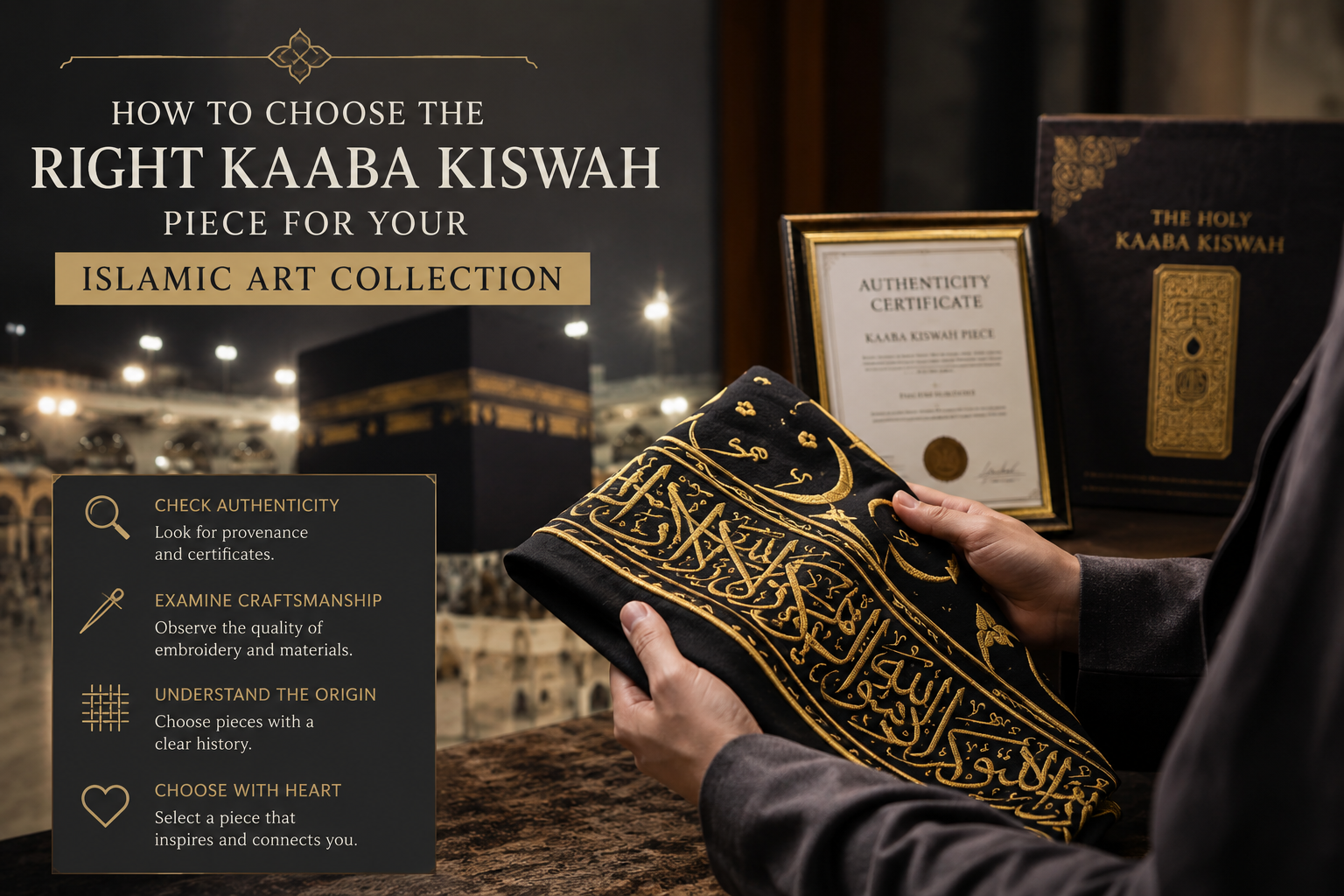
A Kaaba Kiswah piece is much more than a piece of decorated fabric. For collectors, it can represent Islamic heritage, specialist textile craftsmanship, historical importance, and a connection with the Holy Kaaba in Makkah. However, every textile sold under the name “Kiswah” should not automatically be considered equally valuable.
Authenticity, provenance, craftsmanship, condition, rarity, documentation, and the particular section of textile can all influence a fragment’s desirability. Therefore, anyone considering a purchase should understand how these characteristics affect the significance of a Kiswah piece.
Why Is a Kaaba Kiswah Piece Valuable?
The Kiswah is traditionally associated with the covering of the Holy Kaaba. Its recognisable dark exterior, detailed Quranic embroidery, and elaborate textile work make it one of the most distinctive forms of Islamic ceremonial textile.
For collectors, the importance of a genuine Kaaba Kiswah piece goes beyond its material composition. Its connection with the Kaaba gives it cultural and historical significance that an ordinary black embroidered textile cannot reproduce.
A fragment’s potential value may depend on:
- Authenticity
- Provenance
- Historical background
- Rarity
- Craftsmanship
- Condition
- Size
- Embroidery
- Documentation
- Collector demand
These factors should be considered together rather than judging an item by appearance or price alone.
How to Choose Kaaba Kiswah Piece UK
Learning how to choose a Kaaba Kiswah piece in the UK starts with understanding exactly what is being offered.
Ask the seller whether the item is an original Kiswah fragment, a reproduction, or a contemporary textile inspired by the Kaaba covering. These categories should never be presented as identical.
Request detailed photographs showing the front, reverse, edges, seams, embroidery, fabric structure, and any markings. Confirm the exact measurements and compare them with the product description and accompanying documents.
You should also ask where the piece came from, how it was acquired, and whether its ownership history is documented.
A seller who provides clear answers and supporting information gives buyers a stronger foundation for making an informed decision.
Why Provenance Matters
Provenance describes the documented history of an object. For a Kiswah fragment, it may explain its origin, previous ownership, acquisition, and journey to the current seller.
Potential provenance evidence can include:
- Previous ownership records
- Acquisition documentation
- Historical photographs
- Receipts
- Authentication certificates
- Specialist assessments
- Information about the original Kiswah
The strongest provenance is generally supported by multiple consistent records rather than a single unexplained statement.
If you find an authentic Kaaba Kiswah piece for sale in the UK, buyers should ask for relevant provenance information before making a significant purchase.
How to Verify Kiswah Makkah Certificate UK
Buyers researching how to verify Kiswah Makkah certificate UK documentation should examine the certificate carefully instead of assuming that any official-looking document proves authenticity.
Check whether it contains details such as:
- Certificate number
- Date of issue
- Dimensions
- Photographs
- Material description
- Provenance information
- Issuer details
- Signature or authentication information
The certificate should relate specifically to the textile being sold. Its dimensions, description, photographs, and identifying information should correspond with the actual piece.
The issuing organisation or individual should also be investigated independently. Arabic writing, stamps, seals, or references to Makkah do not automatically establish official status.
If the issuer cannot be identified or the claims cannot be reasonably verified, buyers should proceed cautiously.
External Black Kiswah and Green Internal Kiswah
Collectors sometimes ask: What is the difference between external black Kiswah and green internal Kiswah?
These textiles should not be confused simply because both may be associated with the Kaaba.
The familiar black Kiswah is the textile covering associated with the exterior of the Kaaba. Its appearance is strongly connected with dark fabric and elaborate Quranic and decorative embroidery.
Textiles associated with the interior have historically differed in colour and use. Green fabrics may be associated with interior decoration in certain contexts, but a green textile should not automatically be described as an exterior Kiswah fragment.
If a seller offers a green textile as Kiswah, ask precisely what it is, where it was used, and what documentation supports the claim.
Accurate identification is particularly important for collectors interested in historical Islamic textiles.
Craftsmanship Can Influence Collectibility
Another major consideration when evaluating a Kaaba Kiswah piece is craftsmanship.
Kiswah textiles are known for intricate decorative work and carefully produced Arabic calligraphy. Fine embroidery requires precision, consistency, and specialist textile skills.
When examining a potential fragment, look at:
- Stitching quality
- Embroidery detail
- Fabric weave
- Borders
- Seams
- Reverse-side construction
- Overall finishing
Detailed photographs are particularly useful when purchasing online.
A close-up image of the embroidery and fabric structure can reveal considerably more information than a distant photograph showing the entire framed piece.
What About Gold and Silver Embroidery?
The metallic appearance of Kiswah embroidery is one reason these textiles are visually striking. However, buyers should be careful when evaluating claims about precious-metal content.
Gold-coloured thread does not automatically mean that the embroidery contains a particular quantity or purity of gold.
Different thread constructions and metallic materials can produce similar visual effects. Therefore, if a seller makes specific claims about gold or silver content, ask what evidence supports them.
For a high-value acquisition, an independent specialist assessment may be appropriate when material composition forms an important part of the purchase decision.
What Is a Makkah Factory Stamped Kiswah Fragment?
A Makkah factory stamped Kiswah fragment may attract additional attention because a stamp can appear to provide evidence of its connection with Kiswah production.
However, the presence of a stamp should be investigated rather than accepted as automatic proof of authenticity.
Ask:
- What does the stamp represent?
- Where is it located?
- Is the marking original?
- Does the seller have documentation explaining it?
- Does it correspond with the fragment’s provenance?
- Is the marking visible in detailed photographs?
A stamp can be one piece of evidence, but it should ideally be considered alongside provenance, physical characteristics, and authentication documentation.
Rarity and Historical Significance
Rarity can contribute to a fragment’s desirability, but the term should have a meaningful basis.
A Kiswah piece may attract collector interest because of its particular section, documented age, unusual design, distinctive embroidery, historical background, or limited availability of comparable examples.
However, simply describing an item as “rare” does not establish that it is rare.
Buyers should ask why the fragment is considered uncommon and whether evidence supports the claim.
Historical significance can also affect collectibility. A properly documented fragment connected with a particular period may be more interesting to collectors than an apparently old textile whose history is unknown.
Condition and Preservation
Condition is another important factor. The condition of a Kaaba Kiswah piece can be particularly important when assessing its long-term collectibility and preservation requirements.
Historic textiles can be affected by light, humidity, dust, inappropriate storage, and repeated handling. Silk and embroidery may require careful conservation to prevent deterioration.
Before purchasing, ask whether the textile has been:
- Restored
- Trimmed
- Repaired
- Mounted
- Framed
- Altered
Any previous treatment should ideally be disclosed.
If the fragment is framed, buyers should also ask how it has been mounted. Conservation-conscious mounting can help minimise stress on delicate fibres.
Does Size Determine Value?
Size can influence desirability, but a larger fragment is not automatically more valuable.
A smaller piece containing distinctive calligraphy, elaborate embroidery, or strong provenance may be more attractive to a collector than a larger section without reliable documentation.
Therefore, the size of a Kaaba Kiswah piece should be assessed alongside its historical context, condition, craftsmanship, rarity, and authenticity.
Questions to Ask Before Buying
Before purchasing a Kiswah fragment online, ask the seller:
Before purchasing a Kaaba Kiswah piece, especially a valuable or historically significant fragment, buyers should gather as much supporting evidence as possible.
- Is this an original Kiswah fragment or a reproduction?
- Which Kiswah did the piece originate from?
- What evidence supports its provenance?
- Does the certificate identify this exact fragment?
- Who issued the certificate?
- Can the issuing party be independently verified?
- What do any stamps or markings mean?
- What are the exact measurements?
- Has the textile been restored or altered?
- Are claims about silk, gold, silver, or embroidery supported by documentation?
A seller should be comfortable providing reasonable information about a high-value heritage item.
Final Thoughts
The value of a Kaaba Kiswah piece cannot be determined simply by its colour, size, embroidery, or asking price. Authenticity, provenance, craftsmanship, rarity, condition, documentation, and historical context all contribute to its collectible significance.
If you are learning how to choose Kaaba Kiswah piece UK collectors should prioritise evidence before making a purchase. When considering an authentic Kiswah piece for sale UK, carefully examine its provenance and certificate.
Understanding how to verify Kiswah Makkah certificate UK documentation can help you distinguish meaningful evidence from unsupported claims. Likewise, knowing what is the difference between external black Kiswah and green internal Kiswah? can prevent confusion when evaluating different textiles.
Finally, a Makkah factory stamped Kiswah fragment should be investigated through its complete history rather than judged by its stamp alone.
For serious collectors, a Kaaba Kiswah piece becomes considerably more meaningful when its identity, history, and provenance can be responsibly established. A beautifully crafted textile becomes considerably more meaningful when its identity, history, and provenance can be responsibly established.