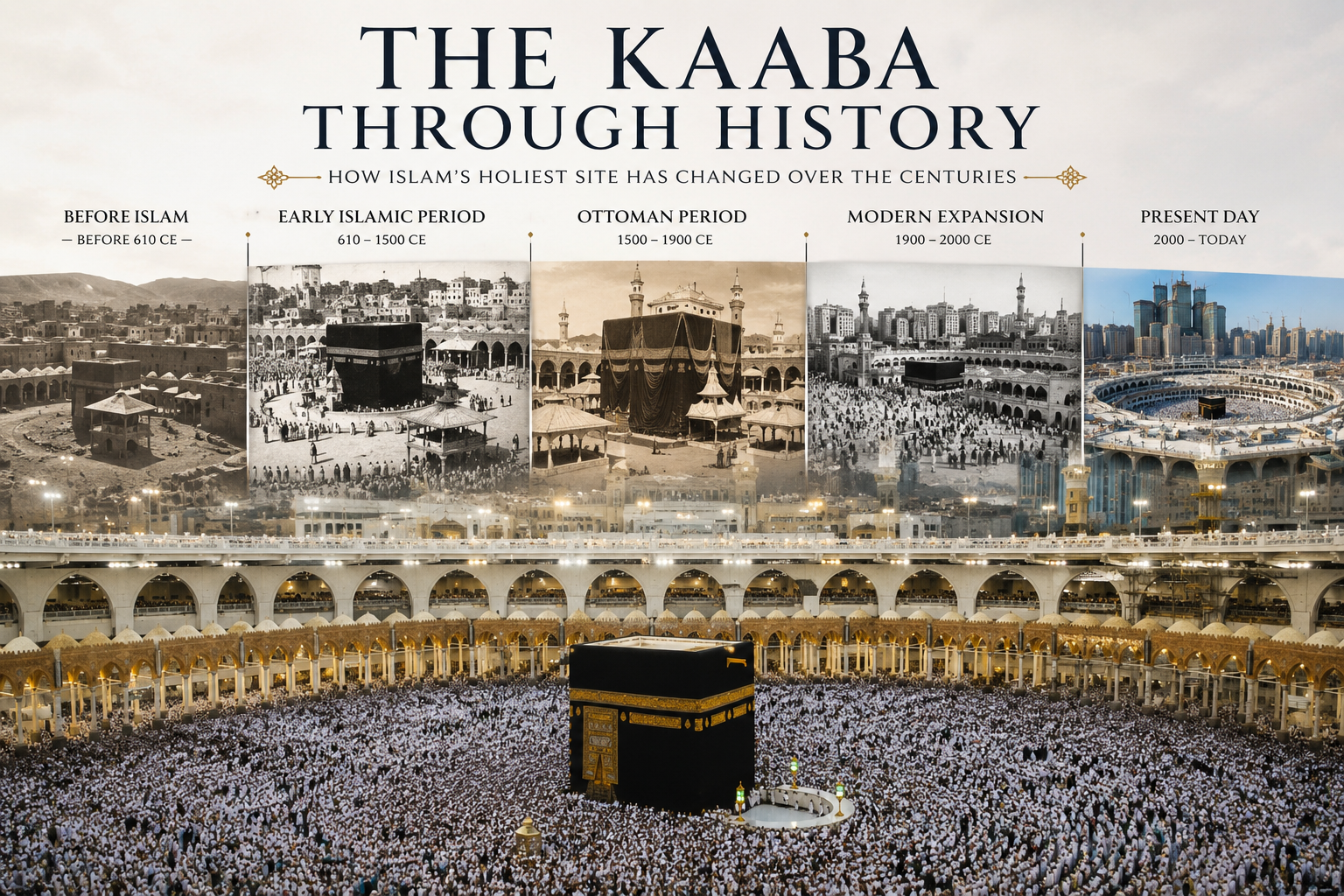
Many Muslims ask, “How Has the Kaaba Changed Over Time?” Understanding its remarkable history reveals how this sacred structure has been carefully preserved while remaining the spiritual centre of Islam.
For more than fourteen centuries, the Holy Kaaba has remained the spiritual heart of Islam and the direction of prayer for Muslims across the world. Every day, millions of believers face this sacred structure during Salah, while millions more travel to Makkah each year to perform Hajj and Umrah. Although the Kaaba’s religious significance has never changed, its physical appearance has evolved through restoration, rebuilding, and expansion projects carried out across different periods of history.
Many people wonder how has the Kaaba changed over time and what events shaped the sacred structure that stands today. The answer lies in a remarkable journey that stretches from the time of Prophet Ibrahim (AS) through the early Islamic era and into the modern age. Alongside the Kaaba itself, the sacred Kiswah has also developed into one of the most recognisable symbols of Islamic craftsmanship.
This guide explores the history of the Kaaba reconstruction, examines the Kaaba before and after Islam, and traces the history of the Kiswah cover while highlighting the enduring importance of Islam’s holiest site.
How Has the Kaaba Changed Over Time? This question continues to inspire Muslims and history enthusiasts who wish to understand how the Holy Kaaba has been preserved across centuries.
The Origins of the Holy Kaaba
According to Islamic tradition, the Kaaba was originally established by Prophet Ibrahim (AS) and his son Prophet Ismail (AS) as a house dedicated to the worship of Allah alone. Its purpose was to serve as a place of devotion and unity for believers, and over time it became the focal point for pilgrimage.
The original structure was simple in appearance. Built from locally available stone, it reflected humility rather than grandeur. Its significance came not from its size or decoration but from its role as the first House of Worship established for the worship of the One God.
For centuries, the Kaaba remained the spiritual centre of Makkah, even as the city grew around it.
To answer How Has the Kaaba Changed Over Time, it is important to begin with the original construction by Prophet Ibrahim (AS) and Prophet Ismail (AS).
The Kaaba Before and After Islam
Understanding the Kaaba before and after Islam helps explain why the arrival of Islam marked one of the most important turning points in its history.
Before the Prophet Muhammad ﷺ received revelation, the Kaaba was respected by the tribes of Arabia but had gradually become surrounded by idols. Although many people still recognised the Kaaba as an ancient sanctuary connected with Prophet Ibrahim (AS), its original purpose had become obscured by practices that differed from pure monotheism.
Following the peaceful conquest of Makkah, Prophet Muhammad ﷺ removed the idols from the Kaaba and rededicated it exclusively to the worship of Allah. This event restored the Kaaba to its original purpose and reaffirmed its position as the spiritual centre of Islam.
While the physical structure remained, its religious significance was renewed, and Muslims have continued to honour it as the Qiblah ever since.
Understanding How Has the Kaaba Changed Over Time also highlights how Islam restored the Kaaba to its original purpose as the House of Allah.
The History of the Kaaba Reconstruction
The history of the Kaaba reconstruction reflects the ongoing commitment to preserving one of Islam’s most sacred landmarks. Over many centuries, the Kaaba has experienced damage caused by floods, natural ageing, and environmental conditions, making restoration necessary from time to time.
One of the earliest well-known reconstructions took place before the beginning of the Prophet Muhammad’s ﷺ mission. Severe flooding weakened the building, prompting the Quraysh to rebuild it using stronger materials. During this reconstruction, the famous dispute over the placement of the Black Stone was peacefully resolved when the Prophet Muhammad ﷺ suggested placing it on a cloth so that representatives of each tribe could participate together before he positioned it himself.
Later generations carried out additional restoration projects whenever structural preservation became necessary. These efforts focused on maintaining the Kaaba while respecting its religious importance and historical design. The history of reconstruction provides one of the clearest answers to How Has the Kaaba Changed Over Time throughout Islamic history.
How Has the Kaaba Changed Over Time?
How Has the Kaaba Changed Over Time? Although the Holy Kaaba has undergone several restorations, its religious purpose and iconic appearance have remained remarkably consistent throughout Islamic history.
Most changes have involved strengthening the structure, replacing weathered materials, improving the roof, restoring internal features, and enhancing the surrounding area within Masjid al-Haram. Modern engineering techniques have helped preserve the building while ensuring that its historical character remains intact.
The greatest transformation has occurred not to the Kaaba itself but to the Sacred Mosque surrounding it. Masjid al-Haram has expanded enormously over the centuries, allowing millions of pilgrims to worship safely while the Kaaba continues to stand at its centre.
The History of the Kiswah Cover
The history of the Kiswah cover is closely connected with the honour and respect shown towards the Holy Kaaba throughout Islamic history.
For centuries, rulers and Muslim communities have contributed to the tradition of covering the Kaaba with a specially crafted textile known as the Kiswah. Earlier coverings appeared in different colours and materials before the now-familiar black silk design became established.
Today’s Kiswah is woven from premium black silk and decorated with intricate Qur’anic calligraphy embroidered using gold and silver-plated thread. Each year, skilled artisans produce a new covering through a process that combines traditional craftsmanship with exceptional precision.
The annual replacement of the Kiswah remains one of the most respected ceremonies associated with the Holy Kaaba and reflects the continuing care devoted to Islam’s holiest site.
Major Reconstructions That Preserved the Kaaba
Throughout Islamic history, preserving the Holy Kaaba has always been a priority. While its sacred status has never changed, the structure has occasionally required careful restoration because of natural disasters, ageing materials, and environmental conditions. Each reconstruction has been carried out with great respect, ensuring that the Kaaba continues to reflect its historical design while remaining structurally secure for future generations.
One of the most significant rebuilding projects occurred during the time of Abdullah ibn al-Zubayr (RA), who reconstructed the Kaaba following damage caused during conflict. His work followed the wishes expressed by Prophet Muhammad ﷺ regarding the original foundations associated with Prophet Ibrahim (AS). Later, during the Umayyad period, the structure was modified again, creating the general appearance that Muslims recognise today.
Subsequent restoration projects focused primarily on strengthening the walls, repairing the roof, replacing weathered stones, and improving drainage systems to protect the building from heavy rainfall. Rather than altering the Kaaba’s identity, these efforts ensured its preservation while respecting centuries of Islamic tradition.
The Kaaba in the Modern Era
Today, the Holy Kaaba remains the spiritual centre of Islam, surrounded by the vast complex of Masjid al-Haram. Although the Sacred Mosque has expanded dramatically over recent decades, the Kaaba itself has remained remarkably consistent in its appearance.
Modern engineering has improved the environment around the Kaaba without changing its historical character. The marble flooring surrounding the structure has been enhanced, crowd management systems have been introduced, and advanced maintenance programmes ensure that the building remains protected throughout the year.
Millions of Muslims now perform Tawaf around the Kaaba in facilities that are safer and more accessible than ever before. Despite these modern developments, the Kaaba continues to preserve the simplicity and dignity that have defined it throughout history.
When people ask How Has the Kaaba Changed Over Time, the answer is that preservation—not transformation—has defined its history. Modern restoration projects have protected the structure while respecting its original design.
Even today, those asking How Has the Kaaba Changed Over Time will find that preservation has always been more important than redesign.
The Continuing History of the Kiswah Cover
The history of the Kiswah cover continues to evolve while remaining firmly rooted in tradition. Every year, a new Kiswah is produced using premium black silk and embroidered with verses from the Holy Qur’an using gold and silver-plated thread. The process requires months of skilled craftsmanship, with experienced artisans carefully weaving, stitching, and assembling each section before it is placed over the Kaaba.
Although manufacturing techniques have benefited from modern technology, the artistic standards and religious respect surrounding the Kiswah have remained unchanged. The annual replacement ceremony symbolises continuity, honour, and devotion, linking today’s Muslim community with generations that came before.
After replacement, the previous Kiswah is carefully preserved. Selected authenticated sections are presented to distinguished institutions, museums, and individuals, ensuring that this important tradition continues to be appreciated around the world.
The Meaning Behind a Kaaba Kiswa Frame UK
For many Muslims living in Britain and elsewhere, owning a Kaaba Kiswa Frame UK offers a meaningful connection with Islam’s holiest site. An authenticated framed piece of the Kiswah is far more than decorative artwork. It represents centuries of craftsmanship, spiritual heritage, and the enduring honour associated with the Holy Kaaba.
Displayed in homes, offices, Islamic centres, or educational institutions, a professionally framed Kiswah piece serves as a reminder of the sacred House of Allah and the annual tradition of renewing its covering. When accompanied by proper authentication, these pieces also preserve an important part of Islamic history for future generations.
At Kaaba Kiswa, we are dedicated to offering authentic Kiswah pieces that celebrate this extraordinary heritage. Every certified frame reflects exceptional craftsmanship while preserving a genuine connection to one of the most respected symbols in Islam.
Why the Kaaba Remains Unchanged in Its Purpose
Although the Kaaba has experienced restoration and careful preservation over many centuries, its purpose has never changed. It remains the Qiblah for Muslims worldwide and the focal point of Hajj and Umrah.
Every reconstruction has sought to protect this sacred building rather than redefine it. While the city of Makkah and Masjid al-Haram have expanded to accommodate millions of pilgrims, the Kaaba continues to stand at the centre as a symbol of unity, devotion, and submission to Allah.
This remarkable balance between preservation and progress explains why the Kaaba continues to inspire Muslims across every generation. Reflecting on How Has the Kaaba Changed Over Time helps Muslims appreciate both its remarkable preservation and its timeless spiritual significance.
Conclusion
How Has the Kaaba Changed Over Time? The answer is a story of preservation rather than transformation. From the time of Prophet Ibrahim (AS) to today, the Holy Kaaba has remained the spiritual centre of Islam.. From the era of Prophet Ibrahim (AS) to the present day, the Holy Kaaba has remained the spiritual centre of Islam while undergoing careful restoration whenever necessary.
The history of the Kaaba reconstruction demonstrates the commitment of successive generations to safeguarding this sacred structure, while the history of the Kiswah cover reflects one of the finest traditions of Islamic craftsmanship. Exploring the Kaaba before and after Islam also reminds us how the Prophet Muhammad ﷺ restored the Kaaba to its original purpose as a house dedicated solely to the worship of Allah.
Today, whether admired in person or through an authentic Kaaba Kiswa Frame UK, the Kaaba continues to connect Muslims around the world with a heritage that has endured for centuries.
Frequently Asked Questions
How Has the Kaaba Changed Over Time?
The Kaaba has retained its overall shape throughout history. Most changes have involved restoration, structural reinforcement, roof repairs, and preservation rather than major architectural redesign.
What is the history of the Kaaba reconstruction?
The Kaaba has been reconstructed several times following floods, natural ageing, and historical events. Each project aimed to preserve the building while respecting its religious and historical significance.
What was the Kaaba like before and after Islam?
Before Islam, idols had been placed inside and around the Kaaba. After the conquest of Makkah, Prophet Muhammad ﷺ removed these idols and restored the Kaaba as a sanctuary dedicated solely to the worship of Allah.
What is the history of the Kiswah cover?
The tradition of covering the Kaaba dates back many centuries. Today, the Kiswah is produced annually from black silk with gold and silver-plated embroidered Qur’anic calligraphy before being ceremonially replaced.