Every year, millions of Muslims travel to Makkah with the dream of praying in Masjid al-Haram and seeing the Holy Kaaba for the first time. How Big Is Masjid al-Haram is one of the most common questions asked by first-time pilgrims.. While photographs and videos show the beauty of this sacred place, they rarely capture its extraordinary scale. Many visitors are amazed by the vast courtyards, towering minarets, and endless rows of worshippers that surround the Kaaba. This often leads people to ask, how big is Masjid al-Haram, and what makes it the largest mosque in the world?
Masjid al-Haram is far more than a single prayer hall. It is a remarkable complex that has expanded over centuries to accommodate the growing number of pilgrims arriving for Hajj and Umrah. At its heart stands the Holy Kaaba, covered by the magnificent Kiswah that symbolises centuries of Islamic craftsmanship and devotion. Understanding the size of the mosque, the Kaaba dimensions and Kiswah size, and its capacity helps us appreciate the incredible engineering and planning that support millions of worshippers every year.
How Big Is Masjid al-Haram?
When people ask how big is Masjid al-Haram, they are often surprised by the answer. The mosque covers an immense area that has grown through numerous expansion projects carried out over many generations. Today, Masjid al-Haram includes large indoor prayer halls, expansive marble courtyards, multiple levels for worship, dedicated areas for Tawaf, walkways connecting Safa and Marwah, and a wide range of facilities designed to serve pilgrims from around the world.
Its enormous size allows visitors to move between different areas of worship while maintaining access to the Holy Kaaba at the centre of the mosque. The scale of the complex reflects both its religious importance and the continuous efforts made to accommodate increasing numbers of pilgrims safely and comfortably.
Grand Mosque Mecca Size in Square Meters
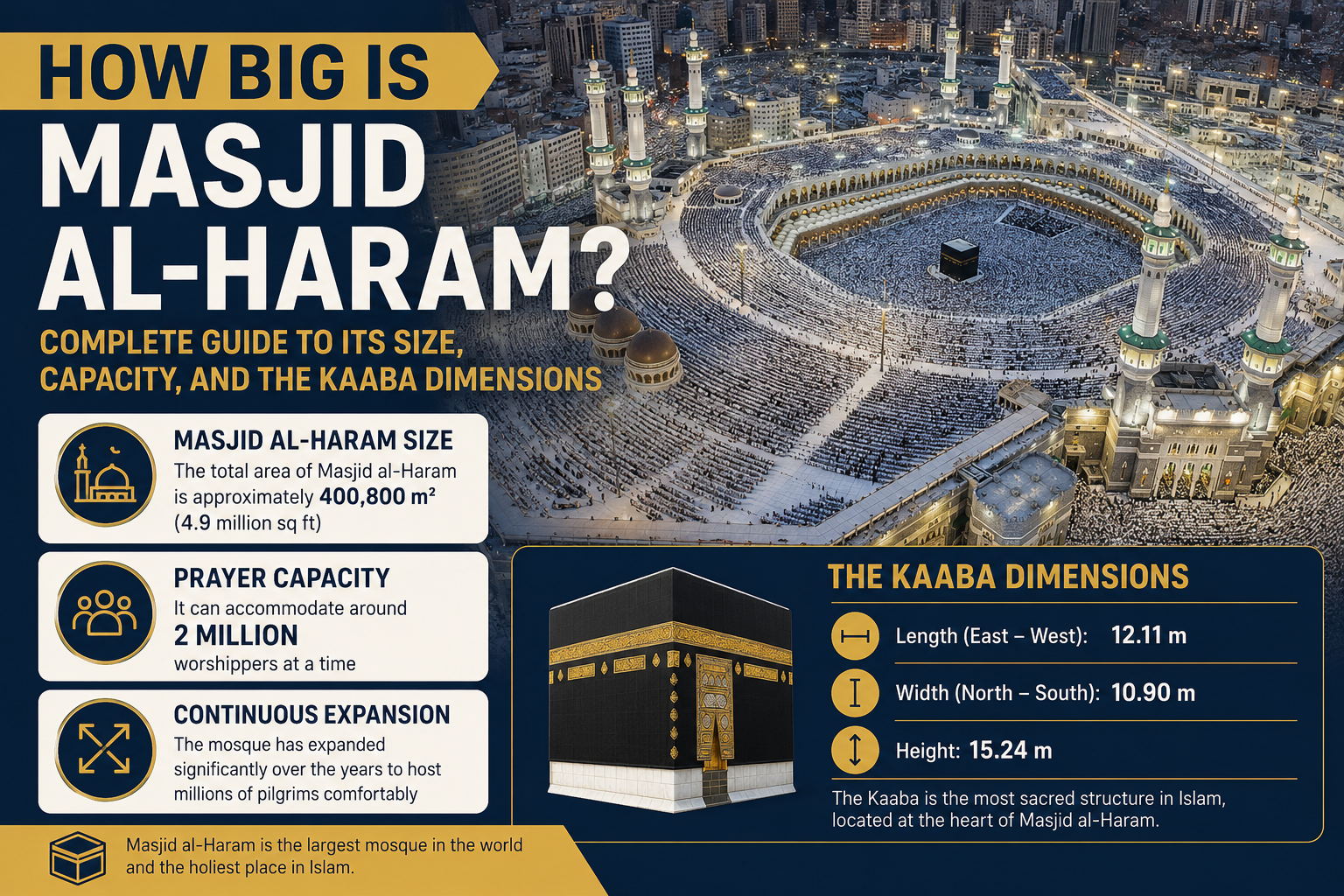
One of the most common questions concerns the Grand Mosque Mecca size in square meters. Following successive expansion projects, Masjid al-Haram now covers approximately 1.5 million square metres, making it one of the largest religious complexes ever constructed.
This remarkable area includes:
- Large indoor prayer spaces.
- Open marble courtyards surrounding the Kaaba.
- Multi-level prayer areas.
- The Sa’i corridor between Safa and Marwah.
- Service facilities for pilgrims.
- Multiple entrances, escalators, and access routes.
Every expansion has been carefully planned to preserve the mosque’s spiritual significance while improving safety, accessibility, and the overall experience for millions of worshippers.
Understanding How Big Is Masjid al-Haram helps visitors appreciate the remarkable scale of this sacred mosque.
The Largest Mosque in the World
If you have ever wondered How Big Is Masjid al-Haram, its massive size reflects centuries of careful expansion to welcome millions of worshippers. Masjid al-Haram is recognised as the largest mosque in the world, both because of its physical size and its ability to welcome enormous numbers of worshippers.
Unlike many historic mosques that were built for local communities, Masjid al-Haram serves the global Muslim population. Pilgrims from every continent gather here throughout the year, with visitor numbers increasing dramatically during Hajj and the final days of Ramadan.
Its scale is not simply an architectural achievement. It reflects the central role of Makkah in Islamic worship and the ongoing commitment to providing sufficient space for Muslims performing prayers, Tawaf, and other acts of devotion.
The Holy Kaaba at the Centre of the Mosque
Although Masjid al-Haram is vast, its spiritual heart is the Holy Kaaba. Positioned at the centre of the mosque, the Kaaba serves as the Qiblah—the direction Muslims face during their daily prayers.
Despite its global significance, the Kaaba itself is modest in size compared with the surrounding mosque. Its simple cube-shaped structure has become one of the most recognisable landmarks in the world, drawing millions of pilgrims every year.
The Kaaba’s black silk Kiswah, embroidered with elegant Qur’anic calligraphy in gold and silver-plated thread, further distinguishes it as one of Islam’s most treasured symbols.
Kaaba Dimensions and Kiswah Size
Understanding the Kaaba dimensions and Kiswah size helps explain the remarkable craftsmanship involved in producing the sacred covering each year.
The Kaaba stands approximately 13.1 metres high, with sides measuring about 11 to 12 metres in length. Although relatively compact compared with the surrounding mosque, its proportions have remained one of the defining features of Islamic architecture.
The Kiswah is specially designed to fit these exact dimensions. Produced from high-quality black silk, it consists of multiple carefully stitched panels that are assembled before being placed over the Kaaba. Skilled artisans spend months weaving, embroidering, and finishing the Kiswah using traditional techniques combined with exceptional attention to detail.
The precision required to produce a covering that fits perfectly reflects the importance of preserving one of Islam’s most respected traditions.
Centuries of Expansion
Masjid al-Haram has not always been the size it is today. Throughout Islamic history, successive rulers have expanded the mosque to accommodate increasing numbers of worshippers.
Each development has sought to balance preservation with progress. While the central position of the Kaaba has remained unchanged, surrounding prayer areas, courtyards, entrances, and facilities have been enlarged to improve accessibility and comfort.
Modern engineering has allowed the mosque to welcome millions of pilgrims without compromising its historical and spiritual significance.
Masjid al-Haram Capacity: How Many Worshippers Can It Accommodate?
The answer to How Big Is Masjid al-Haram becomes even more impressive when you consider its ability to safely accommodate more than two million worshippers during peak seasons. One of the most remarkable features of the Sacred Mosque is its ability to welcome an extraordinary number of worshippers throughout the year. The Masjid al-Haram capacity has increased dramatically through successive expansion projects, allowing the mosque to accommodate more than two million worshippers at one time during peak pilgrimage periods. During Hajj and the last ten nights of Ramadan, every available prayer area, courtyard, and upper level is carefully organised to ensure the safe movement of pilgrims.
Managing such large gatherings requires advanced planning and coordination. Dedicated teams oversee crowd movement, security, cleaning, medical services, and maintenance around the clock. Modern monitoring systems and clearly marked pathways help guide worshippers while preserving the peaceful atmosphere of this sacred place.
Modern Facilities That Support Millions of Pilgrims
The immense size of Masjid al-Haram is complemented by world-class infrastructure designed to make worship comfortable and accessible for people of all ages. Wide prayer halls, climate-controlled indoor areas, escalators, elevators, shaded courtyards, and accessible routes allow visitors to move through the mosque with ease.
The mosque also includes thousands of ablution facilities, drinking water stations supplied with Zamzam water, digital information displays, and extensive lighting systems that enable worship throughout the day and night. These facilities demonstrate how modern engineering can support one of the world’s oldest and most significant places of worship while respecting its religious heritage.
The Relationship Between the Kaaba and Masjid al-Haram
Although people often mention them together, the Kaaba and Masjid al-Haram are not the same. The Kaaba is the sacred structure located at the centre of the mosque, while Masjid al-Haram is the vast complex that surrounds it.
Every Muslim faces the Kaaba during the five daily prayers, regardless of where they are in the world. During Hajj and Umrah, pilgrims gather within Masjid al-Haram to perform Tawaf around the Kaaba before completing other important rituals. The mosque provides the space that allows millions of worshippers to carry out these acts of devotion safely and comfortably.
The annual replacement of the Kiswah further highlights this relationship. The beautifully woven black silk covering is produced specifically for the Kaaba, reflecting centuries of Islamic craftsmanship and honouring one of the most sacred landmarks in Islam.
The Significance of the Kiswah
Understanding the Kaaba dimensions and Kiswah size helps us appreciate the remarkable skill required to create the Kaaba’s covering. Every panel of the Kiswah is carefully measured, woven, embroidered, and assembled to fit the Kaaba perfectly.
The embroidery, produced using gold and silver-plated thread, features verses from the Holy Qur’an in elegant Arabic calligraphy. The production process takes many months and involves highly skilled artisans who continue a tradition that has been preserved for generations.
When the Kiswah is replaced each year, the previous covering is carefully preserved. Authentic pieces of the Kiswah have become treasured reminders of Islamic history and are admired for both their craftsmanship and their connection to the Holy Kaaba.
At Kaaba Kiswa, we are dedicated to preserving this remarkable heritage by offering authentic Kiswah pieces that allow collectors, families, and institutions to appreciate the beauty and history of one of Islam’s most iconic textiles.
Why the Size of Masjid al-Haram Matters
The extraordinary size of Masjid al-Haram is not simply an architectural achievement. It reflects the growing needs of the global Muslim community and ensures that millions of pilgrims can worship in comfort and safety each year.
Its vast courtyards, prayer halls, and supporting facilities allow visitors from every corner of the world to gather in one place while sharing a common purpose. Despite its enormous scale, the focus of every visitor remains the Holy Kaaba at the centre, reminding Muslims of unity, equality, and devotion to Allah.
Knowing How Big Is Masjid al-Haram gives Muslims a deeper appreciation of the engineering, planning, and spiritual significance behind Islam’s holiest mosque.
Conclusion
Anyone asking how big is Masjid al-Haram soon discovers that it is far more than a large mosque. Covering approximately 1.5 million square metres, it is recognised as the largest mosque in the world and continues to welcome millions of worshippers every year.
Its impressive Masjid al-Haram capacity, advanced facilities, and thoughtful design make it possible for pilgrims to perform Hajj, Umrah, and daily prayers with greater comfort and accessibility. At the centre of this magnificent complex stands the Holy Kaaba, whose sacred Kiswah represents centuries of Islamic craftsmanship and tradition.
Learning about the Grand Mosque Mecca size in square meters, the Kaaba dimensions and Kiswah size, and the remarkable history of its expansion helps deepen our appreciation for one of the most important places in the Islamic world.
Frequently Asked Questions
How big is Masjid al-Haram?
Masjid al-Haram covers approximately 1.5 million square metres, making it the largest mosque in the world.
What is the Masjid al-Haram capacity?
During peak pilgrimage periods, the mosque can accommodate more than two million worshippers across its indoor prayer halls, courtyards, and upper levels.
Why is Masjid al-Haram called the largest mosque in the world?
It is recognised as the largest mosque in the world because of its total area, extensive facilities, and its ability to host millions of worshippers throughout the year.
What are the Kaaba dimensions and Kiswah size?
The Kaaba is approximately 13.1 metres high, with sides measuring around 11–12 metres. The Kiswah is custom-made every year to fit these dimensions precisely.
How Big Is Masjid al-Haram compared to other mosques?
Masjid al-Haram is the largest mosque in the world, covering approximately 1.5 million square metres, making it significantly larger than any other mosque and capable of accommodating over two million worshippers during Hajj.