
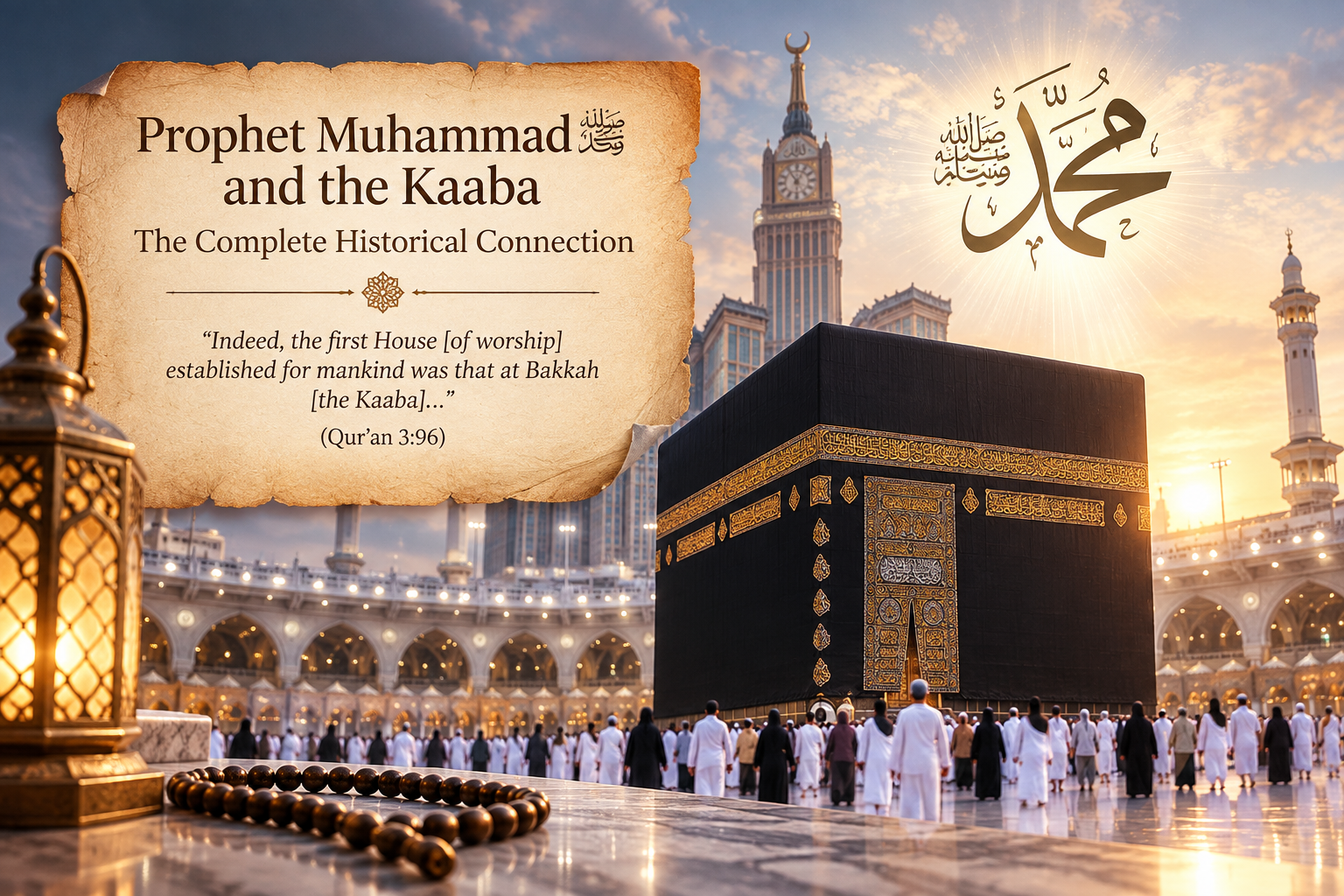
The Kaaba holds a unique position in Islam. Located in Makkah, it is the direction toward which Muslims face during Salah and the central destination of Hajj and Umrah. Its connection with Prophet Muhammad ﷺ is especially significant because many important events in his life took place around the Sacred House.
Understanding Prophet Muhammad and the Kaaba history means looking at his life before prophethood, the reconstruction of the Kaaba during his youth, the famous dispute over the Black Stone, and his later return to Makkah as the Messenger of Allah.
The Kaaba Before the Prophethood of Muhammad ﷺ
Prophet Muhammad ﷺ was born in Makkah and grew up near the Kaaba. The Sacred House was already an important centre for the Arab tribes before his prophetic mission. Prophet Muhammad and the Kaaba history began long before his prophethood, as he grew up in Makkah near the Sacred House.
According to Islamic tradition, the Kaaba had been associated with Prophet Ibrahim عليه السلام and his son Ismail عليه السلام. Over generations, however, idols were placed around the Sacred House, and practices of pre-Islamic Arabia became connected with it.
Muhammad ﷺ witnessed this environment during his childhood and adulthood. Prophet Muhammad and the Kaaba history began long before his prophethood, as he grew up in Makkah near the Sacred House.
His relationship with the Kaaba therefore began long before the first revelation.
The Reconstruction of the Kaaba
One of the most important events connecting Muhammad ﷺ with the Kaaba happened before he became a prophet.
The structure of the Kaaba was damaged by flooding and required reconstruction. The Quraysh decided to rebuild it, with different clans participating in the work.
When the walls were raised to the level where the Black Stone needed to be placed, a serious disagreement developed.
Each clan wanted the honour of positioning the sacred stone.
The dispute became intense and threatened to develop into serious conflict.
How Prophet Muhammad Solved the Black Stone Crisis With His Cloak
The famous incident explains how Prophet Muhammad solved the Black Stone crisis with his cloak.
At that time, Muhammad ﷺ was approximately thirty-five years old, years before the beginning of revelation.
The Quraysh eventually agreed that the next person entering the area should be allowed to settle the disagreement. Muhammad ﷺ appeared, and because of his reputation for honesty, the people accepted his judgement.
Rather than allowing one tribe to receive exclusive honour, he proposed a solution that involved everyone.
He placed the Black Stone on a cloth and instructed representatives from the different clans to lift it together. Once the stone reached the appropriate position, Muhammad ﷺ personally placed it into the wall.
This solution prevented the dispute from becoming violent and allowed the participating groups to share the honour. This event is an important part of Prophet Muhammad and the Kaaba history, showing how his wisdom helped prevent conflict among the Quraysh.
Black Stone Replacement Prophet Muhammad
The Black Stone replacement Prophet Muhammad incident is sometimes described as though Muhammad ﷺ replaced the stone itself. That is not what happened.
The important event was the repositioning of the Black Stone during the reconstruction of the Kaaba.
The stone had been removed while the building was being rebuilt. The disagreement concerned who would have the honour of putting it back into its position.
Muhammad ﷺ did not claim the honour exclusively. Instead, his solution involved the different Quraysh clans.
This episode demonstrates his reputation for wisdom and fairness even before he received revelation.
Did Prophet Muhammad Rebuild the Kaaba?
A common question is, Did Prophet Muhammad rebuild the Kaaba?
He did not construct the Kaaba from its original foundations. The Quraysh were responsible for the reconstruction that took place before his prophethood, although Muhammad ﷺ personally participated in the building work.
He helped carry stones during the reconstruction.
Therefore, it would be more accurate to say that Prophet Muhammad ﷺ participated in the Quraysh reconstruction of the Kaaba rather than saying that he independently rebuilt it. This reconstruction is another significant chapter in Prophet Muhammad and the Kaaba history because it occurred before he received revelation.
This distinction is important when discussing the historical development of the Sacred House.
The Kaaba During His Prophetic Mission
After Muhammad ﷺ received revelation at the age of forty, Prophet Muhammad and the Kaaba history entered a new and important stage in the development of Islam.
The Prophet ﷺ called the people of Makkah toward worshipping Allah alone. This challenged the religious practices surrounding the Kaaba, where numerous idols were present.
The message of Islam did not reject the Kaaba. Instead, it restored the idea that the Sacred House should be dedicated to the worship of the One God. These developments form an important part of Prophet Muhammad and the Kaaba history, connecting the Sacred House with the Prophet’s ﷺ mission of Tawhid.
The Quran repeatedly refers to the Kaaba and its connection with Ibrahim عليه السلام. The events surrounding the Sacred House therefore form an essential part of Prophet Muhammad and the Kaaba history and the development of the early Muslim community.
The Change of the Qiblah
During the Prophet’s ﷺ time in Madinah, Muslims initially prayed toward Jerusalem.
Later, Allah commanded the Muslims to turn toward the Sacred Mosque in Makkah.
This change established the Kaaba as the permanent Qiblah of Muslims.
The event strengthened the connection described throughout Prophet Muhammad and the Kaaba history and remains one of the most important developments in Islamic history.
The Conquest of Makkah
The Prophet’s ﷺ connection with the Kaaba reached another defining moment during the Conquest of Makkah.
After years away from his birthplace, Muhammad ﷺ returned to Makkah with the Muslim community.
The Kaaba, which had once been surrounded by idols, was purified from them. The Prophet ﷺ entered the Sacred Mosque and directed the removal of the idols.
This event represented a dramatic transformation of the religious life of Makkah. The Conquest of Makkah became one of the most significant moments in Prophet Muhammad and the Kaaba history, restoring the Sacred House to the worship of Allah alone.
The Sacred House was restored to the worship of Allah alone.
Did Prophet Muhammad Ever Go Inside the Kaaba?
Another frequently asked question is, Did Prophet Muhammad ever go inside the Kaaba?
Yes. Authentic reports indicate that the Prophet ﷺ entered the Kaaba during his lifetime.
Following the conquest of Makkah, he entered the Sacred House and removed or ordered the removal of images and idols found inside.
He also prayed inside the Kaaba on an occasion during the conquest according to well-known narrations.
These reports demonstrate that his connection with the Sacred House was not limited to the exterior courtyard or surrounding area.
The Kaaba and the Final Prophet
The Kaaba played a role at several stages of Muhammad’s ﷺ life.
As a young man, he participated in its reconstruction. He then resolved the Black Stone dispute through an inclusive solution. Later, as the Messenger of Allah, he called people back to the worship of Allah alone.
The Qiblah was eventually directed toward the Kaaba, and after the conquest of Makkah, the idols surrounding the Sacred House were removed.
These events show a continuous historical connection between the Prophet ﷺ and the Kaaba Together, these events make Prophet Muhammad and the Kaaba history an important part of understanding the development of Islam.
.
What Can We Learn From This History?
The story of Muhammad ﷺ and the Kaaba contains several important lessons.
The Black Stone incident demonstrates the value of peaceful problem-solving. Instead of allowing competition to create conflict, Muhammad ﷺ developed a solution in which different groups could participate.
His later actions at the Kaaba demonstrate the central Islamic principle of Tawhid—the worship of Allah alone.
The history also shows that the Kaaba is not merely an architectural structure. It represents a central symbol of Islamic worship, unity, and devotion.
Final Thoughts
The Prophet Muhammad and the Kaaba history is deeply connected with both his personal life and the development of Islam.
Before prophethood, Muhammad ﷺ helped the Quraysh reconstruct the Kaaba and famously resolved the dispute surrounding the Black Stone. His solution allowed different clans to share the responsibility and prevented a potentially serious conflict.
The answer to Did Prophet Muhammad rebuild the Kaaba? is therefore nuanced: he did not originally build the Sacred House, but he participated in its reconstruction before prophethood.
The answer to Did Prophet Muhammad ever go inside the Kaaba? is also yes, with authentic reports describing his entry into the Sacred House during the Conquest of Makkah.
From his youth in Makkah to the restoration of the Kaaba’s monotheistic purpose, the Sacred House remained an important part of the Prophet’s ﷺ life and the history of Islam.