The Kaaba Kiswah is one of the most distinctive examples of Islamic textile craftsmanship. Made for the covering of the Holy Kaaba in Makkah, it is recognised for its dark silk fabric, detailed Quranic embroidery, and remarkable cultural and religious importance.
Because genuine Kiswah fragments can be highly valuable and rare, buyers should pay close attention to documentation before making a purchase. A Kaaba Kiswah certificate of authenticity UK can provide useful information about a piece, but simply having a document labelled “certificate of authenticity” does not automatically prove that the textile is genuine.
This guide explains what buyers should examine before purchasing an alleged Kaaba Kiswah fragment.
Why Does a Certificate of Authenticity Matter?
A Kiswah certificate is intended to connect a particular textile with information about its origin and authenticity.
For collectors, documentation can help establish:
- What the item is claimed to be
- Where it originated
- Relevant historical information
- Material and dimensions
- Identification or reference details
- The name and details of the issuing party
- Date of certification
- Signature or verification information
However, certificates are only as reliable as the person or organisation issuing them. Buyers should therefore evaluate the document together with the textile, provenance, seller, and supporting evidence.
What Should a Genuine Kaaba Kiswah Certificate of Authenticity Contain?
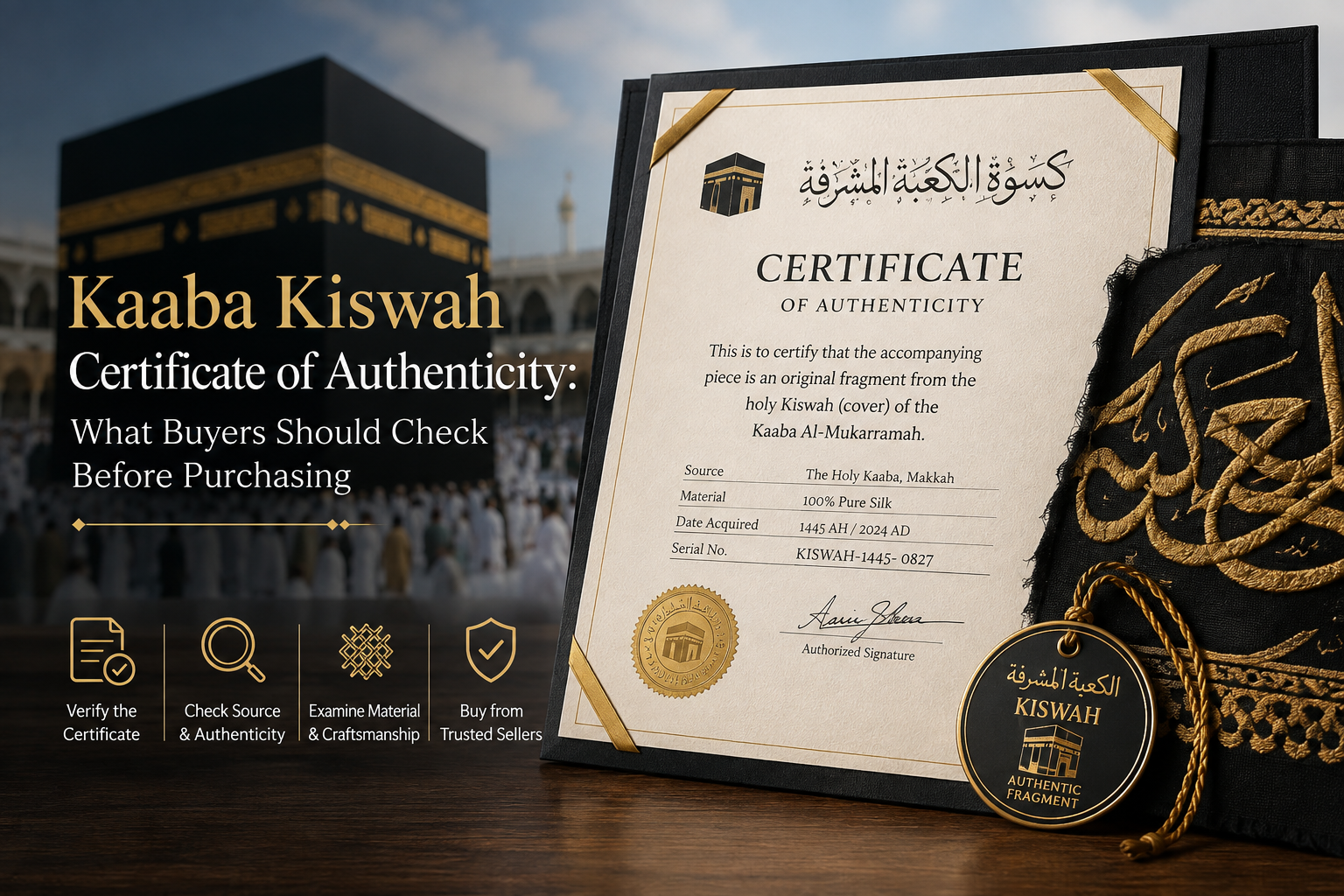
One of the most important questions buyers ask is: What should a genuine Kaaba Kiswah certificate of authenticity contain?
There is no single universally prescribed Kiswah certificate format for every privately owned fragment. Nevertheless, useful documentation should contain enough information to identify the specific item being sold.
Ideally, examine whether the certificate provides:
Item Identification
The document should clearly describe the particular Kiswah fragment rather than making only a general statement about “Kaaba cloth.”
Dimensions
The certificate should correspond with the actual measurements of the textile.
Material Information
Details about the fabric, embroidery, and other identifiable materials can help buyers compare the documentation with the physical piece.
Photographic Reference
A photograph or unique identifying description can make it easier to establish that the certificate belongs to the exact fragment being purchased.
Provenance Information
Information explaining the item’s history can strengthen the documentation.
Issuer Details
The certificate should identify who issued it and provide sufficient information for a buyer to assess that party’s credibility.
Date and Authentication Details
The date of issue, certificate number, signature, stamp, or other verification details can help establish a clear documentation trail.
A certificate containing vague claims but no identifiable information should be treated cautiously.
Authentic Kaaba Cloth Provenance UK
When researching Authentic Kaaba cloth provenance UK, buyers should understand that provenance means more than simply receiving a certificate.
Provenance is the documented history of an object. It may include information about previous ownership, acquisition, transfer, or other evidence connecting the textile with its claimed origin.
For a Kiswah fragment, useful provenance might include historical documentation, previous ownership records, photographs, receipts, institutional references, or other credible supporting material.
The stronger and more consistent the evidence, the easier it is for a buyer to evaluate the claim.
How Do You Verify a Kiswah Certificate From Makkah?
The question How do you verify a Kiswah certificate from Makkah? requires careful investigation.
Start by checking whether the Kiswah certificate contains specific information about the textile. Compare its measurements, photographs, description, and identifying details with the actual piece.
Next, investigate the issuing organisation or individual. Do not assume that a certificate is official merely because it contains Arabic writing, a stamp, a logo, or references to Makkah.
Ask the seller whether the certificate can be independently confirmed and whether additional provenance documents are available.
If the seller makes a claim that the certificate was issued by a particular institution in Makkah, buyers should seek confirmation through an appropriate official channel rather than relying solely on the seller’s statement.
Examine the Kiswah Itself
Documentation should always be considered alongside the physical textile.
Ask for detailed photographs showing:
- Front and reverse sides
- Fabric texture
- Embroidery
- Seams and edges
- Any labels or markings
- Areas showing wear
- Mounting or backing materials
The textile should also be consistent with the description provided by the seller.
For example, if the certificate identifies a particular dimension but the physical item is substantially different, the discrepancy should be explained before purchase.
Be Careful With Claims About Gold and Silver
Kiswah embroidery is known for its elaborate metallic appearance, but visual colour alone cannot establish the precise composition or value of the thread.
A seller claiming that a piece contains a specific quantity of gold or silver should be able to explain the basis for that claim.
Buyers should avoid calculating precious-metal value simply from photographs. If material composition is an important part of the purchase, appropriate professional examination may be necessary.
Can You Buy Original Kaaba Kiswah Legally in the UK?
Another important question is: Can you buy original Kaaba Kiswah legally in the UK?
The legality of purchasing, owning, importing, or selling a particular textile depends on factors including its provenance, ownership history, import circumstances, applicable laws, and the nature of the transaction.
A buyer should not assume that an item is legally sourced simply because it is advertised online.
Before making a significant purchase, ask the seller for documentation showing legitimate ownership and provenance. For expensive or unusual transactions, independent legal or specialist advice may also be appropriate.
Warning Signs Buyers Should Not Ignore
Potential buyers should be cautious when a seller:
- Refuses to provide provenance
- Offers only a generic certificate
- Cannot identify the issuing party
- Uses unusually vague descriptions
- Provides no detailed photographs
- Makes unrealistic authenticity claims
- Pressures buyers to pay immediately
- Cannot explain discrepancies in documentation
- Claims official Makkah connections without evidence
A genuine collector’s item deserves transparent documentation.
A Simple Buyer Verification Checklist
Before purchasing a Kiswah fragment, ask these questions:
1. Is the exact fragment identified on the certificate?
2. Do the dimensions match the physical textile?
3. Is there a documented ownership history?
4. Who issued the certificate?
5. Can the issuer’s credentials be checked?
6. Are detailed photographs available?
7. Are material claims supported by evidence?
8. Is the seller transparent about provenance?
9. Are there any unexplained inconsistencies?
10. Are the transaction and ownership arrangements clear?
Taking time to answer these questions can help buyers avoid making an expensive decision based solely on appearance.
Why Provenance and Documentation Work Together
Authenticity is strongest when multiple pieces of evidence support the same conclusion.
A Kiswah certificate can provide identification, while provenance can explain the object’s history. Photographs can connect the documentation to the physical item, and specialist assessment can provide additional insight into materials and construction.
No single document should automatically be treated as conclusive proof.
This is particularly important when purchasing valuable Islamic heritage textiles online, where buyers may not be able to examine the item personally before payment.
Final Thoughts
Purchasing a Kiswah fragment should involve more than checking whether the seller provides a certificate. A credible Kaaba Kiswah certificate of authenticity UK should contain meaningful identifying information, while Authentic Kaaba cloth provenance UK requires a documented history that can be evaluated independently.
If you are asking What should a genuine Kaaba Kiswah certificate of authenticity contain?, focus on specific item identification, dimensions, material information, photographs, provenance, issuer details, and authentication information.
Likewise, anyone asking How do you verify a Kiswah certificate from Makkah? should compare the certificate with the physical textile and investigate the issuing party rather than accepting claims at face value.
Looking for an Authentic Kaaba Kiswah?
If you are interested in purchasing a genuine Kaaba Kiswah piece, take the time to review its authenticity documentation, provenance, materials, dimensions, and seller information before making a decision.
Explore authentic Kaaba Kiswah pieces and learn more about available Islamic heritage textiles at Kaaba Kiswa today. Choose documentation, transparency, and authenticity over uncertain claims.