
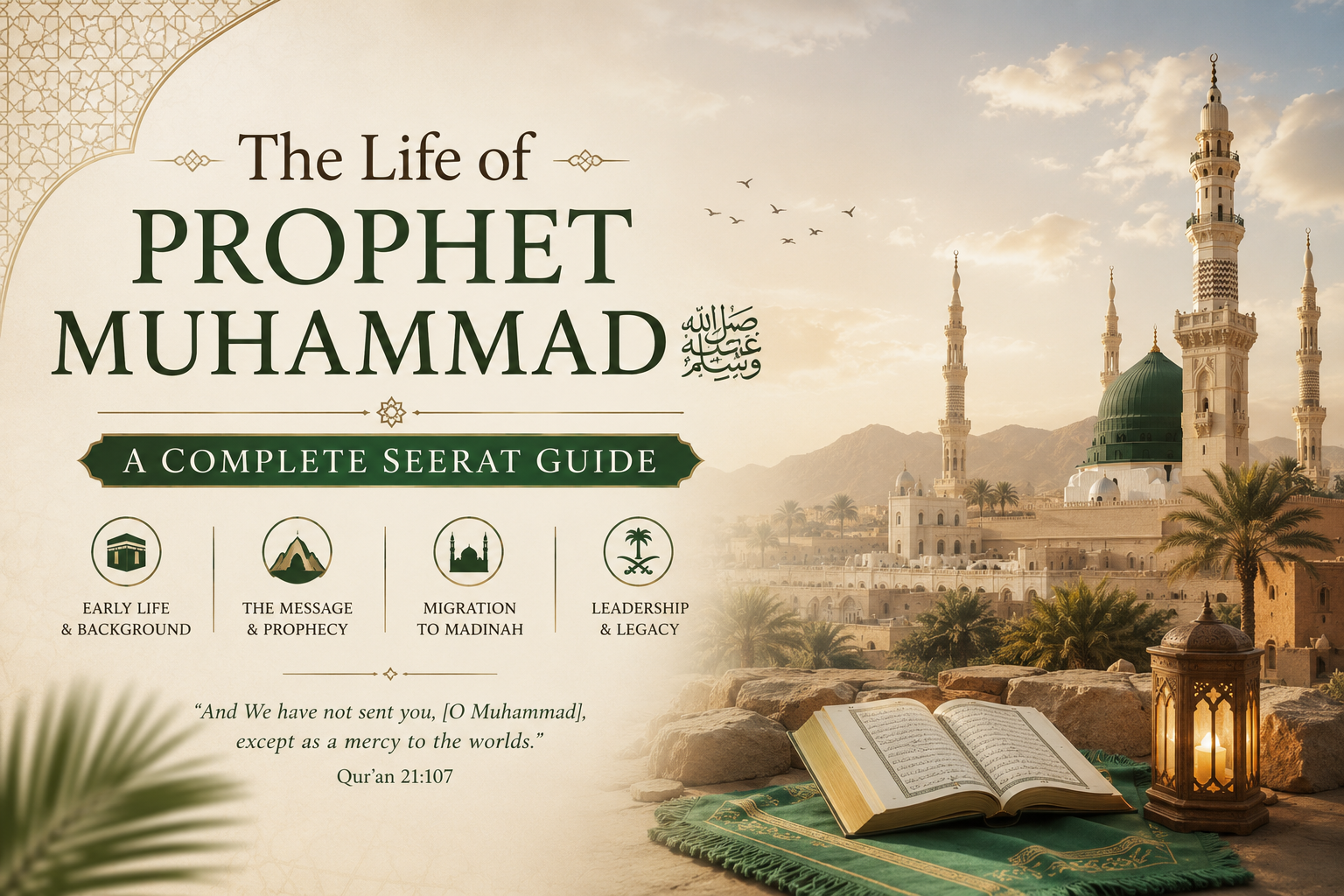
The life of Prophet Muhammad ﷺ is central to understanding Islam. His Seerah describes his childhood in Makkah, his years before prophethood, the beginning of revelation, his mission, migration to Madinah, leadership of the Muslim community, and final years. For Muslims, the Seerah is not simply a record of historical events. It offers an example of faith, patience, mercy, courage, justice, and devotion to Allah.
This Seerah of Prophet Muhammad guide provides an overview of the major stages of his remarkable life while highlighting lessons that remain relevant today.
Early Life in Makkah
Prophet Muhammad ﷺ was born in Makkah into the Quraysh tribe. His father, Abdullah ibn Abd al-Muttalib, died before his birth, while his mother was Aminah bint Wahb.
His childhood included significant personal losses. His mother passed away when he was young, after which he was cared for by his grandfather and later by his uncle Abu Talib. These experiences formed part of a difficult early life that eventually shaped the extraordinary resilience seen throughout the Seerah of Prophet Muhammad.
As he grew older, Muhammad ﷺ became respected among the people of Makkah for his honesty and trustworthy character. Before receiving revelation, he was known as a person whose word could be relied upon. His reputation for integrity became an important part of his identity among the Quraysh.
Marriage to Khadijah رضي الله عنها
As a young man, Muhammad ﷺ worked in trade. His honesty and ability attracted the attention of Khadijah رضي الله عنها, a respected businesswoman of Makkah.
They married and established a family together. Khadijah رضي الله عنها later became the first person to believe in his prophethood.
Her support was especially important during the earliest and most difficult period of the Seerah of Prophet Muhammad. She provided emotional strength when the first revelation brought an experience unlike anything he had previously encountered.
How Old Was Prophet Muhammad When He Received Revelation?
One of the most frequently asked questions about his life is, How old was Prophet Muhammad when he received revelation?
He was forty years old when the first revelation came to him.
Before this event, he increasingly sought solitude and reflection. He would spend time in the Cave of Hira, away from the distractions of Makkah.
The angel Jibril عليه السلام brought the first revelation, beginning with the opening verses of Surah Al-Alaq. This marked the beginning of his prophetic mission. This moment became one of the defining events in the Seerah of Prophet Muhammad, beginning his responsibility as Allah’s Messenger.
After the first revelation, he initially preached privately to people close to him. Later, the message was proclaimed publicly, and the mission gradually expanded. Historical accounts describe approximately three years of private preaching before the public phase of his call.
The Message of Islam
This central principle appears throughout the Seerah of Prophet Muhammad and shaped his entire mission.
He called people away from polytheism and toward belief in one Creator. His message also challenged injustice, exploitation, tribal arrogance, and harmful social practices.
He taught that human beings would be accountable before Allah and that righteousness was not determined simply by wealth, ancestry, or social position.
The early Muslims faced intense opposition because this message challenged established religious and social structures in Makkah.
Hardships in Makkah
The Quraysh opposed the Prophet ﷺ and those who followed him. Muslims experienced insults, persecution, social pressure, and economic hardship.
Despite these difficulties, the Prophet ﷺ continued teaching with patience and determination.
The Makkah period demonstrates that success is not always immediate. The early Muslim community remained small for years, yet the Prophet ﷺ continued his mission without abandoning its principles.
His response to hardship provides one of the most important themes within the Seerah of Prophet Muhammad.
The Hijrah to Madinah
As persecution intensified, the Prophet ﷺ and his companions eventually migrated to Madinah.
The Hijrah became a major turning point in Islamic history. Madinah provided an environment where Muslims could establish a community based on faith, cooperation, responsibility, and mutual support.
The migration was not simply a change of location. It represented sacrifice, courage, planning, trust in Allah, and the willingness to leave familiar surroundings for a greater purpose.
The Hijrah later became the starting point of the Islamic calendar. For this reason, the Hijrah holds a particularly important place in the Seerah of Prophet Muhammad.
Building the Community in Madinah
In Madinah, Prophet Muhammad ﷺ became both a religious guide and community leader.
He helped establish relationships between the Muhajirun, who had migrated from Makkah, and the Ansar, who supported them in Madinah.
The Prophet ﷺ also established principles governing relationships within the growing community. His leadership included religious guidance, diplomacy, social organisation, conflict management, and care for vulnerable people.
His approach demonstrates that leadership in Islam involves responsibility rather than simply authority. This aspect of leadership is an important lesson from the Seerah of Prophet Muhammad.
Major Challenges and Battles
The Madinah period was not free from conflict. The growing Muslim community faced military threats and political challenges.
Major encounters included the battles of Badr, Uhud, and the Trench. Each event brought different circumstances and lessons.
At Badr, the Muslims achieved an important victory despite being significantly outnumbered. Uhud brought painful losses and demonstrated the consequences of disobedience and mistakes. The Battle of the Trench demonstrated strategic planning and collective effort.
The Prophet ﷺ responded to these experiences with patience, consultation, discipline, and continued trust in Allah.
The Treaty of Hudaybiyyah
One of the most significant diplomatic moments of the Seerah was the Treaty of Hudaybiyyah.
At first, some companions found aspects of the agreement difficult to accept. However, the treaty created a period of reduced conflict and opened opportunities for communication and the spread of Islam.
The event demonstrates the importance of patience and long-term thinking, both of which are recurring lessons in the Seerah of Prophet Muhammad. A decision that may appear disappointing in the short term can sometimes create greater opportunities later.
The Conquest of Makkah
The eventual return of the Muslims to Makkah was another defining moment.
When the Prophet ﷺ entered the city with a large Muslim force, he had the opportunity to respond to years of persecution and hostility.
Instead, the conquest became widely remembered for forgiveness and restraint. Many former opponents were granted safety.
This episode is one of the clearest examples of mercy within the Seerah and demonstrates that possessing power does not require revenge.
His Character and Treatment of Others
The Prophet’s ﷺ character is among the most important aspects of his life.
He showed kindness toward children, respect toward neighbours, generosity toward the needy, and compassion toward people facing difficulties.
He also valued consultation and treated his companions with consideration.
His leadership combined firmness with mercy. He could make difficult decisions when necessary while maintaining compassion and humility.
These qualities explain why studying the Seerah of Prophet Muhammad is valuable beyond memorising historical dates.
The Final Years
During the later years of his life, Islam spread across much of Arabia.
The Prophet ﷺ continued teaching the Quran, guiding his companions, strengthening the Muslim community, and fulfilling his responsibilities.
His Farewell Pilgrimage provided an important opportunity to address the Muslim community. His teachings emphasised principles including the sanctity of human life and property, responsibility, and adherence to Islamic guidance.
His final period was marked by illness and increasing concern for the future of the Muslim community.
Prophet Muhammad ﷺ passed away in Madinah in 11 AH. His death was an immense loss for the companions, but the message he delivered continued through the Quran and the teachings preserved by the Muslim community.
Lessons From the Seerah of Prophet Muhammad for Modern Life
The question What lessons can we learn from the Seerah for modern life? has many answers.
The Prophet’s ﷺ life teaches the importance of honesty when trust is difficult, patience when results are delayed, and compassion when dealing with people who are struggling.
His life also demonstrates responsible leadership. He consulted others, accepted difficult circumstances, planned carefully, and remained committed to his principles.
For modern families, the Seerah provides lessons about kindness and responsibility. For professionals and business owners, his reputation for honesty offers a powerful example of ethical conduct. For community leaders, his ability to unite people from different backgrounds demonstrates the value of fairness and cooperation.
The Seerah also teaches resilience. Difficult periods do not necessarily indicate failure. The Makkah years show how perseverance can eventually lead to transformation.
Why Study the Seerah of Prophet Muhammad Today?
A Seerah of Prophet Muhammad summary UK readers can access online can introduce the major events, but deeper study reveals the relationships, decisions, challenges, and moral principles behind those events.
The Seerah of Prophet Muhammad connects Islamic beliefs with real human experiences. It shows how faith can influence behaviour during prosperity, hardship, conflict, family life, leadership, and loss.
Studying authentic sources is important because popular stories about the Prophet ﷺ can sometimes contain details that are weakly transmitted or historically uncertain. A reliable Seerah should distinguish established reports from later narratives.
Final Thoughts
The Seerah of Prophet Muhammad ﷺ represents one of the most influential biographies in world history and is foundational to Muslim faith and practice.
From his difficult childhood in Makkah to the first revelation at forty, from persecution to the Hijrah, and from building the community in Madinah to his final years, every stage of his Seerah contains lessons about faith and character.
For anyone seeking a Seerah of Prophet Muhammad guide, the most valuable approach is to study the Seerah of Prophet Muhammad as both history and moral guidance.
The Full life history of Prophet Muhammad demonstrates that meaningful change requires patience, courage, wisdom, compassion, and trust in Allah. These qualities remain relevant to modern families, communities, professionals, and leaders.
Ultimately, studying the Prophet’s ﷺ life is not merely about knowing when events happened. It is about understanding how he responded to those events and considering how his example can inspire better choices in our own lives.