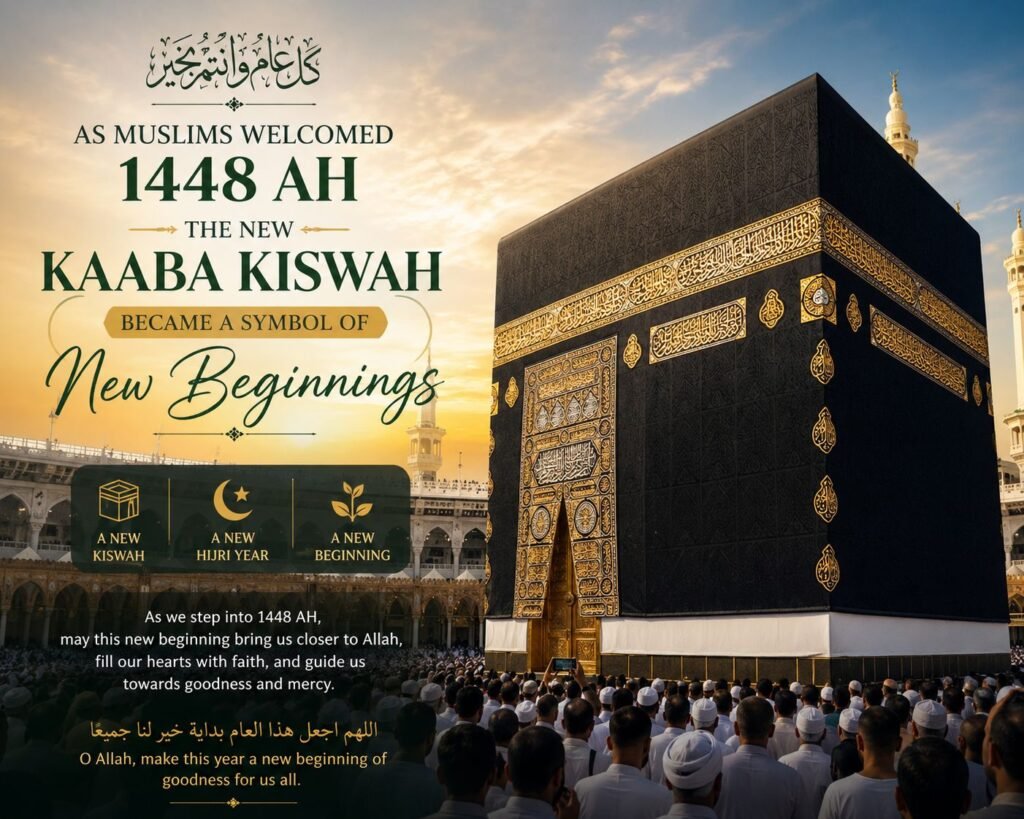
The first day of an Islamic year rarely creates global headlines. Yet, as 1448 AH began, millions of Muslims found themselves sharing and discussing the same images online—the Holy Kaaba dressed in a newly installed Kiswah.
Across social media platforms, Muslims from different countries posted photographs, reflections, and personal thoughts about the event. Some admired the craftsmanship of the new Kiswah. Others viewed it as a powerful reminder of the arrival of a new Islamic year.
What made this moment special was not simply the replacement of a cloth. It was the message many believers found within it.
A Tradition Seen Through Fresh Eyes
Most Muslims are familiar with the Kaaba’s black covering. It appears in photographs, videos, documentaries, and countless memories from Hajj and Umrah.
Yet every time a new Kiswah is installed, people seem to look at it differently.
Perhaps this happens because the Kaaba represents something deeply personal. Every Muslim faces it during prayer. Every pilgrim dreams of seeing it up close. Every visitor to Makkah remembers the emotional impact of their first sight of it.
When the appearance of such a familiar symbol changes, even slightly, it naturally captures attention.
Why the Timing Felt Significant
The arrival of 1 Muharram is not celebrated with fireworks or public festivals in most Muslim communities.
Instead, it often arrives quietly.
Many believers use the occasion to think about their past year, evaluate their actions, and consider how they want to move forward.
Seeing the Kaaba covered with a fresh Kiswah at the same moment created a powerful image.
For many Muslims, it felt as though two forms of renewal were happening together—one visible and one personal.
The Kaaba received a new covering, while believers were being reminded to renew their intentions and goals.
The Power of Visual Symbols
Human beings often connect strongly with symbols.
A flag can represent a nation. A photograph can bring back forgotten memories. A building can remind people of history and identity.
For Muslims, the Kaaba is one of the strongest symbols of unity in existence.
Regardless of where Muslims live, they face the same direction in prayer. This shared focus creates a sense of connection that crosses borders, languages, and cultures.
The new Kiswah therefore became more than a visual change. It became a moment of shared experience for a global community.
Memories That Never Fade
For pilgrims who have visited Makkah, images of the new Kiswah often trigger immediate memories.
Some remember the overwhelming feeling of seeing the Kaaba for the first time.
Others recall moments spent making dua late at night or standing among thousands of worshippers in the Haram.
Years may pass, but these memories often remain vivid.
This emotional connection explains why even a routine annual event can attract worldwide attention.
A Lesson Hidden in Plain Sight
One interesting aspect of the Kiswah replacement is the lesson it quietly teaches.
The Kaaba remains unchanged.
Its purpose remains unchanged.
Its importance remains unchanged.
Only the covering is renewed.
Many Muslims see a parallel between this and personal faith.
Core beliefs remain constant, but individuals must continuously work on improving themselves, correcting mistakes, and renewing their commitment to worship.
In that sense, the new Kiswah becomes a reminder that spiritual growth is an ongoing process.
Social Media and a Global Conversation
In previous generations, only those physically present in Makkah would witness events like the Kiswah replacement.
Today, things are different.
Within minutes, images travel across the world. Muslims in London, Jakarta, Cairo, New York, Karachi, and Lagos can view the same moment almost instantly.
This digital connection has transformed local events into global conversations.
The start of 1448 AH demonstrated how technology can help strengthen a sense of unity among Muslims despite geographical distance.
Looking Beyond the Ceremony
While many people focus on the visual beauty of the new Kiswa, the deeper significance lies elsewhere.
The event encourages reflection on questions such as:
- What should I improve this year?
- What habits should I leave behind?
- How can I strengthen my relationship with Allah?
- What goals should I set for my spiritual future?
These questions are far more important than the fabric itself.
The Kiswah simply serves as a reminder to ask them.
A New Year, A New Opportunity
Every new year offers a fresh beginning.
The Islamic calendar is no different.
As Muslims entered 1448 AH, the newly installed Kiswah provided a powerful visual reminder that renewal is part of life. Mistakes from the past do not define the future. Growth remains possible. Improvement remains possible.
This message resonates regardless of age, nationality, or personal circumstances.
Final Thoughts
The installation of the new Kaaba Kiswah at the beginning of 1448 AH was not significant merely because a sacred covering was replaced. It captured attention because it coincided with a moment of reflection shared by Muslims around the world.
For many believers, the new Kiswah became a symbol of fresh intentions, renewed faith, and hope for the year ahead. Long after the headlines fade, that message is likely to remain the most meaningful part of the event.