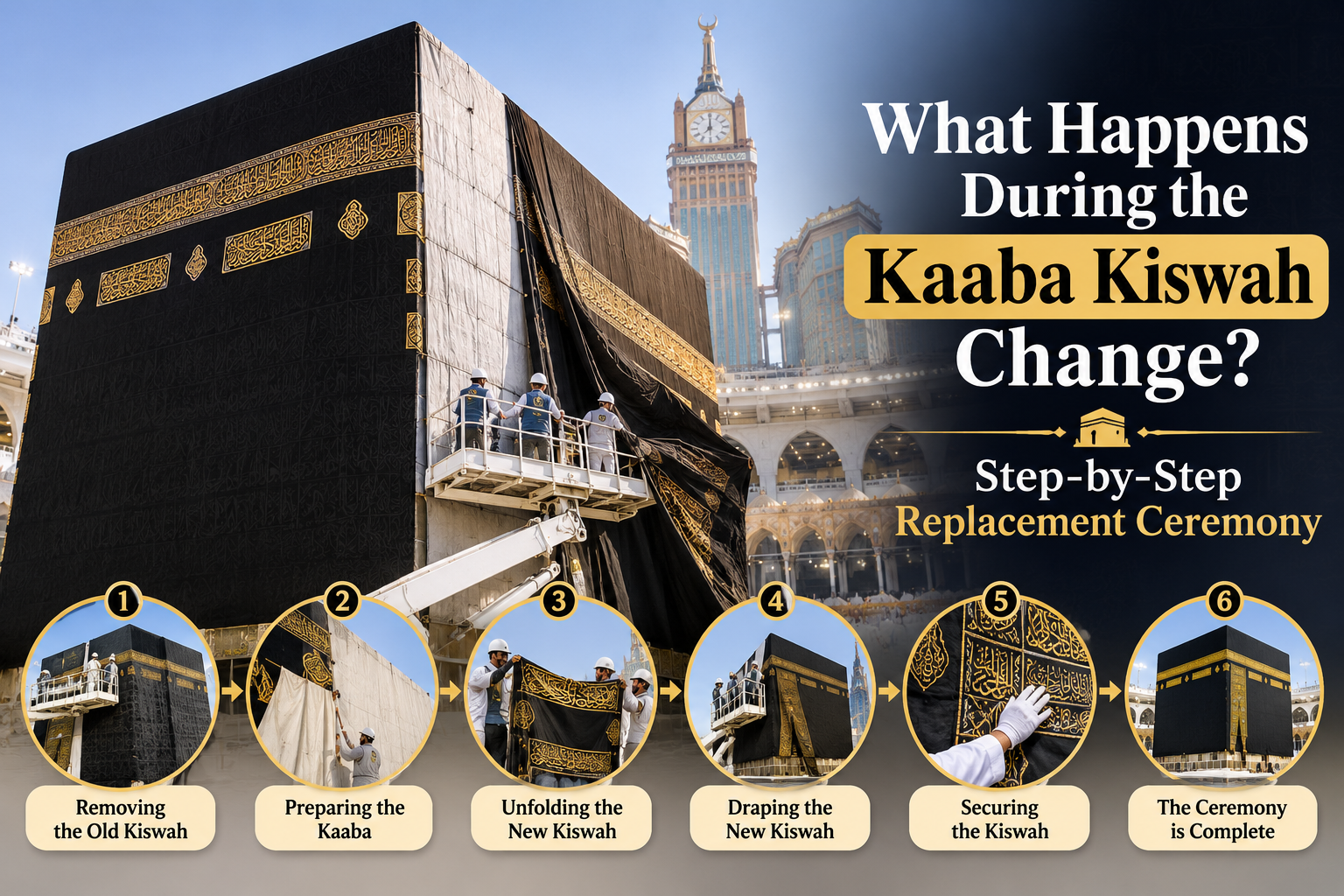
The annual Kaaba Kiswah change is a remarkable event that attracts the attention of Muslims around the world. Every year, the black covering of the Holy Kaaba in Makkah is replaced with a newly prepared Kiswah, featuring beautiful Quranic inscriptions and intricate gold and silver embroidery. The Kaaba Kiswah Change involves skilled Saudi craftsmen, careful planning and several hours of precise work.
But what actually happens during the replacement ceremony? How is the old Kiswah replaced, and how are the new covering and door curtain fitted?
Understanding the Kaaba Kiswah replacement ceremony gives us a closer look at the craftsmanship, organisation and care involved in maintaining the covering of Islam’s holiest site.
When Does the Kaaba Kiswah Change Take Place?
The Kiswah is renewed every Islamic year. Since 2022, the annual replacement has taken place on the first day of Muharram, marking the beginning of the Islamic New Year.
Before installation, the new covering is prepared at the King Abdulaziz Complex for the Holy Kaaba Kiswah in Makkah. Its production involves multiple stages, including silk preparation, weaving, printing, embroidery, assembly and final inspection.
Once completed, the Kiswah is transported to Masjid al-Haram under an organised operational arrangement. The replacement team then prepares the Kaaba for the installation.
Step-by-Step Process of the Kaaba Kiswah Change
Step 1: Preparing the Kaaba for Replacement
Before the new Kiswah is installed, the existing covering is carefully prepared for removal. The team handles the embroidered elements, decorative pieces and door curtain according to the replacement procedure.
The gold-embroidered sections and other attached ornaments are removed as required. This preparation allows the craftsmen to work safely and systematically around the structure.
Every activity is coordinated to ensure that the replacement proceeds without unnecessary disruption inside Masjid al-Haram.
Step 2: Bringing the New Kiswah to Masjid al-Haram
The newly manufactured Kiswah is transported from the King Abdulaziz Complex to the Grand Mosque in a dedicated vehicle.
The covering is made up of separate fabric panels that are prepared in advance. Each section has a specific position and must be fitted correctly to maintain the overall appearance of the Kaaba.
The new covering is handled by trained specialists who understand its weight, dimensions and installation requirements.
Step 3: Raising the Old Kiswah and Installing the New One
This is the main stage of the Kaaba Kiswah Change ceremony. The old covering is gradually raised while the new Kiswah is positioned over the Kaaba.
The replacement is carried out section by section rather than removing the entire old covering at once. This allows the craftsmen to maintain control over the fabric throughout the process.
Each new panel is carefully aligned with the corresponding side of the Kaaba. The team checks its position to ensure that the black silk sits properly across the walls.
Step 4: Securing the Four Sides of the Kiswah
The new Kiswah consists of four main fabric sections, each covering one side of the Kaaba.
After positioning the panels, craftsmen secure the covering at the corners and along the lower sections. The edges are joined carefully so that the fabric forms a continuous covering.
Precise stitching is essential because the Kiswah must remain properly fitted throughout the year. The team checks the alignment of each section before moving to the next stage.
Step 5: Installing the Gold-Embroidered Hizam
One of the most recognisable features of the Kaaba Kiswah is its golden embroidered belt, known as the Hizam.
This decorative band runs around the upper part of the covering and contains Quranic inscriptions embroidered with gold-plated silver threads.
During installation, the Hizam is positioned carefully and stitched into place. Its alignment is particularly important because even small differences can affect the appearance of the complete design.
The beautiful Kiswah Kaaba calligraphy becomes clearly visible once the belt and other embroidered sections are properly fitted.
Step 6: Attaching the Kaaba Door Curtain
The Kiswah also includes a curtain called the Sitara.
It features detailed Quranic inscriptions and elaborate embroidery. Because of its size and weight, installing it requires particular care and precision.
The craftsmen prepare the required opening in the black silk covering and position the curtain correctly. It is then stitched securely from both the inside and outside to ensure proper placement.
Step 7: Final Inspection of the New Kiswah
Once all the panels, corners, embroidered sections and door curtain have been installed, the team checks the complete covering.
They examine the stitching, alignment, fabric placement and overall appearance. The aim is to ensure that the Kiswah is properly secured and that its embroidered details are positioned correctly.
After the final checks, the Kaaba stands covered in its new Kiswah for the coming Hijri year.
How Many People Take Part in the Replacement Ceremony?
The ceremony requires a specialised team of trained professionals. During the 2025 replacement, 154 Saudi craftsmen and specialists participated in the operation.
Team members were assigned different responsibilities according to their experience and technical skills. Some handled the fabric panels, while others worked on stitching, alignment and the installation of the embroidered sections.
Their coordinated efforts demonstrate how much planning and expertise are involved in changing the Kiswah.
Why Is the Kaaba Kiswah So Expensive?
Many people wonder why the Kiswa Kaaba is so expensive. Its production involves high-quality natural silk, gold-plated silver threads, pure silver and skilled craftsmanship.
The embroidery requires considerable time and specialised techniques. Quranic inscriptions must be prepared and stitched with accuracy, while every fabric section undergoes inspection before installation.
These materials and manufacturing processes contribute to the Kiswah’s substantial production cost. Its religious significance and connection with the Holy Kaaba also make it deeply meaningful to Muslims.
Can You Buy an Original Kaaba Kiswah Piece?
People often search for questions such as “Is it possible to buy Kaaba Kiswah?”, “How do I buy authentic Kaaba Kiswah?” and “Where to buy Kaaba Kiswah?”
Genuine Kiswah pieces may be available through specialist sellers, but buyers should carefully check the product’s origin and authenticity documentation.
Before purchasing a Gilafe Kaaba piece, review its description, dimensions, condition and certificate details. Do not rely only on photographs or general claims when choosing an original piece.
If you are researching the original Kaaba Kiswah price or looking to buy Kiswah Kaaba online, make sure the seller provides clear information about what is being offered.
Conclusion: A Remarkable Annual Tradition
The Kaaba Kiswah change is much more than replacing one black covering with another. It is a carefully coordinated process involving skilled craftsmen, detailed stitching, specialised materials and precise installation.
From preparing the old covering to securing the new panels and attaching the golden Hizam and door curtain, every stage contributes to completing this important annual tradition.
The next time you see the Holy Kaaba, remember the extensive work that goes into preparing and fitting its beautiful covering.
Want to learn more about the Kaaba Kiswah? Explore Kaaba Kiswa for more informative articles about its history, manufacturing process, Quranic calligraphy, embroidery and significance. Discover the details behind one of the most recognisable features of the Holy Kaaba and deepen your understanding of its remarkable story.