
The Kaaba in Makkah is the most sacred structure in Islam and the direction toward which Muslims around the world pray. While millions of people see the Kaaba during Hajj, Umrah, or through photographs, many may not know that its structure has four distinct corners, each with its own name and historical significance.
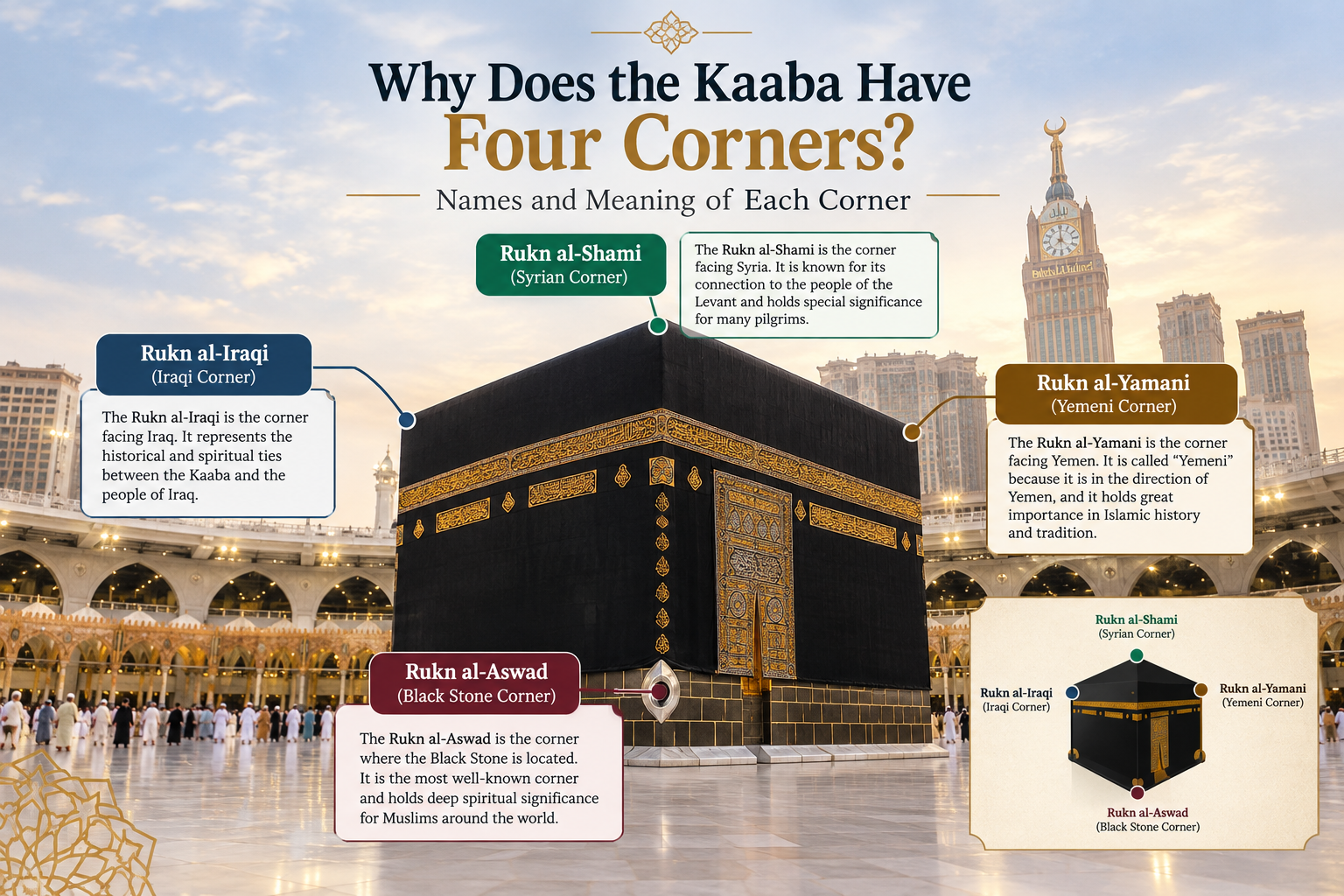
Understanding the four corners of Kaaba can make the experience of visiting Masjid al-Haram even more meaningful. These corners are commonly identified as the Black Stone corner, the Yemeni Corner, the Syrian Corner, and the Iraqi Corner. Their names are associated primarily with the directions they face. Saudi Arabia’s Ministry of Hajj and Umrah identifies the Yemeni Corner as south, the Black Stone as east, the Syrian Corner as west, and the Iraqi Corner as north.
Why Does the Kaaba Have Four Corners?
The four corners of Kaaba are an important part of understanding the structure, orientation, and layout of the Holy Kaaba. The Kaaba has a roughly cuboid structure, which naturally gives it four corners. These corners mark the points where its four sides meet and help define the building’s orientation.
The four corners of Kaaba are important when learning about Kaaba architecture, especially because some of them have specific significance during Tawaf. The Black Stone marks the beginning and ending point of each circuit, while the Yemeni Corner has its own established Sunnah associated with touching it when possible.
The names of the four corners of Kaaba help visitors identify different parts of the structure while performing Tawaf or learning about its architecture.
What Are the Four Corners of the Kaaba Called?
The Kaaba corners names commonly used are:
- Black Stone Corner – Rukn al-Aswad
- Yemeni Corner – Rukn al-Yamani
- Syrian Corner – Rukn al-Shami
- Iraqi Corner – Rukn al-Iraqi
The names help visitors identify different parts of the Kaaba while performing Tawaf or learning about its structure.
1. Black Stone Corner – Rukn al-Aswad
The Black Stone corner is one of the most significant corners of the Kaaba. The Black Stone, known in Arabic as Hajar al-Aswad, is located in this corner and marks the starting and ending point of each Tawaf circuit.
The four corners of Kaaba each have a distinct location, but the Black Stone corner has particular importance during Tawaf.
For pilgrims, this corner has particular importance because Tawaf begins by aligning with the Black Stone. If it is possible without causing harm or pushing others, pilgrims may touch or kiss the Black Stone. When reaching it in crowded conditions, official guidance explains that a pilgrim may gesture toward it and say Allahu Akbar.
The Black Stone is therefore not simply an architectural feature. It serves as an important reference point for the ritual of Tawaf.
2. Yemeni Corner – Rukn al-Yamani
The Rukn al-Yamani, or Yemeni Corner, is located at the southwestern corner of the Kaaba and faces toward Yemen. Saudi Arabia’s official Haramain website states that it is aligned with the corner containing the Black Stone.
Among the four corners of Kaaba, the Yemeni Corner has a special place in the practice of Tawaf. It is recommended to touch it with the right hand when possible, without kissing it. If reaching it is not possible, pilgrims should continue Tawaf rather than pushing or causing difficulty to others.
The area between the Yemeni Corner and the Black Stone is also associated with the well-known supplication:
“Our Lord, give us good in this world and good in the Hereafter, and protect us from the punishment of the Fire.”
This makes the Yemeni Corner especially important for people learning about Tawaf around Kaaba and its etiquette.
3. Syrian Corner – Rukn al-Shami
The Syrian Corner, commonly called Rukn al-Shami, is the corner of the Kaaba facing toward Syria. Saudi Ministry of Hajj and Umrah guidance identifies this as the western-facing corner.
Unlike the Black Stone corner, the Syrian Corner does not contain the Black Stone. It is nevertheless one of the four structural corners that define the shape and orientation of the Kaaba.
Understanding this corner is useful for visitors who want to learn the layout of the Kaaba rather than focusing only on the Black Stone and its door.
4. Iraqi Corner – Rukn al-Iraqi
The Iraqi Corner, known as Rukn al-Iraqi, is the corner facing toward Iraq. Saudi official guidance identifies it as the northern corner of the Kaaba.
Like the Syrian Corner, it is primarily recognized by its geographical direction and its position within the four-corner structure of the Kaaba.
Learning the names of these corners can help first-time visitors understand the orientation of the Kaaba and follow descriptions of its different sides more easily.
Which Corner Does Tawaf Start From?
One of the most common questions about the four corners of Kaaba is where Tawaf begins.
Tawaf starts in line with the Black Stone. Pilgrims keep the Kaaba on their left while completing seven circuits around it. Saudi guidance specifically identifies the Black Stone as the starting reference point for Tawaf.
The Yemeni Corner is encountered shortly before reaching the Black Stone again during each circuit. The other two corners are also passed during the circuit, but the specific Sunnah actions associated with touching the Black Stone and Yemeni Corner should not be confused with the other corners.
Are All Four Kaaba Corners Touched?
No. This is an important distinction for anyone researching the four corners of Kaaba and Tawaf etiquette.
The Black Stone may be touched or kissed when accessible without causing harm. The Yemeni Corner may be touched with the right hand when possible. Official Saudi guidance says there is no need to push through crowds or gesture toward the Yemeni Corner when it cannot be reached.
The Syrian and Iraqi Corners do not have the same prescribed practice of touching during Tawaf.
Pilgrims should always prioritize safety, avoid pushing, and follow established guidance when the area is crowded.
What Is the Connection Between the Corners and the Kiswah?
The four corners are also important when looking at the Kaaba’s covering, known as the Kiswah. The black textile is carefully installed around the structure, including its four sides and corners.
Saudi official information about replacing the Kiswah explains that the covering consists of four separate sides and a door curtain. During installation, each side is raised and secured before the corners are sewn together from top to bottom.
This detailed construction demonstrates why the corners are an important part of both the architecture of the Kaaba and the craftsmanship of its covering.
For people interested in Islamic textile heritage, understanding the structure of the Kaaba can also provide greater appreciation for authentic Kiswah pieces and their intricate calligraphy and embroidery.
Why Are the Four Corners Important?
The four corners of Kaaba help define its physical structure and orientation. They also help visitors understand its relationship with different geographical directions.
More importantly, two corners have specific significance during Tawaf: the Black Stone corner and the Yemeni Corner. The other two corners remain essential structural points but do not have the same ritual practices associated with them.
Learning about the four corners of Kaaba and their distinctions can make information about the Kaaba in Makkah, Tawaf, and Islamic heritage much easier to understand.
Explore the Heritage of the Kaaba With Kaaba Kiswa
The Kaaba is not only an extraordinary sacred structure; it is also connected with centuries of Islamic history, craftsmanship, calligraphy, and textile traditions. The Kiswah covering adds another fascinating dimension to understanding the beauty and heritage of the Holy Kaaba.
If you want to explore more about the Kaaba Kiswa, its craftsmanship, calligraphy, history, and Islamic textile heritage, visit Kaaba Kiswa to discover informative resources and explore pieces connected with this remarkable tradition.
Explore Kaaba Kiswa today and discover the history, artistry, and heritage behind one of the most significant symbols of Islam.