
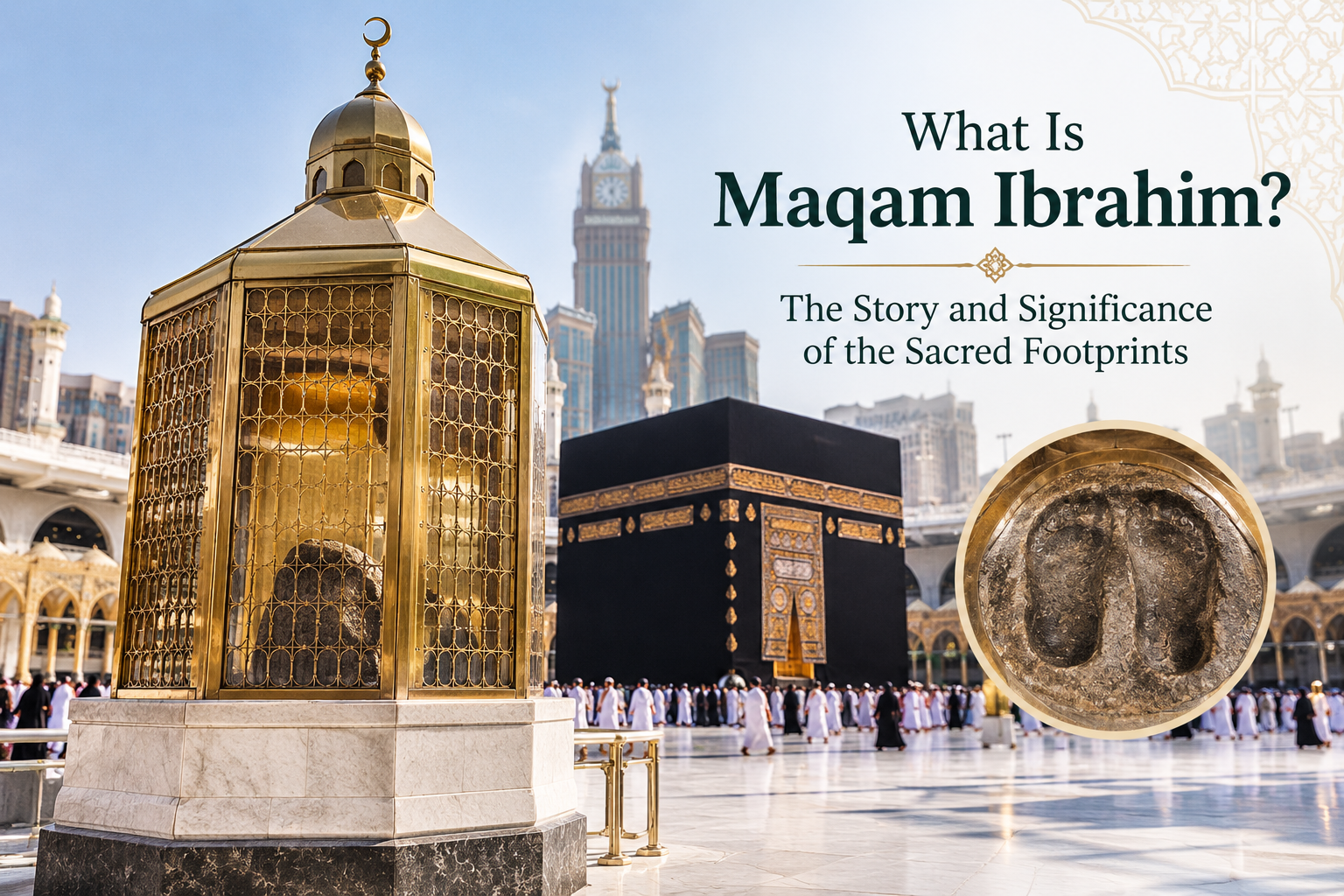
What Is Maqam Ibrahim? Maqam Ibrahim, meaning the “Station of Abraham,” is one of the most revered landmarks in Masjid al-Haram in Makkah. It is a sacred stone associated with Prophet Ibrahim (peace be upon him), who stood upon it while rebuilding the Holy Kaaba with his son, Prophet Ismail (peace be upon him).
Millions of Muslims performing Hajj and Umrah pass this sacred monument while completing Tawaf around the Holy Kaaba. Today, Maqam Ibrahim is preserved inside a golden, glass-fronted enclosure in the Mataf area, where pilgrims can see the historic stone and follow the Sunnah of praying two Raka’at after completing Tawaf.
If you have ever wondered what Maqam Ibrahim actually is, what lies inside the golden enclosure, or why praying behind it carries immense spiritual reward, this comprehensive guide covers its history, religious importance, and step-by-step rituals.
What Is Maqam Ibrahim?
What Is Maqam Ibrahim? Maqam Ibrahim translates to the “Station of Abraham” and refers to a sacred stone upon which Prophet Ibrahim (peace be upon him) stood while rebuilding the upper walls of the Holy Kaaba alongside his son, Prophet Ismail (peace be upon him).
As Prophet Ibrahim raised the foundation of the House of Allah, the stone miraculously softened under his feet, leaving clear, deep imprints of his footprints. Today, this stone is preserved inside a brass and gold-plated crystal enclosure in the Mataf courtyard.
| Key Fact | Detail |
| Location | Mataf area, opposite the entrance door of the Holy Kaaba |
| Enclosure | Golden dome structure made of crystal, glass, and brass |
| Artifact | Square stone bearing the miraculous footprints of Prophet Ibrahim (AS) |
| Core Ritual | Offering two Raka’at of Sunnah prayer after completing Tawaf |
The Miraculous Story Behind Maqam Ibrahim
For those wondering what is Maqam Ibrahim and how it became a sacred part of the Kaaba’s history, Islamic tradition explains that when Allah commanded Prophet Ibrahim (AS) to reconstruct the Kaaba, the walls eventually grew too high for him to reach from the ground.
As the building grew taller, the stone miraculously rose higher into the air to assist Prophet Ibrahim. Whenever he needed to descend or shift positions, the stone moved accordingly. Despite the hard nature of the rock, Allah caused it to soften like dough under Prophet Ibrahim’s weight, preserving the distinct shape of his feet as a lasting sign (Aayah) for future generations.
Significance in the Qur’an and Sunnah
Understanding what is Maqam Ibrahim also means understanding its special place in the Qur’an and the Sunnah. The sacred station is mentioned in the Qur’an and is closely connected with the prayer performed after Tawaf.
Mention in the Holy Qur’an
Allah explicitly commands Muslims in Surah Al-Baqarah (2:125) to offer prayers at this location:
“And take, [O believers], from the standing place of Abraham a place of prayer.”
Additionally, in Surah Ali ‘Imran (3:97), Allah highlights the sanctuary’s clear signs:
“In it are clear signs [such as] the standing place of Abraham. And whoever enters it shall be safe.”
The Prophet’s (PBUH) Example
During his Farewell Pilgrimage, Prophet Muhammad (PBUH) performed seven rounds of Tawaf, walked directly toward Maqam Ibrahim, recited verse 2:125, and offered two Raka’at behind the monument. This established the Sunnah that millions follow to this day.
The Physical Description of the Stone and Enclosure
Over the centuries, the presentation and preservation of Maqam Ibrahim have evolved:
- The Stone: A square-shaped rock measuring approximately 40 centimeters on each side and roughly 20 centimeters in height.
- The Footprints: Two distinct oval-shaped depressions where Prophet Ibrahim’s feet rested. Over centuries of touching by pilgrims prior to its enclosure, the individual toe outlines merged into smooth depressions.
- Modern Enclosure: During the reign of King Faisal bin Abdulaziz, the former large building surrounding the station was removed to clear space for the growing number of pilgrims performing Tawaf. It was replaced with the compact, heat-resistant glass and gold-plated housing seen today.
How to Perform Prayer Behind Maqam Ibrahim
Knowing what is Maqam Ibrahim makes it easier to understand why this location is connected with the prayer performed after Tawaf. Offering two Raka’at behind Maqam Ibrahim is a confirmed Sunnah upon completing the seven circuits of Tawaf during Hajj or Umrah.
- Complete Tawaf: Finish all seven rounds around the Holy Kaaba.
- Move Toward the Station: Step toward Maqam Ibrahim while reciting: “Wattakhithoo min maqaami ibraheema musalla” (Surah Al-Baqarah 2:125).
- Positioning: Stand so that Maqam Ibrahim is situated between you and the Holy Kaaba. If crowding in the Mataf makes a direct spot impossible, you may pray anywhere within Masjid al-Haram.
- Recitation:
- In the first Raka’at (after Surah Al-Fatiha), recite Surah Al-Kafirun.
- In the second Raka’at, recite Surah Al-Ikhlas.
- Proceed to Zamzam: After finalizing the prayer with Taslim, it is Sunnah to drink Zamzam water before heading to Safa and Marwah for Sa’i.
Frequently Asked Questions
For anyone asking what is Maqam Ibrahim and why it matters during Hajj and Umrah, its significance comes from its connection to Prophet Ibrahim (AS) and the rebuilding of the Kaaba. The station also has an important connection with the Sunnah of praying two Raka’at after Tawaf.
What Is Maqam Ibrahim and Why Is It Important?
Maqam Ibrahim is the sacred stone associated with Prophet Ibrahim (AS) and his role in rebuilding the Holy Kaaba. Its importance comes from its mention in the Qur’an and its connection with the Sunnah of praying after Tawaf.
Is it mandatory to touch or kiss Maqam Ibrahim?
No. Touching or kissing the golden enclosure of Maqam Ibrahim is not part of the Sunnah. Pilgrims should avoid pushing or causing disruption in the Mataf to reach the glass structure.
Where should you pray if the area near Maqam Ibrahim is crowded?
If the Mataf is crowded, you do not need to force your way behind the golden structure. You can pray your two Raka’at anywhere within the Haram boundaries, and it will be fully valid.
Are the actual footprints visible today?
The footprints inside the stone are protected inside the sealed golden and crystal vault. Pilgrims passing closely during Tawaf can catch a glance of the stone through the clear glass viewports.
Connect with Sacred History at Home
Understanding what is Maqam Ibrahim helps pilgrims and readers appreciate the connection between the sacred sites of Makkah and the legacy of Prophet Ibrahim (AS). Reflecting on his legacy inspires devotion, sacrifice, and faith. At Kaaba Kiswa, we bring the beauty of Islamic heritage into your living space through premium Islamic wall art, finely crafted prayer rugs, and spiritual home decor inspired by the holy sanctuaries of Makkah and Madinah. Explore our latest collection today to enrich your daily worship environment.