
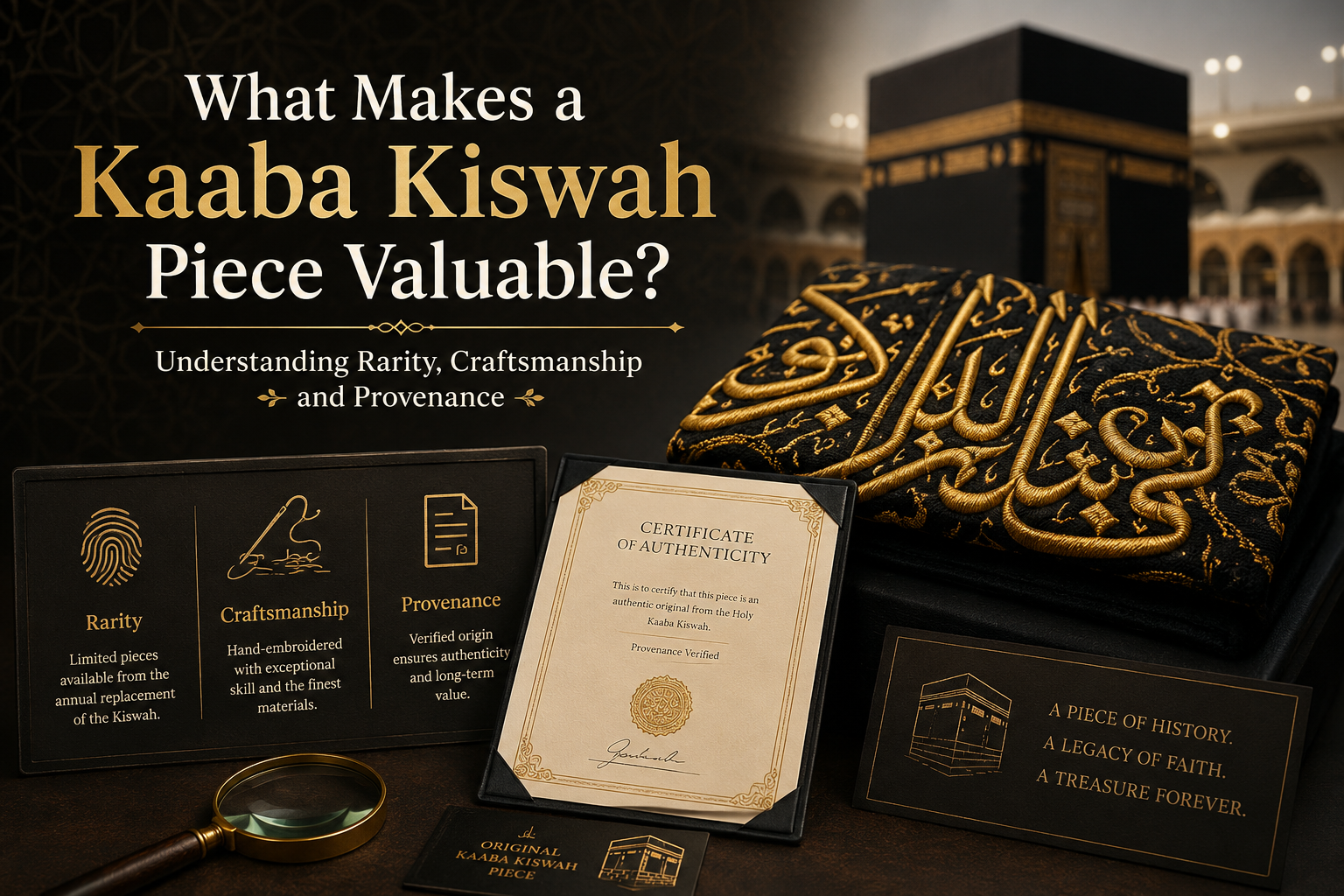
A Kaaba Kiswah fragment is far more than an attractive piece of fabric. For collectors, it can represent Islamic heritage, exceptional textile craftsmanship, and a direct connection with the history of the Holy Kaaba in Makkah.
However, not every black embroidered textile described as Kiswah has the same collectible importance. Factors such as provenance, craftsmanship, condition, rarity, design, size, and documentation can influence how desirable a piece is to collectors.
If you are wondering why Kaaba Kiswah is so valuable, UK collectors should understand these factors before purchasing an alleged authentic fragment.
Why Is the Kaaba Kiswah Valuable?
The Kiswah is the ceremonial covering associated with the Holy Kaaba. A genuine Kaaba Kiswah fragment can therefore carry considerable historical and cultural interest for collectors. Its distinctive appearance comes from dark textile fabric combined with elaborate embroidered Quranic inscriptions and decorative motifs.
Its significance does not come solely from the materials used. The historical and religious association with the Kaaba gives genuine fragments a unique place within Islamic textile collecting.
For collectors, value can therefore come from a combination of:
- Historical association
- Authenticity
- Provenance
- Rarity
- Craftsmanship
- Condition
- Design and embroidery
- Documentation
- Collector demand
A fragment with strong documentation and an identifiable history may be considerably more desirable than an apparently similar textile with no supporting evidence.
Rarity Can Make a Kiswah Fragment More Collectible
One of the biggest questions collectors ask is: What makes a Kaaba Kiswah fragment rare or collectible?
Rarity can relate to several characteristics. A Kaaba Kiswah fragment may be interesting because of the particular section from which it originated, its distinctive embroidery, its age, its documented history, or the limited availability of comparable pieces.
The word “rare,” however, should not be accepted simply because it appears in an online product description.
Collectors should ask what evidence demonstrates rarity. How many comparable examples are known? Is the specific section identifiable? Is its historical background documented?
A genuine claim should be supported by evidence rather than marketing language.
The Importance of Kiswah Craftsmanship
Craftsmanship is another major factor. Examining a Kaaba Kiswah fragment closely can help collectors appreciate its stitching, embroidery, fabric structure and construction details.
The Kiswah is recognised for its detailed decorative work and Quranic calligraphy. Intricate embroidery requires considerable skill, precision, and attention to detail.
Hand embroidered Makkah Kiswah craftsmanship can be particularly interesting to collectors because individual textile characteristics may reveal information about construction and production.
When examining a fragment, look closely at the embroidery, stitching, fabric structure, borders, edges, and reverse side.
High-quality photographs can help buyers examine these details before purchasing online.
Does Gold and Silver Embroidery Increase Value?
The metallic appearance of Kiswah embroidery is one of its most recognisable features. However, buyers should be cautious when interpreting claims about gold or silver content.
Gold-coloured thread does not automatically establish that a textile contains a specific quantity of pure gold.
Different metallic threads and construction methods may produce a similar appearance. Therefore, a seller making claims about precious-metal content should be able to explain the basis for those statements.
For an expensive purchase, professional material assessment may be appropriate if precious-metal composition is an important factor in determining value.
Size Does Not Determine Value Alone
It is tempting to assume that a larger Kiswah fragment must be more valuable than a smaller one.
Size certainly matters, but it is only one part of the evaluation.
A relatively small fragment containing distinctive calligraphy or exceptionally detailed embroidery may attract more collector interest than a larger section with fewer identifying characteristics.
The section’s design, historical context, condition, and documentation should therefore be considered alongside its measurements.
Provenance: The Story Behind the Textile
Provenance is the documented history of an object, and for a Kaaba Kiswah fragment, it can help explain where the textile came from and how it reached its present owner. For an alleged Kiswah fragment, it can help explain where the textile came from and how it reached its present owner.
Potential provenance evidence can include:
- Previous ownership records
- Acquisition documentation
- Historical photographs
- Receipts
- Authentication certificates
- Specialist assessments
- Information identifying the original Kiswah
Strong provenance does not necessarily mean one document proves everything. Instead, several consistent records can collectively create a more convincing history.
How to Verify Kiswah Provenance Documentation UK
Anyone researching how to verify Kiswah provenance documentation UK should examine both the documents and the physical textile.
Start by checking whether the certificate identifies the exact Kaaba Kiswah fragment. Look for dimensions, photographs, descriptions, dates, certificate numbers, issuer information, and material details.
Then investigate the person or organisation that issued the documentation.
If a document claims an official connection with Makkah, buyers should seek appropriate independent confirmation rather than accepting the claim automatically.
The certificate, photographs, product description, and physical piece should all tell the same story.
Condition and Preservation Matter
Silk and embroidered textiles can be sensitive to light, humidity, dust, unsuitable storage, and excessive handling.
A fragment that has been carefully preserved may be more attractive to collectors than one showing extensive deterioration.
These details are particularly important when evaluating a valuable Kaaba Kiswah fragment for long-term collection or display.
If it is already framed, find out how the textile has been mounted. Improper mounting can place stress on delicate fibres.
For valuable pieces, conservation-quality presentation can help protect the textile for the future.
Real Ghilaf e Kaaba Piece Price UK
People searching for Real Ghilaf e Kaaba piece price UK should understand that there is no universal price for every authentic fragment.
The market value of a Kaaba Kiswah fragment can depend on its provenance, size, embroidery, condition, historical background, documentation, and buyer demand.
A seller’s asking price should therefore not be treated as proof of authenticity or rarity.
Likewise, an unusually low price does not necessarily represent a bargain. It may indicate uncertainty about the item’s origin or documentation.
Collectors should evaluate the evidence supporting the item before comparing prices.
Authenticity Should Come Before Price
A genuine heritage textile should be evaluated based on evidence rather than appearance.
A replica can reproduce black fabric, Arabic calligraphy, gold-coloured embroidery, and other visual characteristics associated with the Kiswah.
That does not establish that it was actually part of the Kaaba covering.
Before purchasing, ask the seller to explain the item’s origin, provide relevant documentation, identify the specific fragment, and answer questions about ownership history.
What Collectors Should Check Before Buying
Before purchasing a Kiswah piece online, consider the following checklist:
Authenticity: Is there credible evidence supporting the claim?
Provenance: Is the ownership and acquisition history documented?
Craftsmanship: Does the textile demonstrate distinctive construction and embroidery?
Condition: Has the piece been preserved appropriately?
Dimensions: Do the measurements match the documentation?
Materials: Are claims about silk, gold, or silver supported?
Rarity: Is there evidence supporting claims that the fragment is rare?
Certificate: Does the documentation identify the exact piece?
Seller: Is the seller transparent and willing to answer reasonable questions?
Taking these steps can reduce the risk of buying an item based solely on an attractive description.
Final Thoughts
The value of a Kaaba Kiswah fragment is created by much more than its fabric or decorative appearance. Why are Kaaba Kiswah so valuable to UK collectors ask? The answer lies in the combination of Islamic heritage, craftsmanship, rarity, provenance, condition, and authenticity.
Understanding what makes a Kaaba Kiswah fragment rare or collectible can help buyers distinguish genuine historical significance from marketing claims. Likewise, studying hand embroidered Makkah Kiswah craftsmanship can provide greater appreciation for the skill represented by these textiles.
If you are considering a purchase, always investigate how to verify Kiswah provenance documentation UK and avoid relying on price alone when assessing a Real Ghilaf e Kaaba piece price UK.
Ultimately, evaluating a Kaaba Kiswah fragment requires looking beyond appearance and considering the evidence behind its origin and history. For collectors, the most valuable quality is not simply visual beauty. It is having confidence that the textile’s story, origin, and documentation can withstand careful examination.