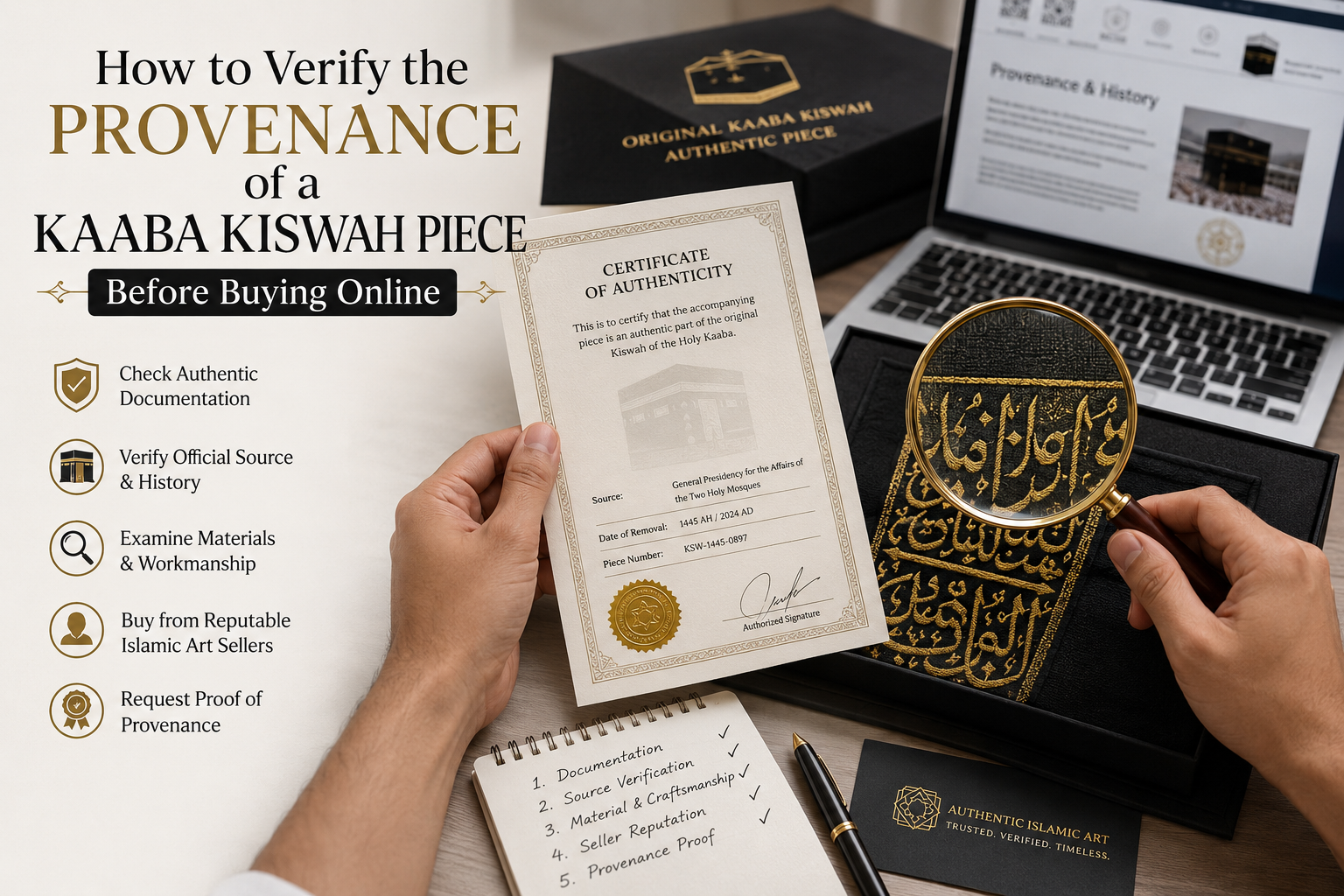
A Kaaba Kiswah provenance record can provide valuable information about the history and authenticity of a Kiswah piece. For collectors and buyers, an authentic fragment can represent an important connection to Islamic heritage, Makkah, and the craftsmanship associated with the covering of the Holy Kaaba.
However, buying a Kiswah piece online requires careful research. Photographs, impressive descriptions, certificates, and claims about precious-metal embroidery should not be accepted without examination.
If you are learning how to verify authentic Kaaba Kiswah UK sellers offer, provenance should be one of the first things you investigate. Provenance helps establish where a piece came from, how it was transferred between owners, and what evidence supports its claimed history.
What Does Provenance Mean for a Kiswah Piece?
Provenance is the documented history of an object. For a Kaaba Kiswah fragment, a Kaaba Kiswah provenance record can provide information connecting the textile with its claimed origin and documenting its ownership or acquisition history.
Useful provenance evidence may include:
- Previous ownership records
- Acquisition documentation
- Historical photographs
- Receipts or transaction records
- Authentication certificates
- Detailed descriptions of the fragment
- Information about its original Kiswah
- Records connecting the piece with a recognised source
A certificate by itself may not establish a complete provenance history. Buyers should consider all available evidence together.
Why Provenance Matters Before Buying
When buying original Kiswah cloth online UK, checking the Kaaba Kiswah provenance can help distinguish a genuinely documented heritage textile from an item that simply resembles Kiswah.
Black fabric with gold-coloured Arabic embroidery can be reproduced commercially. Visual similarity therefore cannot establish that a particular textile was actually used as part of the Kaaba covering.
A transparent seller should be willing to explain the history of the piece and provide documentation supporting important claims.
Check the Certificate Carefully
A certificate of authenticity can be useful when assessing Kaaba Kiswah provenance, but buyers should inspect its details rather than relying on its title alone.
A useful certificate should identify the particular item being sold. Look for information such as:
- Certificate number
- Date of issue
- Dimensions
- Material description
- Photograph or identifying reference
- Description of embroidery
- Provenance information
- Issuer’s name and credentials
- Signature or authentication details
The information should correspond with the actual textile.
For example, if the certificate identifies a particular size but the piece being offered has substantially different measurements, the seller should be able to explain the discrepancy.
Investigate the Issuing Organisation
One of the most important steps in Kaaba Kiswah provenance documentation UK research is checking who issued the paperwork.
A document containing Arabic text, seals, logos, or references to Makkah should not automatically be assumed to be an official document.
Research the issuing organisation independently. Check whether it exists, what authority it has, and whether its stated role matches the claims made by the seller.
If a seller says that documentation originated from a particular institution, ask whether the claim can be independently confirmed.
Examine the Physical Piece
Online buyers cannot always handle the textile before purchasing, making detailed photographs especially important when evaluating Kaaba Kiswah provenance and the condition of the fragment.
Ask for clear images showing the:
- Front surface
- Reverse side
- Edges
- Seams
- Embroidery
- Fabric weave
- Labels or markings
- Backing materials
- Areas of wear
Close-up photographs can reveal construction details that are difficult to notice in standard product images.
The physical piece should also correspond with the description and photographs supplied by the seller.
Be Careful With Claims About Gold Thread
Kiswah embroidery is famous for its striking metallic appearance, but appearance alone cannot establish the precise composition of the thread.
People searching for real gold thread embroidery Kaaba Kiswah UK should ask exactly what the seller means by “gold thread.”
A gold-coloured thread, gold-plated material, metallic thread, and solid precious-metal component are not necessarily the same thing.
If a seller claims that a particular amount of gold is present, ask what evidence supports the claim. For high-value purchases, an appropriate independent specialist assessment may be worth considering.
Do not calculate the value of embroidery simply from its colour or appearance in photographs.
Ask About the Kiswah’s History
A serious buyer should ask specific questions about the fragment’s history and Kaaba Kiswah provenance before completing a purchase.
For example:
Which Kiswah did this piece come from?
When and how was the fragment acquired?
Who previously owned it?
Is there documentation supporting that ownership history?
Does the certificate refer specifically to this piece?
Are there photographs showing the item before it was framed or mounted?
Detailed answers are generally more useful than broad statements such as “genuine Makkah piece.”
Verify Measurements and Description
Dimensions are an easy detail to compare when checking Kaaba Kiswah provenance and determining whether the documentation matches the physical textile.
Measure the actual textile against the measurements stated in the listing and certificate. Also compare the embroidery pattern, shape, borders, colours, and other identifying characteristics.
If the seller provides photographs of the exact item, look for consistency between those photographs and the piece described in the documentation.
Small differences may have reasonable explanations, particularly where textiles have been trimmed, mounted, or conserved. Unexplained major differences deserve further investigation.
Understand the Difference Between Original and Replica
The market contains many beautiful Kaaba-inspired textiles that are reproductions. A replica can reproduce the appearance of Kiswah without having any historical connection to the Kaaba.
There is nothing inherently wrong with purchasing decorative Islamic artwork or a replica when it is honestly described.
The problem arises when a reproduction is marketed as an authentic heritage fragment.
Therefore, ask the seller directly whether the item is:
- An original Kiswah fragment
- A reproduction
- A contemporary Islamic textile
- A decorative piece inspired by the Kiswah
Clear terminology helps buyers make informed decisions.
Where to Buy Certified Kaaba Kiswah in the UK
If you are researching where to buy certified Kaaba Kiswah in the UK, compare specialist sellers carefully.
A responsible seller should provide meaningful product information, clear photographs, authentication documentation, Kaaba Kiswah provenance details, contact information, and transparent purchasing policies.
Do not choose a seller solely because a product is described as “rare,” “museum quality,” or “official.”
Instead, evaluate the evidence supporting the claim.
Independent reviews and the seller’s history can also provide useful context, although reviews should not replace authentication.
Check Ownership and Legal Considerations
Buyers should also consider whether the seller can demonstrate legitimate ownership of the textile and provide evidence supporting its Kaaba Kiswah provenance.
Ask how the piece entered the seller’s collection and whether relevant transfer or acquisition documentation exists.
For expensive heritage items, buyers may wish to obtain professional legal or specialist advice regarding ownership, importation, taxation, and other applicable requirements.
Do not assume that an online listing is legally sourced simply because it includes a certificate.
Watch for Red Flags
Certain warning signs should encourage additional caution when assessing Kaaba Kiswah provenance before making a purchase.
Be careful when:
- Provenance is completely absent
- The seller refuses reasonable questions
- Documentation is generic
- Certificate details do not match the item
- The issuer cannot be identified
- Only heavily edited photographs are provided
- Gold-content claims have no supporting evidence
- The seller creates pressure to pay immediately
- Authenticity claims are unusually vague or exaggerated
A genuine collector should have enough information to investigate before committing significant funds.
A Practical Verification Checklist
Before purchasing a Kiswah fragment online, work through this checklist:
1. Identify the exact textile.
Confirm its dimensions, design, embroidery, and distinguishing characteristics.
2. Request provenance.
Ask for documentation explaining its ownership and acquisition history.
3. Examine the certificate.
Check whether it identifies the exact piece and contains verifiable issuer information.
4. Investigate the issuer.
Research the organisation or individual independently.
5. Compare photographs.
Ensure the certificate, listing, and physical textile correspond.
6. Question material claims.
Request evidence for statements about silk, gold, silver, or other valuable materials.
7. Review the seller.
Look for transparent business information and a credible history.
8. Understand the transaction.
Check returns, shipping, insurance, and other purchasing terms.
9. Seek independent advice for expensive pieces.
A specialist assessment may provide additional confidence.
Should You Buy Without Complete Provenance?
For a low-cost decorative item, extensive provenance may not be necessary. However, when an item is being sold as an original Kaaba Kiswah fragment at a significant price, documentation becomes much more important.
If a seller cannot explain the item’s history or refuses to provide reasonable evidence, buyers should consider whether the risk is justified.
Patience is valuable when purchasing heritage textiles. Walking away from an uncertain transaction is usually better than trying to resolve authenticity questions after payment.
Final Thoughts
Learning how to verify authentic Kaaba Kiswah UK sellers offer requires more than inspecting photographs. Buyers should investigate provenance, certificates, ownership history, physical characteristics, material claims, and the reputation of the seller.
When buying original Kiswah cloth online UK, documentation should correspond with the exact piece being offered. Kaaba Kiswah provenance documentation UK should provide meaningful evidence rather than simply making an unsupported authenticity claim.
If you are looking for where to buy certified Kaaba Kiswah in the UK, choose transparency over pressure and evidence over appearance. Likewise, claims involving real gold thread embroidery Kaaba Kiswah UK should be supported by credible information rather than assumptions based on colour or visual presentation.
A genuine Kiswah fragment carries cultural and historical significance that cannot be measured by appearance alone. Taking time to verify its provenance before purchasing can help collectors make a more informed and confident decision.