
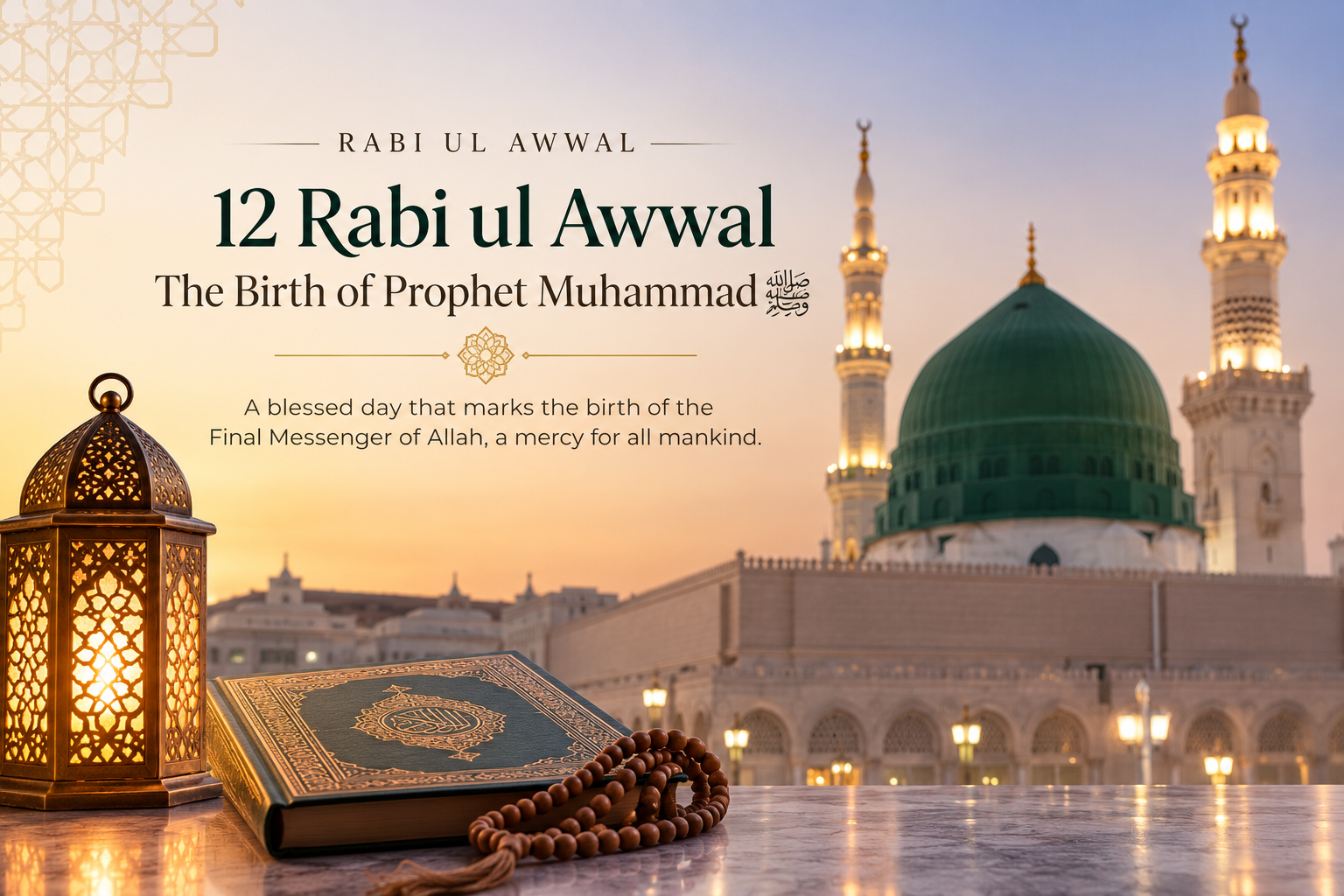
Rabi ul Awwal is the third month of the Islamic Hijri calendar and is closely connected with important moments from the life of Prophet Muhammad ﷺ. Among Muslims, 12 Rabi ul Awwal is particularly well known because it is traditionally regarded by many as the date of his birth.
The subject deserves careful explanation because historical sources do not unanimously establish the exact date of the Prophet’s ﷺ birth. Different Muslim communities also have different views about Mawlid and how, or whether, it should be commemorated.
What Is 12 Rabi ul Awwal?
12 Rabi ul Awwal means the twelfth day of Rabi ul Awwal. Since the Hijri calendar follows lunar cycles, its dates move through the Gregorian calendar each year.
For 12 Rabi ul Awwal 2026, many published Islamic calendars place the date on 25 August 2026. However, the date followed by a particular community can differ because Islamic months may be established through different calendar calculations or moon-sighting methods.
The historical date of the Prophet’s ﷺ birth is also debated. While 12 Rabi ul Awwal is extremely well known, other dates have been mentioned by scholars and historians.
The Birth of Prophet Muhammad ﷺ
Prophet Muhammad ﷺ was born in Makkah among the Quraysh. His father, Abdullah, passed away before his birth, and his mother was Aminah bint Wahb.
His early years were marked by hardship and loss. His mother died when he was still young, after which he was cared for first by his grandfather and later by his uncle Abu Talib.
The Prophet ﷺ eventually became the Messenger of Allah, receiving the first revelation at the age of forty. His mission transformed the religious and social history of Arabia and ultimately influenced communities across the world.
What Day Was the Prophet ﷺ Born?
There is stronger evidence concerning the weekday of his birth than the precise date of the month.
In an authentic hadith recorded in Sahih Muslim, the Prophet ﷺ explained that Monday was the day on which he was born. He also mentioned Monday in connection with the beginning of revelation.
Therefore, Monday is firmly connected with his birth through authentic evidence, while the exact day of Rabi ul Awwal remains a historical discussion.
Why Is 12 Rabi ul Awwal Celebrated?
The question Why is 12 Rabi ul Awwal celebrated has no single answer accepted by every Muslim community.
Many Muslims who observe Mawlid regard the date as an opportunity to remember the Prophet ﷺ and express gratitude for his message. Their gatherings may involve Seerah lessons, Quran recitation, religious talks, poetry, Nasheeds, charity, and meals.
Other Muslims do not regard Mawlid as an established annual religious occasion. They may believe that the earliest generations of Muslims did not celebrate the Prophet’s ﷺ birth in this manner and therefore choose not to establish a yearly observance.
Both approaches exist among Muslims, making it important to discuss Mawlid without assuming that every Muslim observes it.
Significance of 12 Rabi ul Awwal in Islam
The Significance of 12 Rabi ul Awwal in Islam is largely connected with the Prophet’s ﷺ life and the opportunity to study his example.
Muslims regard Muhammad ﷺ as the final Messenger of Allah. His life demonstrates important Islamic qualities, including truthfulness, patience, compassion, courage, forgiveness, humility, and justice.
For many families, Rabi ul Awwal becomes a time to introduce children to the Seerah. Adults may also use the month to read biographies, study hadith, attend educational programmes, and reflect upon the Prophet’s ﷺ conduct.
The value of such learning does not depend on one particular day. The Prophet’s ﷺ example remains relevant throughout the entire year.
The Year of the Elephant
The Prophet ﷺ was born during the period traditionally identified as the Year of the Elephant.
This name comes from the reported expedition of Abraha toward Makkah with an army that included elephants. The purpose of the expedition was connected with an attempt to attack the Kaaba.
Surah Al-Fil refers to this event and describes Allah’s protection of the Sacred House.
The connection between the Prophet’s ﷺ birth and the Year of the Elephant places his birth within an important chapter of Arabian history and the history of Makkah.
How to Celebrate Mawlid al-Nabi in Accordance with Sunnah?
The question: How to celebrate Mawlid al-Nabi in accordance with Sunnah? requires recognising the disagreement surrounding Mawlid itself.
There is no universally accepted prescribed Sunnah ceremony specifically for 12 Rabi ul Awwal. Muslims who commemorate Mawlid may choose activities that are independently recognised as beneficial, such as learning about the Seerah, giving charity, feeding others, remembering Allah, and sending blessings upon the Prophet ﷺ.
Such activities should not be described as compulsory when there is no evidence making them obligatory.
Muslims who do not observe Mawlid may instead dedicate themselves to studying the Prophet’s ﷺ teachings throughout the year.
Stories About the Prophet’s Birth
Many popular books and speeches mention extraordinary incidents said to have occurred around the Prophet’s ﷺ birth.
Some accounts describe unusual happenings involving rulers, religious fires, buildings, or other signs. However, these stories do not all have equal historical strength.
A responsible approach is to distinguish between information established through authentic sources and later narratives whose reliability is uncertain.
The Quran itself remains the greatest miracle associated with Prophet Muhammad ﷺ, and his Prophethood does not depend upon accepting every story circulated about the circumstances of his birth.
Remembering His Character
The most valuable way to remember the Prophet ﷺ is to understand how he lived.
He was known for honesty and trustworthiness before receiving revelation. During his mission, he experienced persecution and tremendous personal difficulties.
Despite these challenges, his life demonstrated compassion toward the vulnerable, patience during hardship, fairness in dealings, forgiveness, and devotion to Allah.
Studying these qualities gives Rabi ul Awwal a practical meaning. Remembrance can become an incentive to improve personal behaviour rather than remaining limited to a calendar date.
Eid Milad un Nabi Mubarak
The expression Eid Milad un Nabi Mubarak is commonly exchanged by Muslims who participate in Mawlid traditions.
For these communities, it functions as a greeting associated with remembering the Prophet’s ﷺ birth.
However, the term “Eid” can have different implications in Islamic discussion, and not every Muslim regards Mawlid as a religious Eid. Some therefore do not use this greeting.
Understanding these differences helps maintain respect between communities with different interpretations.
How Families Can Use Rabi ul Awwal for Learning
Rabi ul Awwal can provide families with an opportunity to study the Prophet’s ﷺ biography together.
Parents can share age-appropriate stories about his childhood, honesty, family relationships, migration, community leadership, and treatment of others.
Children can also learn simple lessons from his character, such as speaking truthfully, helping people, showing patience, and treating parents and neighbours with kindness.
Adults can explore reliable historical works and authentic hadith to develop a deeper understanding of his life.
Is Rabi ul Awwal One of the Sacred Months?
Rabi ul Awwal is not one of Islam’s four officially designated sacred months.
The four sacred months are Dhul-Qadah, Dhul-Hijjah, Muharram, and Rajab.
Therefore, Rabi ul Awwal should not be described as a sacred month in the technical sense used in Islamic sources.
Its importance instead comes from its historical association with Prophet Muhammad ﷺ and significant events in his life.
Final Thoughts
12 Rabi ul Awwal has a special place in the traditions of many Muslim communities because it is widely associated with the birth of Prophet Muhammad ﷺ. The commonly published date for 12 Rabi ul Awwal 2026 is 25 August, although local calendars and moon-sighting practices may result in different dates.
Understanding Why is 12 Rabi ul Awwal celebrated requires awareness of the different positions Muslims hold regarding Mawlid. Some commemorate the occasion, while others do not regard an annual celebration as part of Islamic practice.
The Significance of 12 Rabi ul Awwal in Islam can therefore be explored through the Prophet’s ﷺ history, character, teachings, and legacy.
For those who observe Mawlid, the occasion can encourage learning, charity, remembrance, and reflection. For those who do not, studying the Seerah and following the Prophet’s ﷺ example remain important throughout the year.
Ultimately, understanding the life of Prophet Muhammad ﷺ is far more significant than focusing solely on a particular date. His message, character, and example continue to hold lasting importance for Muslims around the world.