
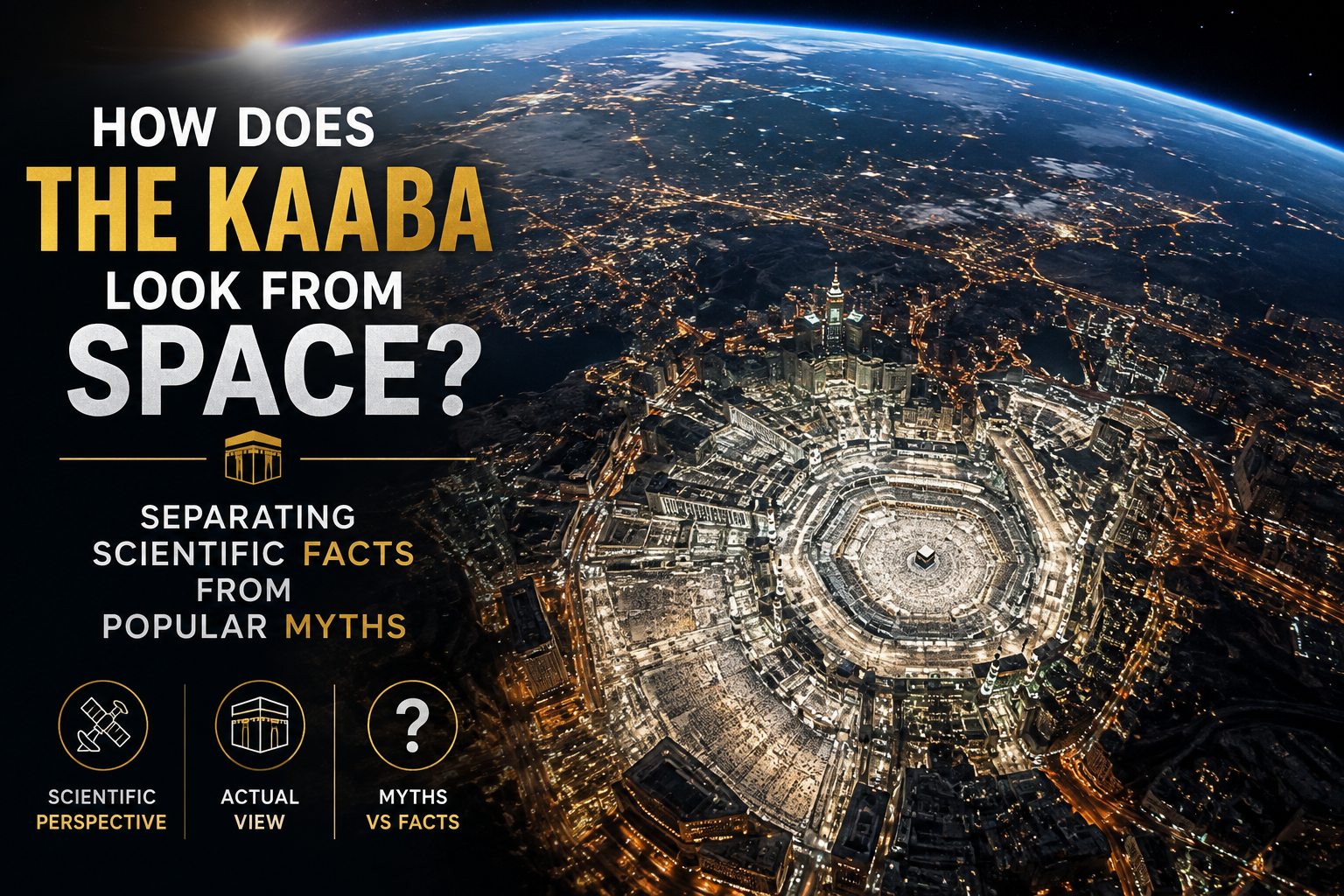
For centuries, the Holy Kaaba has inspired awe among Muslims across the world. As the spiritual centre of Islam and the direction of daily prayer, it holds unmatched religious significance. In recent years, curiosity has extended beyond its history and architecture to an unusual question: Can you see the Kaaba from space? Social media posts, edited satellite images, and viral videos often make extraordinary claims about the Kaaba being visible from orbit or emitting a mysterious light that can be seen from space. While these stories attract millions of views, many of them blur the line between faith and scientific reality. Many readers wonder, “Can you see the Kaaba from space?” This question has become one of the most searched topics about the Holy Kaaba in recent years.
Understanding what astronauts and satellites can actually observe helps separate verified facts from popular myths. Science does not diminish the importance of the Kaaba; instead, it provides an accurate explanation of how modern imaging technology captures one of the world’s most visited religious sites. In this article, we’ll examine the evidence, explore satellite imagery, and explain why the Grand Mosque appears the way it does when viewed from above. Many readers ask, “Can you see the Kaaba from space?” because social media often presents conflicting information. Understanding the scientific facts helps answer this question accurately while respecting the Kaaba’s spiritual significance.
Why This Question Has Become So Popular
The internet has transformed the way people learn about famous landmarks. High-resolution satellite imagery is now available to anyone with an internet connection, making it easy to explore cities, mountains, deserts, and even sacred sites from above.
As interest in Makkah has grown, many people have begun searching for answers to questions such as Can you see the Kaaba from space? Some believe the Kaaba shines with a supernatural light visible from orbit, while others assume it appears as a bright beacon among surrounding buildings.
These ideas are widely shared online, but they often lack scientific evidence. To understand the truth, it is important to know how satellites and astronauts observe Earth.
The question “Can you see the Kaaba from space?” continues to trend because many online videos and images claim to show extraordinary views of the Holy Kaaba from orbit.
How Objects Appear from Space
When people imagine “space,” they often picture astronauts looking directly down at Earth with perfect clarity. In reality, the answer depends on altitude, lighting conditions, weather, camera equipment, and the size of the object being viewed. Before answering “Can you see the Kaaba from space?”, it is important to understand how satellites and astronauts observe objects on Earth from different altitudes.
The Grand Mosque Makkah from orbit can certainly be photographed using modern satellites equipped with powerful cameras. Commercial satellite systems capture detailed images of cities, airports, stadiums, and other large structures. Since Masjid al-Haram covers a vast area, it is clearly identifiable in these images. To answer “Can you see the Kaaba from space?”, it is essential to understand how satellite cameras differ from human eyesight in orbit.
The Kaaba itself, however, occupies only a small portion of the mosque’s central courtyard. To distinguish it clearly, high-resolution imaging is required. Standard photographs taken from the International Space Station or by astronauts without magnification generally show the mosque complex rather than fine architectural details.
This distinction is important because many online posts confuse the visibility of the Grand Mosque with the visibility of the Kaaba as an individual structure.
Can You See the Kaaba from Space?
The short answer is yes—but with important qualifications.
If the phrase Can you see the Kaaba from space? refers to satellite imagery captured using specialised cameras, the answer is yes. Modern Earth-observation satellites can produce images detailed enough to identify the Kaaba within Masjid al-Haram.
However, if the question refers to whether astronauts can easily recognise the Kaaba with the naked eye while orbiting Earth, the answer is generally no. From hundreds of kilometres above the planet, the human eye cannot distinguish such a relatively small structure without optical assistance.
This scientific explanation differs from many viral claims, yet it does not lessen the Kaaba’s religious importance. Its significance comes from faith and history, not from extraordinary visual effects observed from space.
Scientific Facts About the Kaaba Location
One of the most interesting scientific facts about the Kaaba location is its setting within the heart of Makkah. The Kaaba stands at the centre of Masjid al-Haram, one of the largest mosque complexes in the world. Over the decades, continuous expansion projects have dramatically increased the size of the surrounding mosque to accommodate millions of worshippers during Hajj and Umrah.
From satellite imagery, the mosque is easy to identify because of its distinctive open white marble courtyard enclosed by large architectural structures. The Kaaba appears as a small black cube positioned at the centre of this expansive open area.
Its location is therefore scientifically identifiable through mapping technology, satellite photography, and geographic coordinates. There is no mystery surrounding its position; it has been accurately documented using modern surveying techniques and global navigation systems.
These geographical facts also explain why the answer to “Can you see the Kaaba from space?” depends largely on the type of imaging technology being used. These scientific facts help explain why people often ask, “Can you see the Kaaba from space?”, and why the answer depends on the technology being used.
Kaaba Light Emission Myth vs Reality
Among the most persistent online stories is the claim that the Kaaba emits a unique light visible from outer space. This belief has circulated for years through edited photographs, inspirational videos, and social media messages.
The discussion surrounding the Kaaba light emission myth vs reality deserves careful attention.
Scientifically, there is no verified evidence showing that the Kaaba produces a special beam of light detectable by satellites or astronauts. No recognised space agency or scientific institution has reported such a phenomenon.
Many viral images claiming to show glowing light above the Kaaba are digitally enhanced, artistically modified, or created for symbolic purposes rather than scientific documentation. Others capture reflections, exposure effects, or bright lighting installed around Masjid al-Haram during night-time photography.
Understanding the difference between symbolic artwork and authentic satellite imagery helps prevent misinformation while encouraging appreciation based on verified facts.
Looking Beyond the Myths
The fascination with the Kaaba is understandable. It is not only the holiest site in Islam but also one of the world’s most recognised religious landmarks. However, its spiritual value does not depend on extraordinary scientific claims.
The true significance of the Kaaba lies in its role as the Qiblah for Muslims worldwide, its connection to Prophet Ibrahim (AS) and Prophet Ismail (AS), and the millions of believers who gather around it each year in worship.
By approaching these topics with both faith and factual understanding, we gain a deeper appreciation for the Sacred House without relying on myths that cannot be supported by evidence.
Why Makkah Looks Bright from Space
Another topic that frequently appears online is Why Makkah looks bright from space. Some people interpret the brightness as evidence of a supernatural glow surrounding the Kaaba, while others believe it is caused by the city’s unique geographical location. In reality, the explanation is much simpler and supported by science.
Masjid al-Haram is one of the largest illuminated religious complexes in the world. Thousands of high-powered lights are installed throughout the mosque to ensure safe movement for worshippers during day and night, especially during Ramadan, Hajj, and Umrah seasons. These lights reflect off the vast white marble courtyards, making the mosque stand out in nighttime satellite images.
The surrounding urban development of Makkah also contributes to its visibility. Roads, hotels, commercial buildings, and transportation networks create a dense concentration of artificial lighting, making the city appear brighter than many nearby desert regions.
Therefore, the brightness seen in satellite photographs is primarily the result of extensive lighting infrastructure rather than an unexplained physical phenomenon. Some people mistakenly believe this brightness answers the question “Can you see the Kaaba from space?”, but lighting and image resolution are the real reasons.
Grand Mosque Makkah from Orbit
Viewing the Grand Mosque Makkah from orbit provides an impressive perspective of one of the world’s busiest religious destinations. From hundreds of kilometres above Earth, the mosque’s circular flow of pilgrims, expansive courtyards, and surrounding cityscape create a distinctive pattern that is easily recognised in high-resolution satellite imagery.
The mosque has expanded significantly over the last several decades to accommodate the growing number of pilgrims. These developments include larger prayer areas, additional entrances, pedestrian bridges, and modern facilities designed to improve safety and accessibility.
From orbit, these architectural features are much easier to appreciate because they reveal the scale of the entire complex rather than the close-up details experienced by visitors on the ground. Anyone searching “Can you see the Kaaba from space?” should understand that the entire mosque complex is much easier to identify than the Kaaba alone.
How Satellites Capture Images of the Kaaba
Modern Earth-observation satellites rely on advanced optical sensors rather than ordinary cameras. Their ability to capture detailed images depends on several factors, including altitude, atmospheric conditions, lighting, and image resolution.
When skies are clear, commercial satellites can record highly detailed photographs of major landmarks across the globe. Since Masjid al-Haram occupies a large area within central Makkah, it is relatively easy to locate in these images.
The Kaaba itself becomes visible because it contrasts sharply with the bright marble courtyard surrounding it. Its black Kiswah covering creates a distinct visual reference point at the centre of the mosque.
This visibility is entirely consistent with modern imaging technology and should not be confused with claims that the Kaaba emits light or possesses unusual physical properties detectable from space.
This is why experts explain that the answer to “Can you see the Kaaba from space?” is yes when using high-resolution satellite imagery, but not necessarily with the naked eye from orbit. Modern technology clearly demonstrates that “Can you see the Kaaba from space?” has a scientific answer based on image resolution rather than myth.
Faith and Science Can Exist Together
Discussions about the Kaaba often combine religious belief with scientific curiosity. While faith explains the spiritual importance of the Sacred House, science explains how it appears when viewed from satellites, aircraft, or orbiting spacecraft. Whether people ask “Can you see the Kaaba from space?” out of curiosity or faith, reliable scientific evidence provides the most accurate explanation.
Accepting scientific explanations does not reduce the Kaaba’s significance. Muslims honour the Kaaba because Allah designated it as the Qiblah and because of its connection to Prophet Ibrahim (AS) and Prophet Ismail (AS). These beliefs stand independently of whether the structure is visible from space or whether photographs reveal particular lighting effects.
Understanding verified information allows believers to appreciate both the spiritual and physical aspects of this remarkable place without relying on unsupported stories.
Common Misconceptions About the Kaaba
The internet has made information more accessible than ever, but it has also increased the spread of myths. Here are a few examples often shared online:
- Myth: The Kaaba emits a beam of light visible from outer space.
Reality: No scientific evidence or recognised space agency has confirmed this claim. - Myth: Astronauts can easily identify the Kaaba with the naked eye from orbit.
Reality: Astronauts generally rely on cameras and optical equipment to observe smaller landmarks on Earth. - Myth: The brightness of Makkah proves a supernatural light source.
Reality: The city’s powerful lighting systems and reflective marble surfaces explain why it appears bright in many satellite images.
Much of the confusion surrounding “Can you see the Kaaba from space?” comes from edited images and unsupported claims shared online. Knowing the difference between verified facts and internet myths helps preserve both knowledge and respect for this sacred site.
Appreciating the Kaaba Beyond the Images
Whether viewed from the ground, through satellite imagery, or in educational documentaries, the Kaaba remains one of the most meaningful landmarks in the world for Muslims. Although many people search online asking, “Can you see the Kaaba from space?”, its true importance goes far beyond what satellites or cameras can capture.
Its importance cannot be measured by how clearly it appears in photographs. Instead, it lies in its role as the direction of prayer for billions of Muslims across generations and as the focal point of Hajj and Umrah.
For those unable to visit Makkah immediately, learning about the Kaaba through reliable educational resources, historical studies, and authentic imagery can deepen understanding while strengthening anticipation for a future pilgrimage.
Conclusion
Questions such as Can you see the Kaaba from space? continue to inspire curiosity among Muslims and non-Muslims alike. Modern satellite technology confirms that the Grand Mosque Makkah from orbit can be identified with remarkable clarity, while high-resolution imagery can also reveal the Kaaba itself. However, these observations should not be confused with unsupported claims surrounding the Kaaba light emission myth vs reality.
Understanding Scientific facts about the Kaaba location helps separate evidence from speculation. Likewise, knowing why Makkah looks bright from space reveals that advanced lighting systems, reflective marble, and the city’s extensive development provide a practical explanation for its appearance in nighttime images.
At Kaaba Kiswa, we believe that knowledge and faith complement one another. By exploring authentic history, verified scientific information, and the timeless significance of the Holy Kaaba, readers can develop a deeper appreciation for Islam’s most sacred site. The Kaaba’s true greatness is not defined by extraordinary claims but by the enduring devotion of millions who turn towards it in prayer every day and aspire to visit it at least once in their lifetime.
Ultimately, the answer to “Can you see the Kaaba from space?” is based on modern satellite technology, while the Kaaba’s true importance remains its spiritual significance for Muslims worldwide.
As technology continues to improve, satellite imagery and space exploration will offer even clearer views of our world. Yet no image from orbit can fully capture the spiritual experience of standing before the Kaaba, hearing the call to prayer echo through Masjid al-Haram, and witnessing the unity of believers gathered around the Sacred House in worship.