
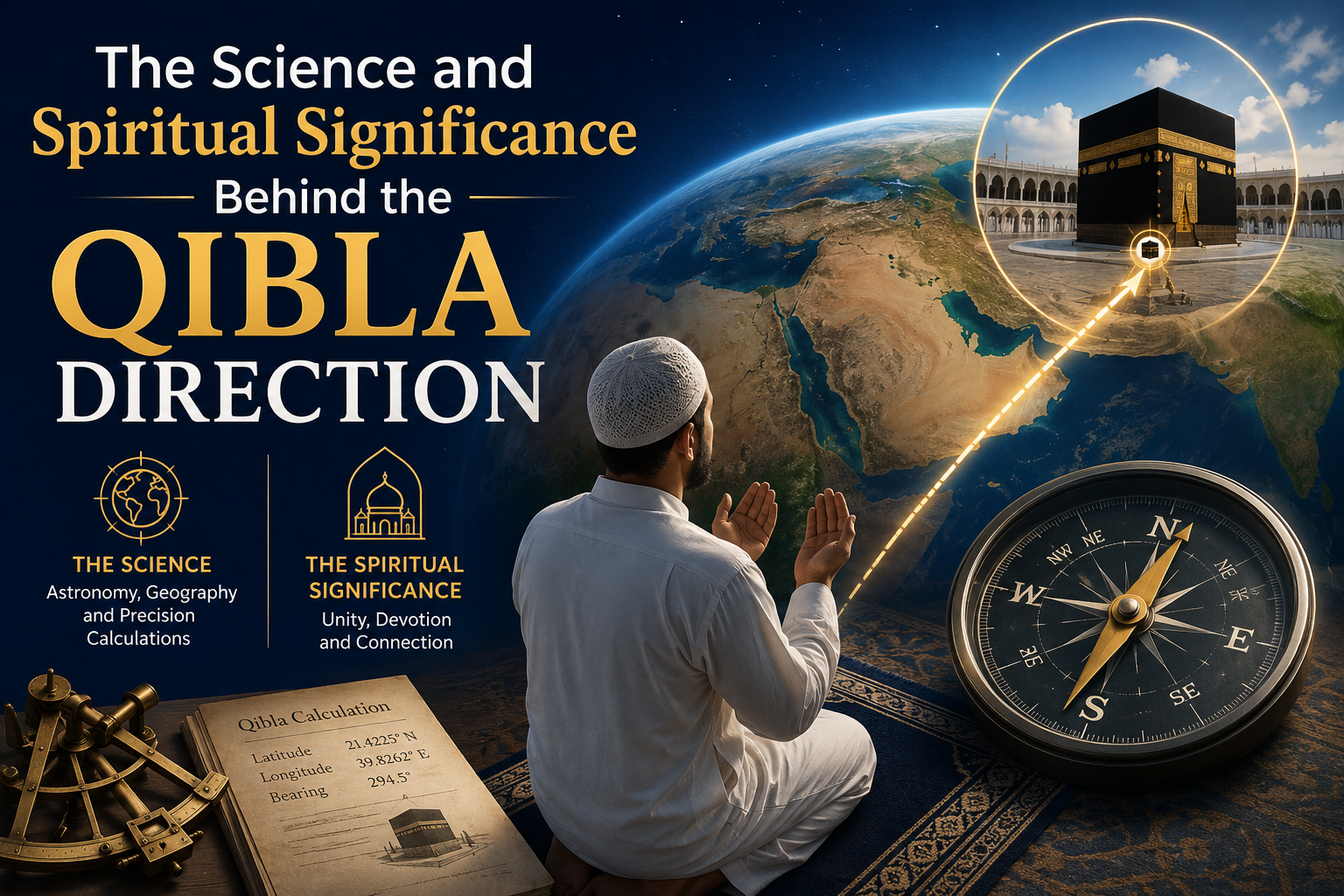
Every day, millions of Muslims around the world stand in prayer facing a single direction—the Holy Kaaba in Makkah. This direction, known as the Qibla, unites Muslims regardless of their language, nationality, or location. Whether someone is praying in London, Manchester, Birmingham, or elsewhere, every act of Salah is performed while facing the same sacred point.
For many people, the Qibla represents far more than geographical orientation. It symbolises unity, obedience to Allah, and a shared connection with the House of Allah. At the same time, modern technology and geographical science have made determining the Qibla more accurate than ever before, leading many people to explore the science behind Qibla direction alongside its deep religious significance.
This guide explains the Science Behind Qibla Direction, the history of Qibla change, explores the spiritual meaning of facing the Kaaba, discusses the scientific methods used to determine prayer direction, and explains how to find Qibla direction in the UK accurately.
What Is the Qibla?
The Qibla is the direction Muslims face while performing their five daily prayers. It points towards the Holy Kaaba, located within Masjid al-Haram in Makkah, Saudi Arabia.
Facing the Qibla is one of the essential requirements for Salah whenever possible. Regardless of where Muslims live, every prayer performed across the world is directed towards the same sacred structure. This shared direction creates a remarkable sense of unity among the global Muslim community.
Although Muslims live across different continents and cultures, the Qibla reminds believers that they worship one Allah and belong to one Ummah.
The History of Qibla Change
Understanding the history of Qibla change provides valuable insight into one of the significant moments in early Islamic history.
During the early period of Islam, Muslims initially prayed facing Bayt al-Maqdis (Jerusalem). This continued for approximately sixteen to seventeen months after the migration of Prophet Muhammad ﷺ to Madinah.
Later, Allah revealed verses instructing the Prophet ﷺ to turn towards the Holy Kaaba in Makkah. This command permanently established the Kaaba as the Qibla for Muslims everywhere. The change reinforced the unique identity of the Muslim community while restoring the Kaaba to its central role in Islamic worship, a role connected with Prophet Ibrahim (AS).
Since that moment, Muslims across the world have continued to face the Kaaba during every obligatory and voluntary prayer.
The Spiritual Meaning of Facing the Kaaba
The spiritual meaning of facing the Kaaba extends far beyond physical direction. Muslims do not worship the Kaaba itself. Rather, they worship Allah alone, while the Kaaba serves as the divinely appointed focal point for prayer.
Facing a common direction symbolises unity, discipline, equality, and obedience. Whether someone is wealthy or poor, young or old, every believer stands shoulder to shoulder facing the same sacred point.
The Qibla also reminds Muslims of the legacy of Prophet Ibrahim (AS), whose devotion and submission to Allah remain an example for believers throughout history. Every prayer reinforces this spiritual connection while strengthening the sense of belonging to the worldwide Muslim community.
For many believers, simply knowing that millions of Muslims are praying towards the same point at the same time creates a profound feeling of unity and faith.
The Science Behind Qibla Direction
The Science Behind Qibla Direction continues to evolve through satellite navigation, digital mapping, and advanced GPS systems, allowing Muslims around the world to identify the correct direction for Salah with remarkable accuracy. The science behind Qibla direction combines geography, astronomy, mathematics, and modern navigation technology. Determining the shortest direction between any location on Earth and the Holy Kaaba requires accurate geographical calculations based on the Earth’s curved surface.
Historically, Muslim scholars relied on astronomical observations, the position of the sun, stars, and detailed mathematical calculations to estimate the correct prayer direction. Their contributions played an important role in the development of navigation, geography, and scientific measurement during the Islamic Golden Age.
Today, satellite technology, GPS systems, digital mapping, and smartphone applications calculate the Qibla with remarkable precision. These tools allow Muslims almost anywhere in the world to determine the correct prayer direction within seconds.
Although technology has simplified the process, the purpose remains unchanged: helping believers fulfil an important requirement of Salah accurately.
How to Find Qibla Direction in UK
Many Muslims living in Britain ask how to find Qibla directions in the UK when moving into a new home, travelling, or visiting unfamiliar places. Modern applications use the Science Behind Qibla Direction to calculate the shortest path from any location in the UK to the Holy Kaaba.
The most reliable methods include dedicated Qibla smartphone applications, online Qibla compass services, GPS navigation tools, and mosque guidance. Many mosques also display permanent Qibla indicators to assist worshippers.
Some people continue to use traditional compasses, although these require accurate adjustment depending on geographical location. Digital tools generally provide greater precision because they automatically calculate direction using satellite positioning and mapping technology.
Whichever method is used, the objective is the same: ensuring that Salah is performed while facing the Holy Kaaba as accurately as reasonably possible.
The Importance of the Qibla in Daily Worship
Facing the Qibla is one of the defining characteristics of Islamic prayer. It creates order and uniformity in worship, allowing Muslims across every continent to perform Salah with a shared purpose. Whether a person prays alone at home or joins thousands of worshippers in a mosque, everyone turns towards the Holy Kaaba, reinforcing the sense of belonging to one global Muslim community.
The Qibla also encourages discipline. Before each prayer, Muslims consciously prepare themselves by determining the correct direction, making intention (niyyah), and standing before Allah with humility. This simple act transforms prayer into an experience of spiritual focus rather than a routine habit.
For those performing Hajj or Umrah, seeing the Kaaba in person strengthens this connection even further. However, Muslims who never have the opportunity to visit Makkah still maintain the same spiritual bond by facing the Qibla every day.
Common Misconceptions About the Qibla
There are several misunderstandings surrounding the Qibla. One of the most common is the belief that Muslims worship the Kaaba itself. In reality, Muslims worship Allah alone. The Kaaba serves only as the unified direction for prayer and not as an object of worship.
Another misconception is that the Qibla must always be determined with perfect mathematical precision. Islam recognises practical circumstances. If someone sincerely makes every reasonable effort to identify the correct direction using available knowledge or reliable tools, their prayer remains valid even if a slight error is later discovered.
Some also assume that modern technology has replaced traditional knowledge. While GPS applications and digital compasses provide remarkable accuracy, they complement rather than diminish the rich scientific and scholarly heritage developed by Muslim astronomers and geographers over many centuries.
Faith and Science Working Together
The Science Behind Qibla Direction demonstrates how centuries of Islamic scholarship continue to support worship through modern technology. The relationship between faith and science is clearly demonstrated through the Qibla. Islamic scholars historically developed sophisticated methods of astronomy, geometry, and geography to determine prayer direction long before modern navigation systems existed.
Today, these scientific principles continue to support worship through satellite positioning, digital mapping, and mobile technology. The science behind Qibla direction therefore reflects how scientific knowledge can assist religious practice without changing its spiritual purpose.
This harmony between faith and knowledge illustrates one of the strengths of Islamic civilization, where scientific advancement has often been encouraged in the service of worship and community.
Preserving a Spiritual Connection Through a Kaaba Kiswa Frame UK
Many Muslims choose to strengthen their connection with the Holy Kaaba by displaying an authentic Kaaba Kiswa Frame UK in their home or workplace. A genuine framed piece of the Kiswah is not simply decorative artwork; it represents centuries of Islamic craftsmanship and serves as a reminder of the sacred House of Allah towards which Muslims pray every day.
Professionally framed Kiswah pieces are admired for their intricate Qur’anic calligraphy, luxurious black silk, and gold and silver embroidery. When accompanied by proper authentication, they become treasured keepsakes that preserve an important part of Islamic heritage.
At Kaaba Kiswa, we are committed to offering authenticated Kiswah pieces that honour the history, artistry, and spiritual significance of the Holy Kaaba. Every framed piece reflects a tradition that has been preserved with great care across generations.
Why the Qibla Continues to Unite Muslims
The Qibla remains one of the strongest symbols of unity in Islam. Despite differences in culture, language, nationality, and geography, Muslims throughout the world stand together in worship facing the same sacred direction.
The history of Qibla change reminds believers of Allah’s guidance, while the spiritual meaning of facing the Kaaba strengthens faith and humility during every prayer. At the same time, the science behind Qibla direction demonstrates how knowledge and technology continue to help Muslims fulfil an important aspect of worship with confidence.
This unique combination of faith, history, and science explains why the Qibla continues to hold such profound importance for Muslims across every generation.
Understanding the Science Behind Qibla Direction strengthens both practical knowledge and spiritual appreciation of facing the Holy Kaaba during every prayer.
Conclusion
The Qibla is far more than a geographical direction. It is a powerful symbol of unity, obedience, and devotion that connects Muslims everywhere with the Holy Kaaba in Makkah. Understanding the history of Qibla change provides valuable insight into early Islamic history, while appreciating the spiritual meaning of facing the Kaaba deepens every act of worship.
Modern navigation systems have made finding the Qibla direction in the UK and elsewhere easier than ever before, yet the purpose remains exactly the same: helping believers face the House of Allah during Salah. The science behind Qibla direction complements this spiritual practice by providing accurate methods that support one of Islam’s most important acts of worship.
Frequently Asked Questions
What is Qibla?
The Qibla is the direction Muslims face while performing Salah. It points towards the Holy Kaaba in Masjid al-Haram, Makkah. Understanding the Science Behind Qibla Direction helps Muslims appreciate how faith and modern geographical knowledge work together.
What is the history of Qibla change?
Muslims initially prayed towards Jerusalem before Allah revealed the command to face the Holy Kaaba in Makkah, permanently establishing it as the Qibla.
What is the spiritual meaning of facing the Kaaba?
Facing the Kaaba symbolises unity, obedience to Allah, equality among believers, and a shared connection with the global Muslim community.
How can I find the Qibla direction in the UK?
You can determine how to find Qibla directions in the UK by using trusted Qibla smartphone apps, GPS navigation, online Qibla compass tools, or guidance provided by your local mosque.
What is the Science Behind Qibla Direction?
The Science Behind Qibla Direction uses geography, astronomy, mathematics, GPS, and satellite technology to calculate the most accurate direction towards the Holy Kaaba from any location in the world.