
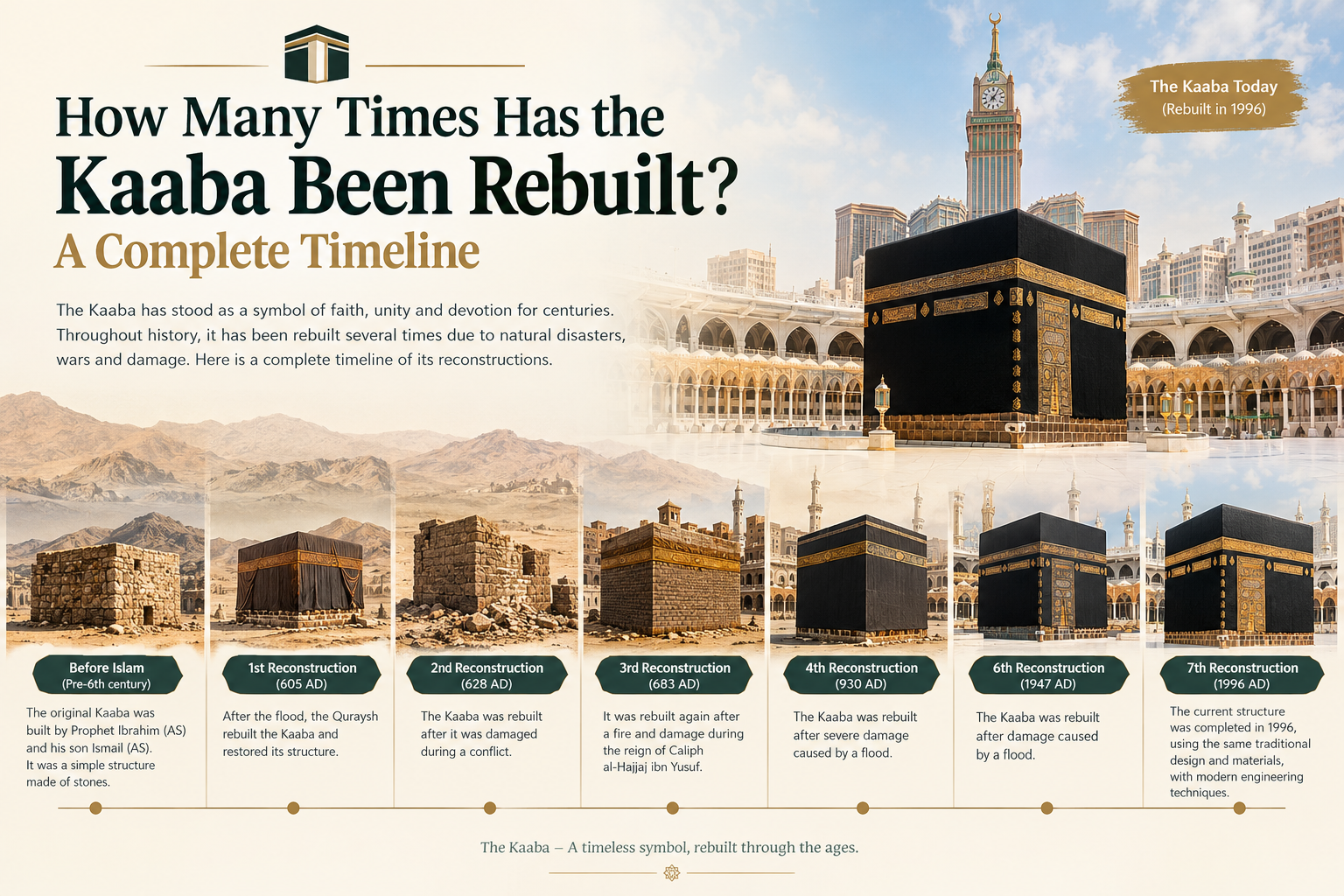
The Kaaba rebuilt throughout history has undergone several important architectural changes. Floods, structural damage, political conflicts, and preservation projects have all influenced its physical development. This raises an important question: how many times has the Kaaba been rebuilt?
Understanding when the Kaaba rebuilt its historical form helps explain the major architectural changes that took place over the centuries.
The answer depends on which historical accounts are included. Some describe the earliest foundations through Islamic tradition, while others count later reconstructions supported by historical records. Exploring the main events separately provides a clearer picture of how the Kaaba developed into the structure recognised by Muslims today.
How Often Has the Kaaba Been Reconstructed?
The question of how often the Kaaba rebuilt its structure is discussed in several historical accounts. The number depends on whether early construction, complete rebuilding, architectural changes, and later restoration projects are counted separately.
The Kaaba’s story is therefore best understood as a sequence of major building events rather than a simple count. Its history also helps explain the architectural setting in which the Kaaba kiswa, the textile covering, is displayed.
1. The Foundations Raised by Prophet Ibrahim and Prophet Ismail
Islamic tradition connects the Kaaba’s foundations with Prophet Ibrahim and his son Prophet Ismail. The Quran describes the two prophets raising the foundations of the House and asking Allah to accept their efforts.
This event holds a central place in Islamic belief. The Kaaba became a focal point for worship and remains the direction towards which Muslims pray. Muslims honour this history through the acts of worship they perform during Hajj and Umrah in Makkah.
This foundational account differs from later reconstructions because it describes the establishment of the Sacred House rather than a rebuilding following documented structural damage.
2. The Quraysh Construction Before Islam
The Quraysh rebuilt the Kaaba before the beginning of Prophet Muhammad’s prophethood. This important construction project followed concerns about the building’s condition and stability.
One important outcome involved the building’s dimensions. The Quraysh did not enclose the entire area traditionally associated with Prophet Ibrahim’s original foundations. As a result, Hijr Ismail was left beyond the boundaries of the rebuilt structure.
Another well-known part of this episode concerns the Black Stone. When disagreement arose over who would return it to its place, Prophet Muhammad proposed a solution that allowed representatives of different groups to participate.
The Quraysh reconstruction is an important turning point because it influenced the Kaaba’s later shape.
3. The Reconstruction Led by Abdullah ibn al-Zubayr
In 683 CE, the Kaaba rebuilt under the direction of Abdullah ibn al-Zubayr after conflict in Makkah caused severe damage to the structure. His project introduced important changes to the building’s design.
He sought to align the building more closely with the form traditionally associated with Prophet Ibrahim. The reconstruction incorporated the Hijr area into the design and included two entrances.
These changes created a structure that differed from the version built by the Quraysh. The episode illustrates how historical interpretations of the Kaaba’s original form influenced decisions about its architecture.
4. Changes Under Al-Hajjaj ibn Yusuf
After Abdullah ibn al-Zubayr’s death, the Kaaba rebuilt to restore key features of the Quraysh design. Al-Hajjaj ibn Yusuf oversaw changes that altered the building’s layout.
Al-Hajjaj’s work altered the layout introduced earlier, reducing the enclosed space and returning the Kaaba to a single entrance. Hijr Ismail once again remained outside the main structure.
This stage is particularly important when examining the Kaaba’s dimensions. These alterations reflected choices made by the authorities of that period, rather than repairs required only because of physical damage.
5. Sultan Murad IV and the Seventeenth-Century Rebuilding
The Kaaba rebuilt during the reign of Ottoman Sultan Murad IV followed destructive flooding in Makkah in 1630. The building suffered considerable damage, making extensive reconstruction necessary.
During the reign of Ottoman Sultan Murad IV, the reconstruction was completed around 1631. The project restored the structure using stone and established the basis of the building that remained in place through later centuries.
The reconstruction under Sultan Murad IV is widely considered the most recent full-scale rebuilding of the Kaaba. Subsequent projects have primarily focused on repairs, conservation, and structural maintenance.
6. The Major Restoration of 1996
In 1996, the Kaaba received a major restoration during the reign of King Fahd bin Abdulaziz. Unlike the period when the Kaaba was rebuilt after severe damage, this project focused on preserving and strengthening the existing structure.
The work addressed important parts of the structure, including its walls, roof, and interior. The aim was to preserve the historic building while ensuring its continued stability.
This project should be distinguished from a complete rebuilding. Restoration strengthens and protects an existing structure, whereas reconstruction involves rebuilding substantial parts of it. Modern maintenance continues to play an important role in preserving the Kaaba.
Each time the Kaaba rebuilt its structure or underwent major reconstruction, its architectural history entered a new stage. These events help explain the building’s development across different historical periods.
A Simple Timeline of Major Events
| Period | What happened |
| Time of Prophet Ibrahim and Prophet Ismail | The foundations of the Sacred House were raised |
| Before Prophet Muhammad’s prophethood | The Quraysh rebuilt the Kaaba |
| 683 CE | Abdullah ibn al-Zubayr commissioned a reconstruction |
| Around 693 CE | Al-Hajjaj ibn Yusuf restored the earlier Quraysh design |
| 1630–1631 CE | Major rebuilding followed destructive flooding |
| 1996 CE | A major restoration took place under King Fahd |
This overview covers the principal events commonly discussed in the Kaaba’s architectural history. It does not count every repair or every additional construction mentioned in traditional narratives.
What Is the Connection Between the Kaaba’s History and Its Kiswah?
The history of the Kaaba rebuilt across different periods is separate from the history of its Kiswah. The Kaaba is a masonry structure, while the Kiswah is the specially crafted textile covering its exterior.
The Kiswah kaaba calligraphy is one of its most recognisable features, combining carefully designed inscriptions with detailed embroidery. Understanding this distinction helps readers appreciate both the architecture and the textile heritage without confusing the two.
Collectors researching a Gilafe kaaba piece or looking for Where to buy kaaba kiswah should pay attention to a piece’s documented origin, condition, and authenticity. These details are more useful than relying on photographs or price alone.
Discover the Heritage of the Kaaba Kiswah
The Kaaba’s architectural story includes foundational construction, changes to its design, rebuilding after serious damage, and modern conservation. Each period helps explain how the sacred structure has been maintained across generations. Learning how the Kaaba rebuilt and preserved its structure over time offers a deeper understanding of its architectural heritage.
Visit Kaaba Kiswa to explore more about the Kaaba, its textile covering, and the history behind its distinctive calligraphy. If you are interested in authentic Kiswah heritage, learning about its origins and craftsmanship is a valuable starting point.