
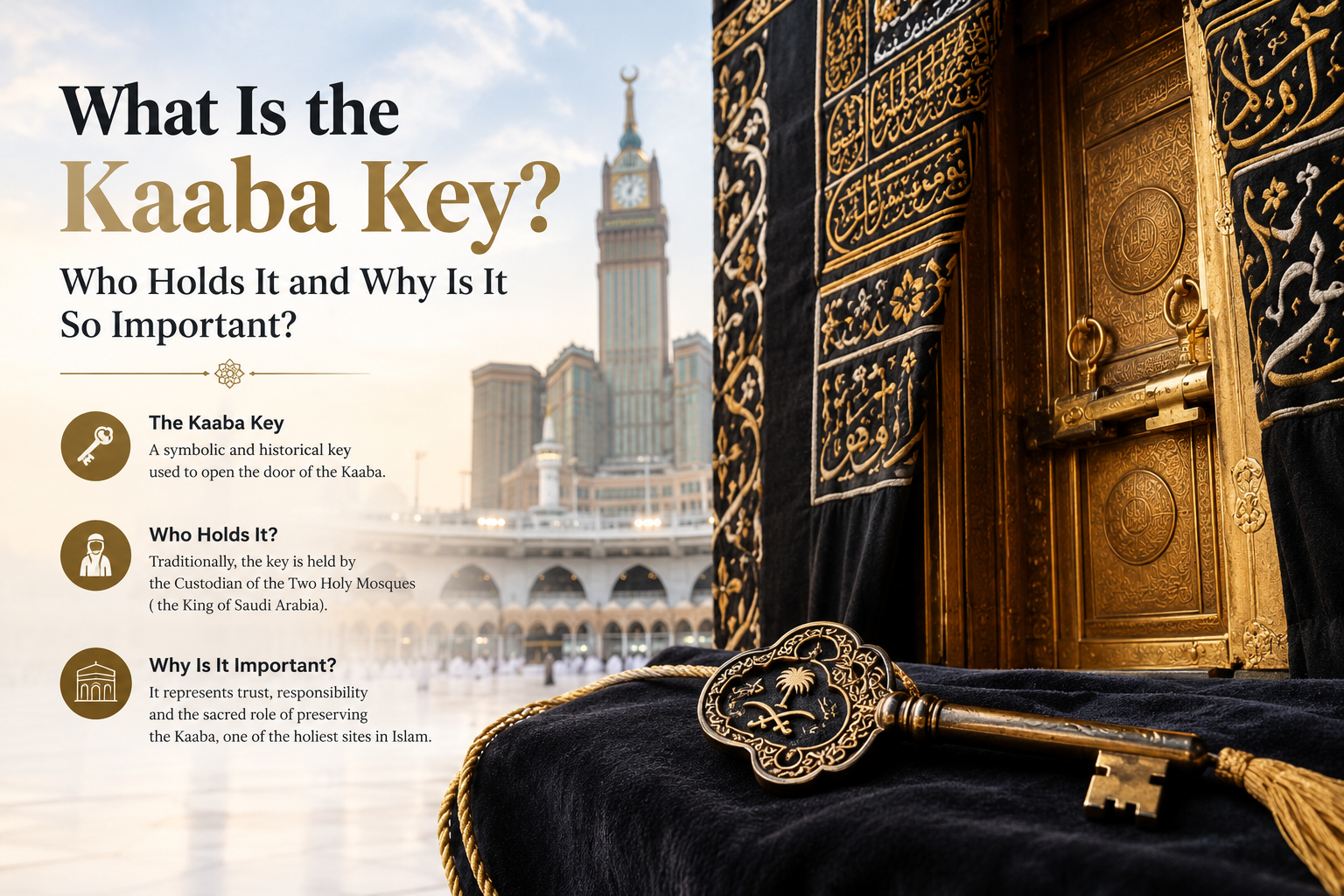
The Kaaba is one of the most sacred sites in Islam, but many people know less about the fascinating traditions surrounding its door, lock, and key. The Kaaba key is not simply an object used to open a door. It represents a centuries-old custodianship connected with the care and protection of the Sacred House.
The responsibility for the Kaaba’s key has historically belonged to a particular family, and that tradition continues today. Understanding who holds the key, how this responsibility began, and why the key has such significance reveals an important part of Islamic heritage.
What Is the Kaaba Key?
The Kaaba key is used to open the lock of the door of the Holy Kaaba. Because access to the interior of the Kaaba is highly restricted, the key has a significance far beyond its practical function.
According to the official Haramain website, the custodianship of the Kaaba has remained within the descendants of Abdul Dar from the Quraysh lineage. During the lifetime of Prophet Muhammad ﷺ, the custodian was Uthman ibn Talha from Banu Abdul Dar.
This historic responsibility is known as Sidana, referring to the custodianship and care of the Kaaba.
Who Holds the Kaaba Key Today?
The key of the Kaaba remains with the Al-Shaibi family, descendants of the traditional custodians. The official Haramain website explains that after Uthman ibn Talha, the custodianship passed to his cousin Shaybah ibn Uthman, and it has continued through his lineage.
Today, the eldest custodian holds the key and oversees ceremonies involving the opening of the Kaaba and its interior washing. This responsibility has therefore remained connected to the same hereditary custodial tradition for centuries.
The official description of the Noble Kaaba also identifies the Al-Shaibi family as the custodians responsible for safeguarding its door.
The Story of Uthman ibn Talha and the Kaaba Key
The history of the Kaaba key becomes especially significant during the conquest of Makkah.
At that time, Uthman ibn Talha was the custodian of the Kaaba. The official Haramain account states that Prophet Muhammad ﷺ took the key from Uthman ibn Talha, entered the Kaaba, and purified it from idols. Afterward, the key was returned to Uthman ibn Talha along with the continuing responsibility of custodianship.
This event established an enduring tradition. The responsibility was not transferred permanently to another family or authority. Instead, it was returned to the established custodians, reinforcing the hereditary nature of the duty.
This is one reason the key carries such historical importance within Islamic heritage.
Why Is the Kaaba Key So Important?
The importance of the key comes from what it represents.
First, it represents custodianship. The person holding the key is entrusted with responsibility connected with the Sacred House.
Second, it represents historical continuity. The custodianship has continued through generations of the Al-Shaibi family.
Third, it represents care for the Kaaba. The key is connected with occasions when the Kaaba is opened for specific purposes, including its interior washing and certain honored visits.
Therefore, the key should be understood as a symbol of responsibility and trust rather than simply a rare historical object.
When Is the Kaaba Opened?
The interior of the Kaaba is not open to the general public. According to the official Haramain website, the Kaaba is opened for interior cleansing on two occasions each year. It may also be opened to honor visiting heads of state.
The washing ceremony is an important part of the care associated with the Sacred House. The custodians participate in the opening and washing process, continuing their traditional responsibility.
This restricted access also explains why the Kaaba key has such a distinctive place in Islamic history. It is connected with access to one of the most sacred structures in the Muslim world.
Has the Kaaba Always Had the Same Key?
No. Historical records show that the locks and keys associated with the Kaaba have changed across different periods.
The official Haramain website documents keys and locks from the Abbasid, Mamluk, and Ottoman periods. Historical examples were made from different materials and featured varying decorative techniques, including gold and silver inlay and calligraphic inscriptions.
The website also records an Ottoman-era lock and key commissioned by Sultan Abdul Hamid Khan in 1309 AH. The current lock and key were introduced during the Saudi era when the Kaaba door was replaced during the reign of King Khalid bin Abdul Aziz in 1398 AH.
This history demonstrates that the Kaaba’s lock and key are also part of a long tradition of Islamic metalwork and craftsmanship.
What Do Historical Kaaba Keys Look Like?
Historical Kaaba keys can look very different from ordinary modern keys. Some surviving examples feature elaborate inscriptions, decorative metalwork, and carefully crafted handles.
The Haramain website highlights historical examples preserved in collections such as the Topkapi Museum in Istanbul. It describes early locks and keys made from wood and later examples made from iron, with some decorated using gold or silver inlay.
These objects provide valuable information about the artistic traditions of different Islamic periods.
For researchers and collectors of Islamic heritage, they demonstrate how functional objects associated with the Sacred House could also become examples of sophisticated craftsmanship.
Is the Kaaba Key Connected to the Kiswah?
The key and the Kiswah are different parts of the Kaaba’s heritage, but both are connected with the care and presentation of the Sacred House.
The Kaaba kiswa is the textile covering placed over the Kaaba. It is produced with black silk and decorated with Quranic inscriptions and elaborate embroidery. Saudi official reporting describes the Kiswa as an important expression of care and reverence for the Sacred House.
The connection becomes particularly interesting for people researching Kiswah kaaba calligraphy. The embroidered inscriptions on the Kiswa represent a separate textile tradition from the metal craftsmanship seen in historical locks and keys.
Together, these elements show how different forms of Islamic craftsmanship have been used in connection with the Kaaba.
Can You Buy the Kaaba Key or Kiswah?
The Kaaba key itself should not be confused with commercially available Islamic decorative products. Historical keys are museum and heritage objects, while the current key is part of the custodianship of the Kaaba.
If your interest is in owning a meaningful piece of Islamic textile heritage, you may instead research authentic Kiswah-related pieces. People often search phrases such as Where to buy kaaba kiswah or How do I buy authentic kaaba kiswah when looking for genuine textile pieces.
However, buyers should carefully distinguish between authentic Kiswah material, replicas, and decorative textiles inspired by the Kaaba. Product descriptions, provenance, dimensions, certification, and seller transparency should all be considered before purchasing.
Can You Buy Kaaba Kiswah Online?
The question Can you buy kaaba kiswah online is common among collectors and people interested in Islamic heritage.
The answer depends on what is being offered. The complete covering used on the Kaaba is not an ordinary retail product. However, specialist sellers may offer individual Kiswah-related textile pieces.
If you are researching Buy kiswah kaaba online, do not rely only on photographs. Examine the product information carefully and look for details about the textile, craftsmanship, size, authenticity, and documentation.
A genuine-looking design alone does not establish provenance.
Explore Kaaba Kiswa and Islamic Textile Heritage
The story of the Kaaba key shows that the heritage of the Sacred House extends far beyond its architecture. Its door, lock, key, Kiswah, calligraphy, and custodianship all represent different aspects of a remarkable Islamic tradition.
For those interested in the textile side of this heritage, Kaaba Kiswa provides an opportunity to explore the history, craftsmanship, calligraphy, and cultural significance associated with the Kiswah.
Whether you are researching the history of the Kaaba, learning about its sacred objects, or looking for authentic Islamic textile art, understanding the story behind each element makes the experience more meaningful.
Explore Kaaba Kiswa today to discover the history, craftsmanship, and remarkable heritage connected with the Holy Kaaba and its iconic Kiswah.