
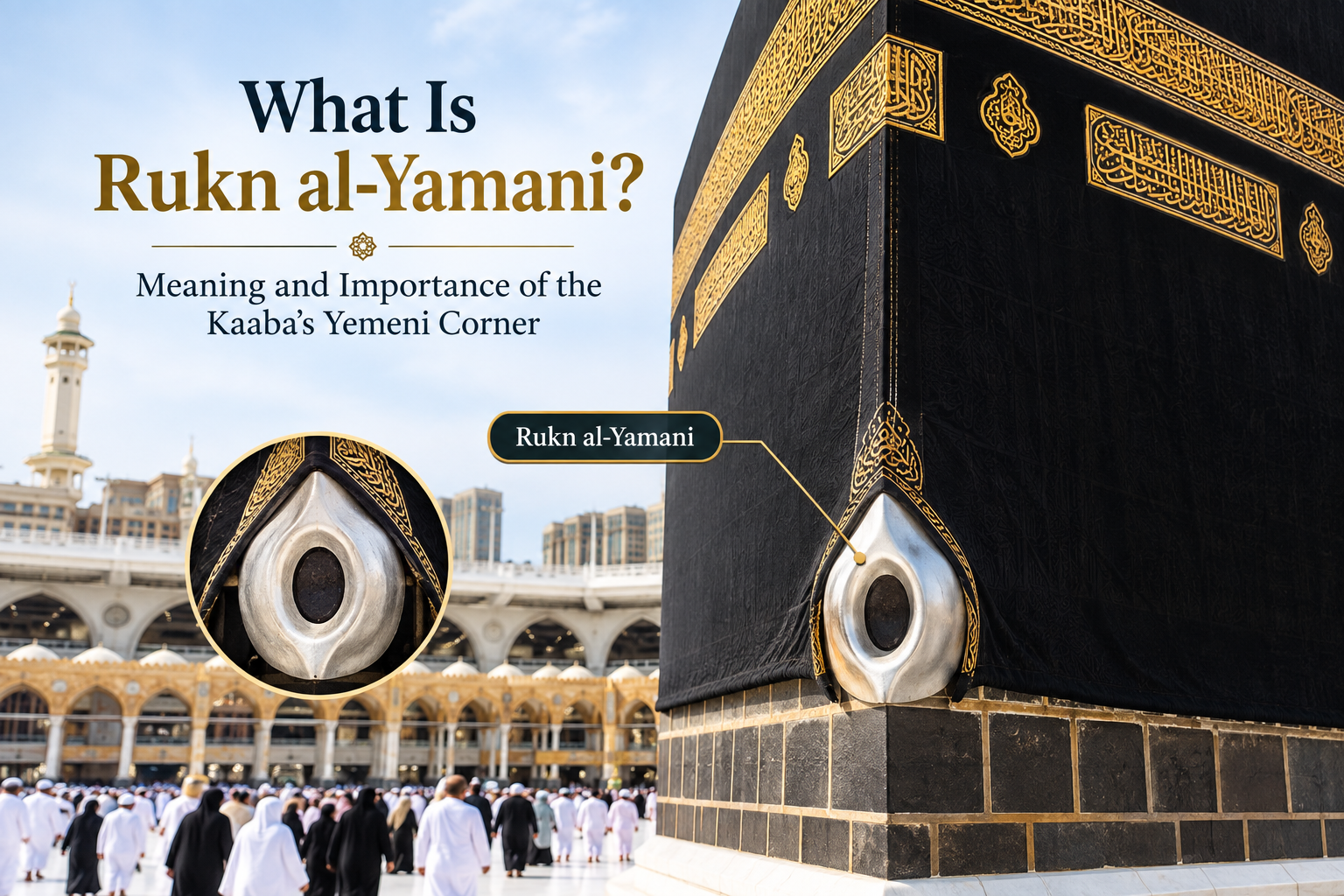
Millions of Muslims around the world turn toward the Holy Kaaba in Makkah five times a day. While performing Hajj or Umrah, pilgrims complete Tawaf by circumambulating this sacred cuboid structure. During each circuit, pilgrims pass four distinct corners, one of the most spiritually significant being Rukn al-Yamani, also known as the Yemeni Corner of the Kaaba.
Understanding the historical meaning, spiritual importance, and Sunnah practices associated with Rukn al-Yamani enhances your connection and focus during your pilgrimage.
What Does Rukn al-Yamani Mean?
The Arabic phrase Rukn al-Yamani (الركن اليماني) translates directly to “The Yemeni Corner.”
- Rukn (ركن): Means “corner,” “pillar,” or “fundamental support.”
- Al-Yamani (اليماني): Refers to the geographical direction of Yemen.
The corner earned this name because it points directly southwest toward the country of Yemen. It is located immediately before the corner containing Hajar al-Aswad (The Black Stone) as pilgrims move in an anti-clockwise direction during Tawaf.
The Four Corners of the Holy Kaaba
To understand the location of the Yemeni Corner, it helps to look at how all four corners of the Kaaba are designated based on geographical direction:
| Corner Name | Geographical Alignment | Distinctive Feature |
| Rukn al-Aswad | East | Holds Hajar al-Aswad (The Black Stone); marks Tawaf start/end line |
| Rukn al-Yamani | Southwest | Points toward Yemen; standing on the original foundation of Prophet Ibrahim (AS) |
| Rukn al-Shami | Northwest | Points toward Levant/Syria (Ash-Sham) |
| Rukn al-Iraqi | Northeast | Points toward Iraq; situated near Hijr Ismail (Hateem) |
Why Is Rukn al-Yamani So Important in Islam?
The Yemeni Corner holds a unique spiritual status in Islamic tradition due to two major historical and religious reasons:
1. Built on the Original Foundations of Prophet Ibrahim (AS)
When the Quraish rebuilt the Kaaba prior to the prophethood of Prophet Muhammad (PBUH), they ran short of halal funds to complete the entire original rectangular footprint. As a result, they excluded the semi-circular area known as Hijr Ismail (Hateem) on the northern side. However, the southern wall—where Rukn al-Yamani and Hajar al-Aswad stand—was built directly upon the original foundations set by Prophet Ibrahim (AS) and his son Prophet Ismail (AS).
2. The Practice (Sunnah) of Prophet Muhammad (PBUH)
Prophet Muhammad (PBUH) gave special attention to Rukn al-Yamani during Tawaf. Authentic Hadiths record that he would touch this corner with his noble hands whenever he passed it during circumambulation.
“The Messenger of Allah (PBUH) did not leave untouched the two corners: the Yemeni Corner and Hajar al-Aswad during every circuit.” — (Sahih al-Bukhari & Sahih Muslim)
Recommended Sunnah Rituals at the Yemeni Corner
When performing Umrah or Hajj, specific guidelines govern how pilgrims interact with Rukn al-Yamani:
- Touch with the Right Hand (Istilam): If you can reach the corner safely without causing harm, push, or crowd others, it is Sunnah to touch Rukn al-Yamani with your right hand.
- Do Not Kiss the Corner: Unlike Hajar al-Aswad, there is no Sunnah instruction to kiss Rukn al-Yamani or touch your forehead against it. Touching it gently with the right hand is sufficient.
- Do Not Wave or Gesture from Distance: If the Mataaf is crowded and you cannot physically touch the corner, simply pass by it normally without stopping, waving, or saying Allahu Akbar toward it.
- Recite the Specific Dua Between the Two Corners: The stretch of the Kaaba wall between Rukn al-Yamani and Hajar al-Aswad is designated for a specific supplication taught by Prophet Muhammad (PBUH).
The Special Dua Recited at Rukn al-Yamani
As you walk from Rukn al-Yamani toward the Black Stone to complete each lap of Tawaf, it is recommended to recite the Quranic supplication:
Arabic:
رَبَّنَا آتِنَا فِي الدُّنْيَا حَسَنَةً وَفِي الآخِرَةِ حَسَنَةً وَقِنَا عَذَابَ النَّارِ
Transliteration:
“Rabbana atina fid-dunya hasanatan wa fil-akhirati hasanatan wa qina ‘adhab an-nar.”
Translation:
“Our Lord, give us in this world that which is good and in the Hereafter that which is good, and save us from the punishment of the Fire.” — (Surah Al-Baqarah, 2:201)
Key Facts About Rukn al-Yamani
- Exposed Stone Work: Unlike other parts of the Kaaba wall, a small lower portion of the stone masonry at Rukn al-Yamani is held together by special bonding material to preserve its historic structure.
- Forgiveness of Sins: Hadiths mentioned in Sunan an-Nasa’i state that touching Hajar al-Aswad and Rukn al-Yamani wipes away sins.
- Special Crack/Feature: Over centuries, natural weathering caused small fissures in the stone at this corner, which caretakers routinely maintain with specialized mortars and perfume oils like pure Oud.
Final Thoughts
The Yemeni Corner (Rukn al-Yamani) stands as an enduring physical connection to the foundations built by Prophet Ibrahim (AS). Remembering its history, respecting the Sunnah practices of touching it gently without crowding, and reciting the prescribed Dua between the corners enriches your pilgrimage experience.
May Allah grant every believer the opportunity to perform Tawaf around the Holy Kaaba and touch its blessed corners.