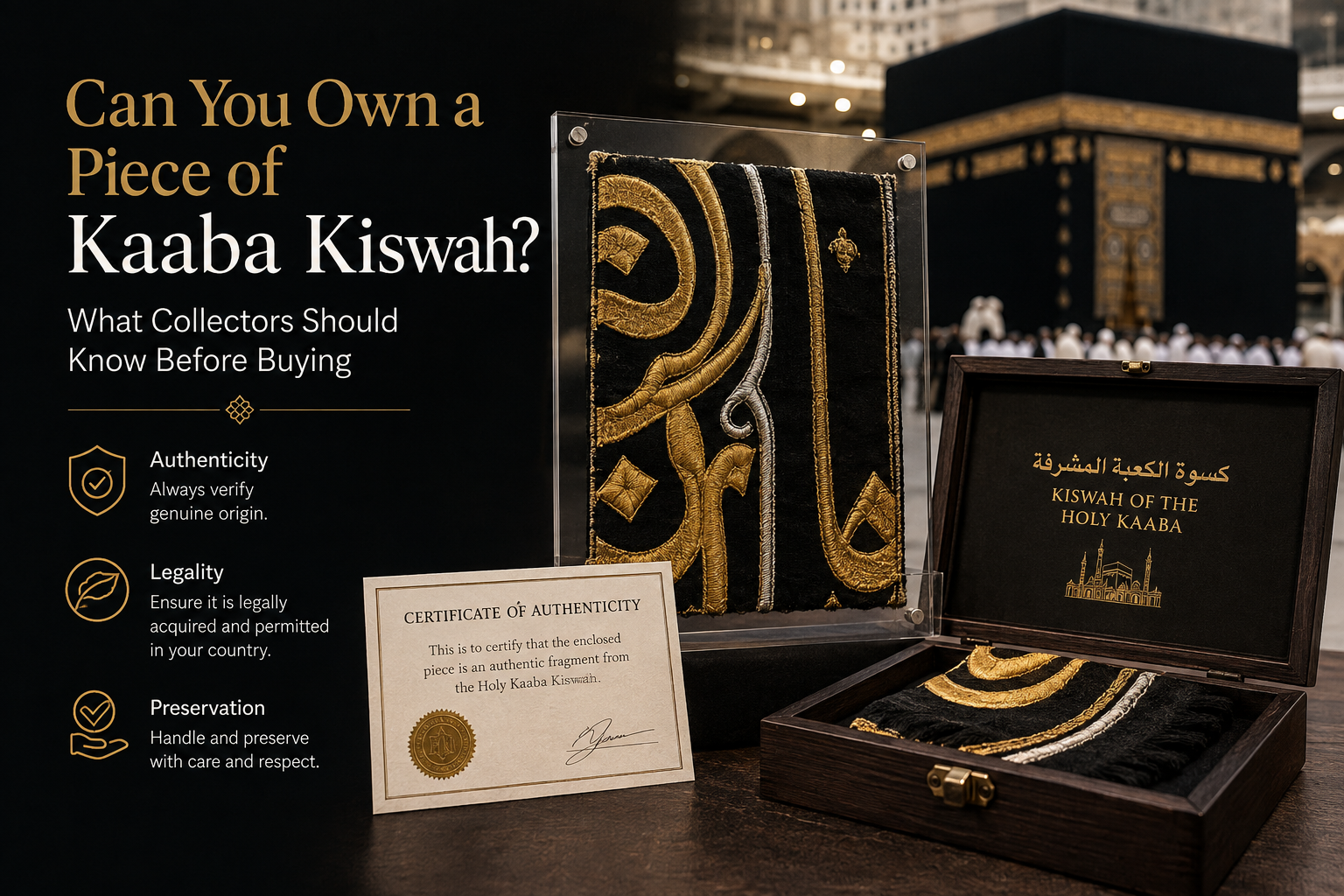
The Kaaba Kiswah of the Holy Kaaba is one of the most recognisable textiles in Islamic heritage. Its black silk surface, intricate Arabic calligraphy, and metallic embroidery distinguish it from ordinary fabrics. Because of its religious and cultural importance, many collectors wonder whether individuals can legally and ethically own a genuine piece of the Kiswah.
The short answer is that genuine Kiswah-related pieces may exist in private collections, but buyers should understand exactly what they are purchasing, how the material was obtained, and what documentation supports its claimed origin.
This guide explains the key considerations for anyone interested in owning a piece connected with the Kaaba Kiswah.
Can You Own a Piece of the Kaaba Kiswah?
The question Can you own a piece of the Kaaba Kiswah does not have a simple yes-or-no answer.
Kiswah material has historically been treated in different ways after replacement, and individual fragments can enter collections through various legitimate channels. However, the existence of a piece being offered for sale does not automatically establish that it genuinely came from the Kaaba.
For collectors, the most important distinction is between an authenticated Kiswah fragment and a textile that merely imitates its appearance.
A black textile featuring gold-coloured Arabic embroidery could be a beautiful Islamic artwork without having any connection to the actual Kiswah. Therefore, ownership should begin with verification rather than price or visual appeal.
Why Is the Kiswah Important to Collectors?
The Kaaba Kiswah is closely associated with the Holy Kaaba in Makkah and represents a remarkable tradition of Islamic textile craftsmanship.
Its production involves specialised weaving, sewing, embroidery, and calligraphy. The combination of black silk and elaborate metallic embroidery gives the textile a distinctive appearance.
For collectors, the attraction is not simply the fabric itself. A genuine fragment can represent a tangible connection to Islamic history and the craftsmanship associated with one of the world’s most significant religious sites.
This cultural context is what separates a genuine heritage fragment from an ordinary decorative textile.
How Are Old Kaaba Kiswah Coverings Distributed?
People frequently ask How are old Kaaba Kiswah coverings distributed after a replacement takes place.
The handling of previous Kaaba Kiswah material can depend on official practices and circumstances. Pieces may be retained, presented, preserved, or distributed through appropriate channels rather than being treated like ordinary commercial fabric.
This is why claims surrounding a particular fragment should be examined carefully.
A seller should be able to explain how the textile was obtained and why it is being described as an authentic Kiswah piece. A vague statement about an item being “from the Kaaba” is not sufficient evidence for a serious collector.
What Should Buyers Look for?
The first consideration should be provenance.
Provenance describes the history of an object, including its origin, previous ownership, acquisition, and movement between collections. Strong provenance can provide important support for an item’s claimed identity.
Ask for information such as:
- Where the piece originated
- When it was acquired
- How it entered the seller’s possession
- Whether previous ownership is documented
- Whether authentication documentation exists
- Whether dimensions and materials are recorded
- Whether photographs show the complete piece
Documentation should correspond with the actual textile being offered.
Authenticity Is More Important Than Appearance
Modern Islamic textiles can reproduce many features associated with the Kiswah. These include black silk, gold calligraphy, geometric decoration, and Hizam-inspired designs.
Such characteristics can create a convincing visual impression, but they do not prove historical origin.
Collectors should therefore examine the construction of the textile, embroidery techniques, materials, edges, backing, stitching, wear, and other physical characteristics.
Where the purchase involves substantial money, obtaining independent professional advice may be sensible.
Understanding Certificates and Documentation
A certificate can be useful, but buyers should understand what it actually establishes.
A strong document should identify the particular item and provide relevant information about its dimensions, materials, claimed origin, and authentication basis. It should also identify the person or organisation responsible for issuing it.
A generic certificate with little information should not be treated as conclusive evidence.
Buyers should also keep invoices, correspondence, photographs, certificates, and product descriptions as part of their permanent collection records.
Buying Original Kaaba Cloth in the UK
Anyone searching for Where to buy original Kaaba Kiswah cloth UK should investigate the seller before making a purchase.
Look for transparent product descriptions, clear photographs, specific dimensions, material information, provenance details, and authentication documentation.
A reputable seller should be willing to answer questions rather than relying on urgency or emotional sales language.
Before paying, ask whether the piece comes with documentation and whether the seller provides a reasonable return policy.
The purchase should be based on evidence rather than the assumption that a high asking price proves authenticity.
A Collector’s Guide for UK Buyers
A useful Kaaba Kiswah collector guide UK should encourage buyers to consider several factors together.
Provenance
A documented history can help establish where a fragment came from.
Condition
Silk is sensitive to environmental conditions. Examine fading, tears, loose threads, staining, repairs, and deterioration.
Size
Dimensions should be measured accurately and included in the documentation.
Embroidery
Study the quality, construction, and detail of the calligraphy and metallic embroidery.
Preservation
Ask how the textile has been stored and whether it has been professionally mounted or framed.
Documentation
Keep all available records relating to authenticity and ownership.
These factors provide a more reliable basis for collecting than appearance alone.
How Much Should You Pay?
There is no universal market price for an authentic Kiswah fragment.
Value can be influenced by provenance, size, embroidery, condition, historical context, rarity, documentation, and seller reputation.
A smaller fragment with exceptional provenance may be more desirable than a larger textile with uncertain origins.
Collectors should therefore compare the evidence supporting different pieces rather than comparing prices alone.
Is a Kiswah Fragment an Investment?
A genuine Kaaba Kiswah fragment may have considerable cultural and collectible significance, but no seller can guarantee future financial appreciation.
Collectors should purchase heritage textiles because they value their history, craftsmanship, cultural meaning, and rarity.
Treating every piece as a guaranteed investment can lead to poor purchasing decisions, particularly when authenticity has not been adequately established.
Rare Islamic Heritage Collectibles in the UK
Interest in rare Islamic heritage collectibles for UK buyers continues to include textiles, manuscripts, calligraphic works, architectural fragments, and other historically significant objects.
However, rarity should always be supported by evidence. A product should not be considered rare simply because a seller describes it that way.
Collectors should ask why the object is rare, how many comparable examples are known, and whether its history can be independently supported.
Questions to Ask Before Buying
Before purchasing a claimed Kiswah fragment, ask:
- What exactly is this textile?
- What evidence connects it to the Kaaba?
- Is its provenance documented?
- Who authenticated it?
- What materials were used?
- What are the exact dimensions?
- Has it been repaired or restored?
- How has it been preserved?
- Is there a certificate?
- What is the seller’s return policy?
Clear answers to these questions can significantly improve the buying process.
Final Thoughts
Owning a genuine piece connected with the Kaaba Kiswah can be meaningful for a collector interested in Islamic history and textile craftsmanship. However, the significance of such an object depends heavily on authenticity, provenance, documentation, condition, and responsible preservation.
Whether you are asking Can you own a piece of the Kaaba Kiswah, researching How are old Kaaba Kiswah coverings distributed, looking for Where to buy original Kaaba cloth UK, following a Kaaba Kiswa collector guide UK, or exploring Rare Islamic heritage collectibles for UK buyers, careful verification should always come before purchase.
A genuine heritage textile deserves more than a price tag. It deserves accurate documentation, respectful handling, and preservation so its historical and cultural significance can continue to be appreciated by future generations.