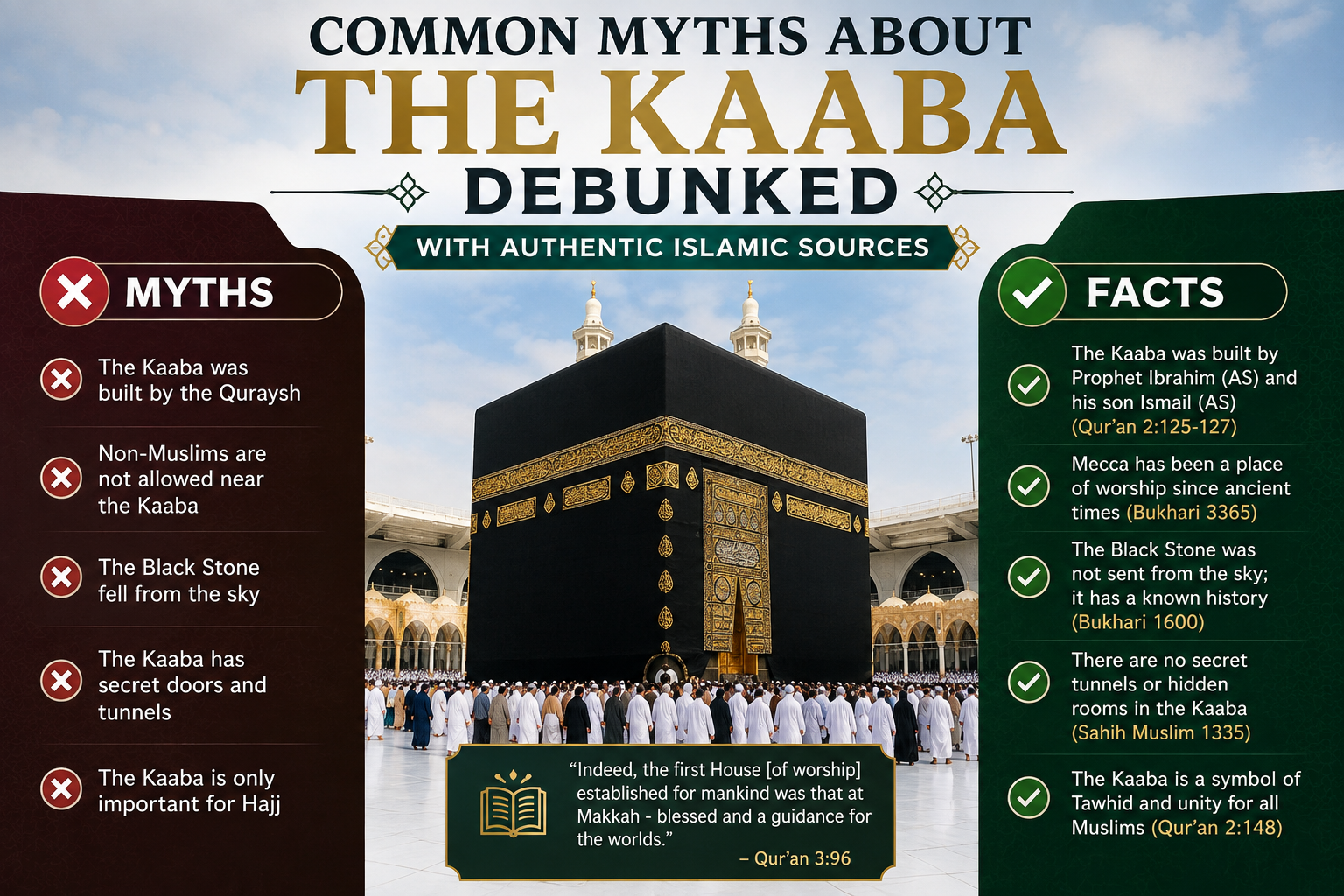
The Holy Kaaba is one of the most recognised places in the world. For Muslims, it is the Sacred House towards which they turn during prayer and the centre around which pilgrims perform Tawaf during Hajj and Umrah. Because the Kaaba has such a long history and deep spiritual importance, many stories about it circulate online. Some are based on authentic Islamic teachings, while others are misunderstandings, exaggerations, or popular traditions without reliable evidence.
Understanding the difference between fact and fiction is important when discussing a sacred subject. This guide examines several common Misconceptions about the Kaaba using the Quran and authentic Hadith collections. The goal is not simply to correct myths but to understand what Islam actually teaches about the Sacred House, the Black Stone, Tawaf, and the Kiswah.
What Does the Quran Say About the Kaaba?
Before discussing individual myths, it is useful to begin with the Quran. Allah describes the Kaaba as the Ancient House and connects it with worship, Tawaf, prayer, and the legacy of Prophet Ibrahim (AS).
These teachings help clear up common Misconceptions about the Kaaba and show why the Sacred House holds such an important place in Islam.
In Surah Al-Baqarah, Allah mentions the House as a place of return and security and refers to its purification for those who perform Tawaf, worship, bow, and prostrate.
Similarly, Surah Al-Hajj instructs pilgrims to perform Tawaf around the Ancient House.
These verses establish an important principle: the Kaaba is honoured because of its role in worshipping Allah. It is not an object that Muslims worship. The Quran therefore provides an important foundation for correcting misconceptions about the Kaaba and understanding its true religious significance.
Myth 1: Muslims Worship the Kaaba
One of the most common Islamic myths vs authentic sources discussions concerns whether Muslims worship the Kaaba.
The Reality
Muslims do not worship the Kaaba. They worship Allah alone.
The Kaaba serves as the Qiblah, or direction of prayer. Facing a particular direction during Salah does not mean worshipping the structure located in that direction. This distinction is fundamental to Islamic belief.
The Quran describes the House in connection with worship and prayer, while repeatedly establishing worship of Allah alone.
The same principle explains why Muslims do not believe that the walls of the Kaaba possess independent supernatural powers. Respecting a sacred symbol is different from treating that symbol as a deity. This distinction is essential when examining misconceptions about the Kaaba and Islamic beliefs surrounding the Sacred House.
Myth 2: Is the Black Stone Worshipped in Islam?
Another widespread misunderstanding asks: Is the Black Stone worshipped in Islam?
The answer is no.
The Black Stone, known as Hajar al-Aswad, is respected because the Prophet Muhammad ﷺ interacted with it during Tawaf. However, Muslims do not believe that the stone is a god or that it independently controls people’s lives.
One of the clearest pieces of evidence comes from the statement of Umar ibn al-Khattab (RA), recorded in Sahih al-Bukhari. When he kissed the Black Stone, he explicitly acknowledged that it was a stone and that it could neither benefit nor harm anyone. He explained that he kissed it because he had seen the Prophet ﷺ do so.
A similar narration appears in Sahih Muslim.
This provides a powerful answer to the misconception. The act is one of following the Sunnah, not worshipping the stone. This is one of the most important Misconceptions about the Kaaba to clarify because respecting the Black Stone is not the same as worshipping it.
Myth 3: Is Touching or Kissing the Kaaba Compulsory in Tawaf?
People sometimes believe that every pilgrim must physically touch or kiss the Kaaba during Tawaf. This can create unnecessary pressure, especially when the Mataf is crowded.
So, Is touching or kissing the Kaaba compulsory in Tawaf?
The Reality
Kissing the Black Stone is an established Sunnah, but a pilgrim should not endanger others or create harm in an attempt to reach it.
Authentic narrations show that Umar (RA) kissed the Black Stone because he saw the Prophet ﷺ do so.
Another authentic narration records that during the Prophet’s ﷺ final Hajj, he performed Tawaf while riding and indicated toward the Black Stone with a bent-headed stick.
This demonstrates an important practical lesson: physical contact is not the only way the Black Stone can be acknowledged during Tawaf.
Pilgrims should therefore avoid pushing, hurting others, or causing congestion simply to reach the Stone. Worship should be performed with patience, respect, and consideration for fellow Muslims. This guidance helps correct Misconceptions about the Kaaba and prevents pilgrims from feeling that physical contact is required for their Tawaf to be valid.
Myth 4: The Kaaba Has Always Been Covered in Black
The black Kiswah is so closely associated with the Kaaba today that some people assume it has always had the same colour.
So, Was the Kiswa cover always black?
The Reality
No. Historical accounts indicate that the Kiswah has appeared in different colours and fabrics throughout Islamic history.
Reports about earlier coverings describe Yemeni textiles as well as white, red, green, and other coverings used during different periods. Historical research also records changes in the colour and material of the Kiswah across different dynasties and eras.
A modern historical account notes that the Prophet Muhammad ﷺ is reported to have used Yemeni cloth, while white, red, green, and black coverings appeared during later periods. Black eventually became the established colour associated with the Kiswah today.
Therefore, the black Kiswah is an important and familiar tradition today, but it should not be presented as though every historical covering of the Kaaba was necessarily black. Understanding this history helps address misconceptions about the Kaaba and prevents modern practices from being mistaken for unchanging historical traditions.
Myth 5: The Black Kiswah Is Mentioned as a Required Islamic Ritual
Another misunderstanding is that Islam specifically commands Muslims to cover the Kaaba with a black cloth.
The Reality
The Quran establishes the sacred status of the Kaaba and its connection with worship, but it does not prescribe black as a required colour for its covering.
The tradition of covering the Kaaba has a long history, and the colour and type of fabric changed over different periods. Authentic Islamic history therefore needs to be distinguished from later customs and established traditions.
Today, the black Kiswah is an iconic part of the visual identity of the Kaaba. Its detailed Quranic calligraphy and craftsmanship have also become an important expression of Islamic artistic heritage.
At Kaaba Kiswa, preserving interest in this heritage means understanding the history behind the covering rather than assuming that today’s appearance has remained unchanged for more than fourteen centuries.
Myth 6: The Kaaba Itself Has Supernatural Power
Some stories suggest that touching the Kaaba’s walls, doors, or other physical parts automatically grants a person specific worldly benefits.
The Reality
Islam teaches Muslims to place their trust in Allah rather than in physical objects.
The example of Umar (RA) and the Black Stone is particularly important. His statement makes clear that the Stone itself cannot independently cause benefit or harm.
The sacredness of the Kaaba therefore should not be confused with the belief that its physical materials possess independent divine powers.
Muslims honour the Sacred House because Allah has given it a special religious status. That honour is expressed through worship, prayer, Tawaf, remembrance of Allah, and respect for the sacred rituals. Such claims are among the common Misconceptions about the Kaaba that should be evaluated against authentic Islamic teachings.
Myth 7: Everyone Must Touch the Kaaba During a Pilgrimage
Crowded social-media videos can sometimes give the impression that physically reaching the Kaaba is an essential part of completing Hajj or Umrah.
This is another misconception.
The Quran specifically mentions Tawaf around the Ancient House as part of the pilgrimage rites. The authentic Sunnah also demonstrates different ways of acknowledging the Black Stone, including pointing toward it when direct contact is not possible.
Therefore, pilgrims should never believe that pushing through a crowd or causing injury is necessary to complete their worship.
The spiritual objective is obedience to Allah and following the guidance of the Prophet ﷺ, not winning a physical struggle to reach a particular spot.
Why Authentic Sources Matter for Misconceptions About the Kaaba
The internet contains countless claims about the Kaaba. Some are harmless stories, while others can create genuine confusion about Islamic beliefs and rituals. Understanding misconceptions about the Kaaba requires checking popular claims against the Quran and authentic Hadith rather than relying on assumptions.
The safest approach is to return to reliable primary sources.
The Quran provides the foundation for understanding the Sacred House, while authentic Hadith collections preserve detailed examples from the life and practice of Prophet Muhammad ﷺ. For example, Quranic verses establish the connection between the Kaaba, worship, and Tawaf, while Sahih al-Bukhari and Sahih Muslim provide important evidence concerning the Black Stone and its treatment during Tawaf.
This approach also prevents cultural traditions, social-media claims, and unverified stories from being presented as Islamic teachings. It is especially useful for correcting misconceptions about the Kaaba that are repeated online without reliable evidence.
The Kiswah: A Tradition Worth Understanding
The Kiswah deserves special attention because it is one of the most visible features of the Kaaba.
The magnificent black covering seen today is decorated with intricate Quranic calligraphy and has become a powerful symbol of the Sacred House. Yet its history is more varied than many people realise. Different periods saw different colours, fabrics, and methods of covering the Kaaba.
Learning this history makes today’s Kiswah even more fascinating. It shows how Islamic heritage has developed over centuries while the Kaaba itself has remained at the centre of Muslim worship. This history also helps correct misconceptions about the Kaaba that develop when modern traditions are assumed to have existed unchanged throughout Islamic history.
For people interested in authentic Kiswah heritage, Islamic art, and meaningful reminders of Makkah, Kaaba Kiswa offers an opportunity to explore this remarkable tradition more closely.
Learning about Misconceptions about the Kaaba through authentic Islamic sources allows readers to separate established religious teachings from stories, assumptions, and modern internet claims.
Conclusion
The Kaaba deserves to be discussed with both reverence and accuracy. Addressing misconceptions about the Kaaba with authentic evidence helps readers understand its significance without confusion. Many Misconceptions about the Kaaba become easier to understand when compared directly with the Quran and authentic Hadith.
Muslims worship Allah, not the Kaaba. The Black Stone is respected but is not worshipped. Kissing it follows the example of the Prophet ﷺ, but pilgrims should never harm others while attempting to reach it. And the answer to Was the Kiswa cover always black? is no; historical records show that different colours and fabrics were used before black became the established tradition.
The question Is the Black Stone worshipped in Islam can therefore be answered clearly through the words and actions preserved in authentic Hadith. Likewise, the question Is touching or kissing the Kaaba compulsory in Tawaf? should be approached through the Sunnah rather than social-media expectations.
Understanding misconceptions about the Kaaba through authentic Islamic sources does more than correct misinformation. It helps readers distinguish established teachings from popular stories and assumptions.
The Kaaba’s true significance is not found in legends surrounding its stones or coverings. Its greatness comes from its role in the worship of Allah, its connection to the legacy of Prophet Ibrahim (AS), and the unity of Muslims who turn toward it in prayer and gather around it for Hajj and Umrah.
The black Kiswah that covers the Sacred House today adds another beautiful layer to this history. Knowing this history can also help readers avoid misconceptions about the Kaaba and appreciate its traditions more accurately.
Its calligraphy, craftsmanship, and changing story across generations make it an enduring symbol of Islamic heritage—one that deserves to be studied through authentic knowledge rather than popular myths.