
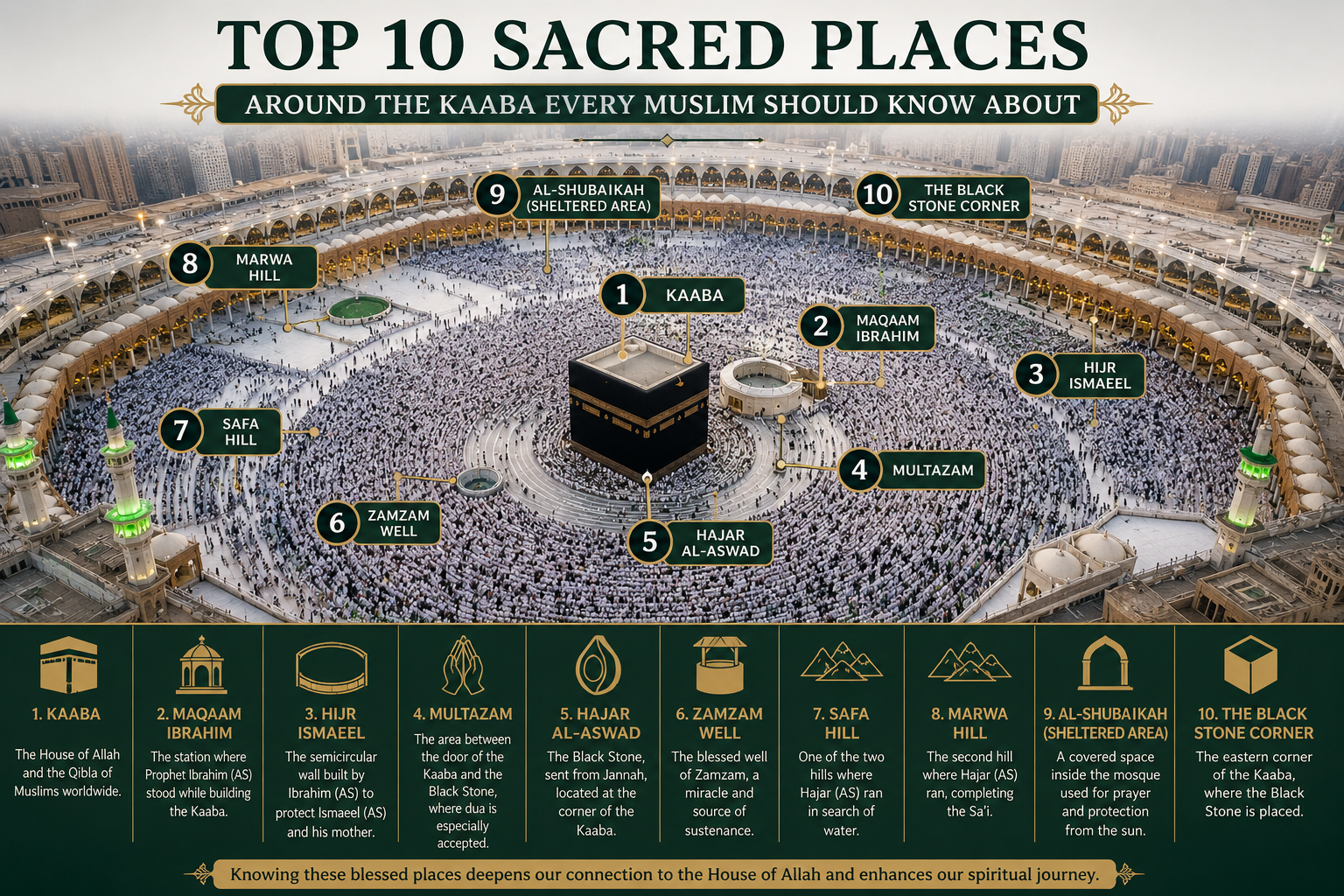
Sacred Places Around the Kaaba offer every Muslim an opportunity to connect deeply with the history, spirituality, and legacy of Islam. For every Muslim, visiting Makkah is far more than a journey—it is a life-changing spiritual experience. While the Holy Kaaba remains the centre of worship and the Qiblah for Muslims across the globe, the area surrounding it is filled with places that hold profound religious and historical importance. Each location tells a story connected to the Prophets, the early Muslim community, and significant moments in Islamic history.
Learning about these Sacred Places Around the Kaaba before performing Hajj or Umrah helps pilgrims appreciate the deeper meaning behind their visit. Beyond completing the rituals, understanding these sacred landmarks strengthens one’s connection with Islamic heritage and makes every step inside Masjid al-Haram more meaningful.
In this guide, we explore ten remarkable Sacred Places Around the Kaaba that every Muslim should know about.
1. Sacred Places Around the Kaaba: The Holy Kaaba – The Centre of Islamic Worship
The Sacred Places Around the Kaaba continue to inspire millions of Muslims by preserving the legacy of the Prophets and the rich history of Islam.
The Kaaba is the most sacred structure in Islam and the direction toward which Muslims pray five times a day. Located at the heart of Masjid al-Haram, it has served as the spiritual focal point of the Muslim Ummah for centuries.
According to Islamic tradition, Prophet Ibrahim (AS) and his son Prophet Ismail (AS) rebuilt the Kaaba as a house dedicated to the worship of Allah alone. Every year, millions of believers gather around it to perform Tawaf, demonstrating the unity of Muslims regardless of nationality, language, or culture.
The Kaaba is covered with the beautifully embroidered black Kiswah, which is replaced annually. Its elegant Quranic calligraphy and gold-embroidered belt remind pilgrims of the honour and sanctity of Allah’s Sacred House. Among all the Sacred Places Around the Kaaba, Maqam Ibrahim remains one of the most respected landmarks in Islamic history.
2. Maqam Ibrahim – A Symbol of Faith and Dedication
Among the most respected Historical places near Kaaba is Maqam Ibrahim. This sacred stone is believed to bear the footprints of Prophet Ibrahim (AS), left while he was constructing the Kaaba.
The Quran mentions Maqam Ibrahim, and pilgrims are encouraged to offer two units of prayer after completing Tawaf if circumstances allow. Although protected within a crystal enclosure today, the site continues to remind Muslims of Prophet Ibrahim’s unwavering obedience and commitment to fulfilling Allah’s command.
Its presence near the Kaaba reflects the lasting legacy of one of Islam’s greatest Prophets.
3. The Well of Zamzam – A Miracle That Continues Today
Only a short distance from the Kaaba lies one of the greatest miracles in Islamic history—the Well of Zamzam.
According to Islamic tradition, Allah caused this blessed water to spring from the ground when Hajar (AS) desperately searched for water for her infant son, Prophet Ismail (AS). What began as a miracle in the barren desert continues to provide millions of pilgrims with fresh water every year.
Drinking Zamzam is a cherished Sunnah during Hajj and Umrah, and many Muslims make heartfelt supplications while drinking it, hoping for Allah’s blessings and mercy.
More than just water, Zamzam symbolizes Allah’s provision, compassion, and limitless power.
4. Safa and Marwah – A Lesson in Trusting Allah
The hills of Safa and Marwah represent one of the most moving stories in Islamic history.
Hajar (AS), searching tirelessly for water for her thirsty child, ran between these two hills seven times with complete trust in Allah. Her patience and faith became an everlasting example for every believer.
Today, pilgrims perform Sa’i by walking between Safa and Marwah as an essential ritual of both Hajj and Umrah. This act reminds Muslims that sincere reliance upon Allah is always rewarded, even during life’s most difficult moments.
These hills remain among the Important places in Masjid al Haram, inspiring millions of visitors every year. Several Sacred Places Around the Kaaba continue to inspire millions of Muslims through their deep historical and spiritual significance.
5. Hijr Ismail (Hateem) – A Blessed Area Beside the Kaaba
Adjacent to the Kaaba is the semi-circular area known as Hijr Ismail or the Hateem.
Islamic tradition teaches that this space originally formed part of the Kaaba’s foundation before later rebuilding reduced its size. Because of this, praying inside the Hateem is regarded as equivalent to praying within the Kaaba itself.
Although access may be limited during busy pilgrimage seasons, many worshippers patiently wait for an opportunity to offer voluntary prayers in this blessed area.
For countless visitors, the Hateem is one of the most peaceful places inside the Sacred Mosque, encouraging quiet reflection and sincere worship.
6. The Black Stone (Hajar al-Aswad) – The Starting Point of Tawaf
Positioned in the eastern corner of the Holy Kaaba, Hajar al-Aswad holds a special place in the hearts of Muslims. Every circuit of Tawaf begins and ends in line with this blessed stone, following the practice of Prophet Muhammad ﷺ.
While many pilgrims hope to kiss or touch the Black Stone, Islam teaches that doing so should never involve pushing or harming others. If reaching it is not possible, simply pointing towards it while continuing Tawaf fulfills the Sunnah.
Its significance lies not in the stone itself, but in following the example of the Prophet ﷺ with humility and respect.
7. The Multazam – A Place for Heartfelt Supplication
Between the door of the Kaaba and the Black Stone is an area known as the Multazam. This location has long been regarded by Muslims as a blessed place to make sincere du’a.
Pilgrims often raise their hands in prayer here, asking Allah for forgiveness, guidance, and mercy. Although reaching the Multazam can be difficult during busy periods, its spiritual importance remains deeply cherished.
For many visitors, moments spent here become some of the most memorable parts of their pilgrimage. Every one of these Sacred Places Around the Kaaba reminds believers of important events connected with the Prophets and the early history of Islam.
8. The Kaaba Door and the Sacred Sitara
The golden door of the Holy Kaaba stands several feet above the ground and is covered by the beautifully embroidered Sitara, an elegant curtain decorated with Quranic verses in gold and silver thread.
The Sitara reflects extraordinary Islamic craftsmanship and symbolizes the honour given to the House of Allah. While the Kaaba door is opened only on special occasions, pilgrims often spend time admiring its intricate design from below.
Today, authentic fragments of the Kiswah and Sitara are preserved as valuable reminders of Islamic history and heritage.
9. The Courtyards of Masjid al-Haram
The vast courtyards surrounding the Kaaba are among the busiest places of worship in the world. They provide additional space for millions of pilgrims who gather for daily prayers, Friday congregations, Ramadan, Hajj, and Umrah.
Standing anywhere in these courtyards offers breathtaking views of the Holy Kaaba and reminds visitors of the unity of Muslims from every nation and background.
These open spaces also allow pilgrims to pause, reflect, recite the Quran, and prepare spiritually before continuing their acts of worship.
10. The Kiswah – A Living Symbol of Islamic Heritage
Although it covers the Kaaba itself, the Kiswah deserves special recognition because of its religious, artistic, and historical importance.
Made from premium black silk and adorned with gold and silver embroidered Quranic calligraphy, the Kiswah represents centuries of Islamic craftsmanship. Every year, a new Kiswah is placed over the Kaaba, continuing a tradition that has existed for generations.
Authentic Kiswah fragments preserved from previous coverings are treasured around the world as meaningful reminders of the sacred sanctuary in Makkah. Exploring the Sacred Places Around the Kaaba before your journey can make every ritual more meaningful and spiritually rewarding.
Important Ziyarat Spots During Umrah from UK
Many pilgrims planning Important Ziyarat spots during Umrah from UK choose to learn about Makkah’s sacred sites before travelling. Understanding the significance of each location helps visitors perform their pilgrimage with greater appreciation and reflection.
In addition to the Holy Kaaba, pilgrims often include visits to nearby Islamic landmarks that played an important role in the life of Prophet Muhammad ﷺ and the history of Islam. Preparing a thoughtful itinerary allows worshippers to make the most of their spiritual journey while respecting local guidance and pilgrimage schedules.
Visiting these Sacred Places Around the Kaaba allows pilgrims to understand the spiritual significance behind every step of their Hajj or Umrah journey.
Sacred Landmarks in Mecca That Continue to Inspire Muslims
The Sacred landmarks in Mecca are not simply historical locations—they are enduring symbols of faith, sacrifice, and complete trust in Allah.
Every place surrounding the Kaaba carries lessons that remain relevant today. From the patience of Hajar (AS) to the devotion of Prophet Ibrahim (AS), these landmarks remind believers that sincere faith, perseverance, and obedience are rewarded by Allah.
Visiting these places encourages Muslims to reflect on their own relationship with their Creator while strengthening their understanding of Islamic history.
Final Thoughts
The Sacred Places Around the Kaaba remind every Muslim of faith, sacrifice, patience, and complete trust in Allah. The Holy Kaaba is surrounded by remarkable places that have shaped the story of Islam.
Each location reflects the devotion of the Prophets, the perseverance of the early believers, and the timeless message of worshipping Allah alone.
Whether you are exploring the Sacred Places Around the Kaaba, discovering Sacred Places in Makkah, learning about Important places in Masjid al Haram, researching Important Ziyarat spots during Umrah from UK, or visiting Historical places near Kaaba, understanding these blessed sites transforms an ordinary visit into a deeply meaningful spiritual experience.
Reflecting on the Sacred Places Around the Kaaba helps Muslims develop a stronger appreciation for the sacred history of Makkah and the timeless message of Islam.
At Kaaba Kiswa, we are committed to preserving the heritage of the Holy Kaaba by sharing authentic educational resources and offering genuine Kiswah pieces that help Muslims around the world maintain a lasting connection with Islam’s most sacred sanctuary.