
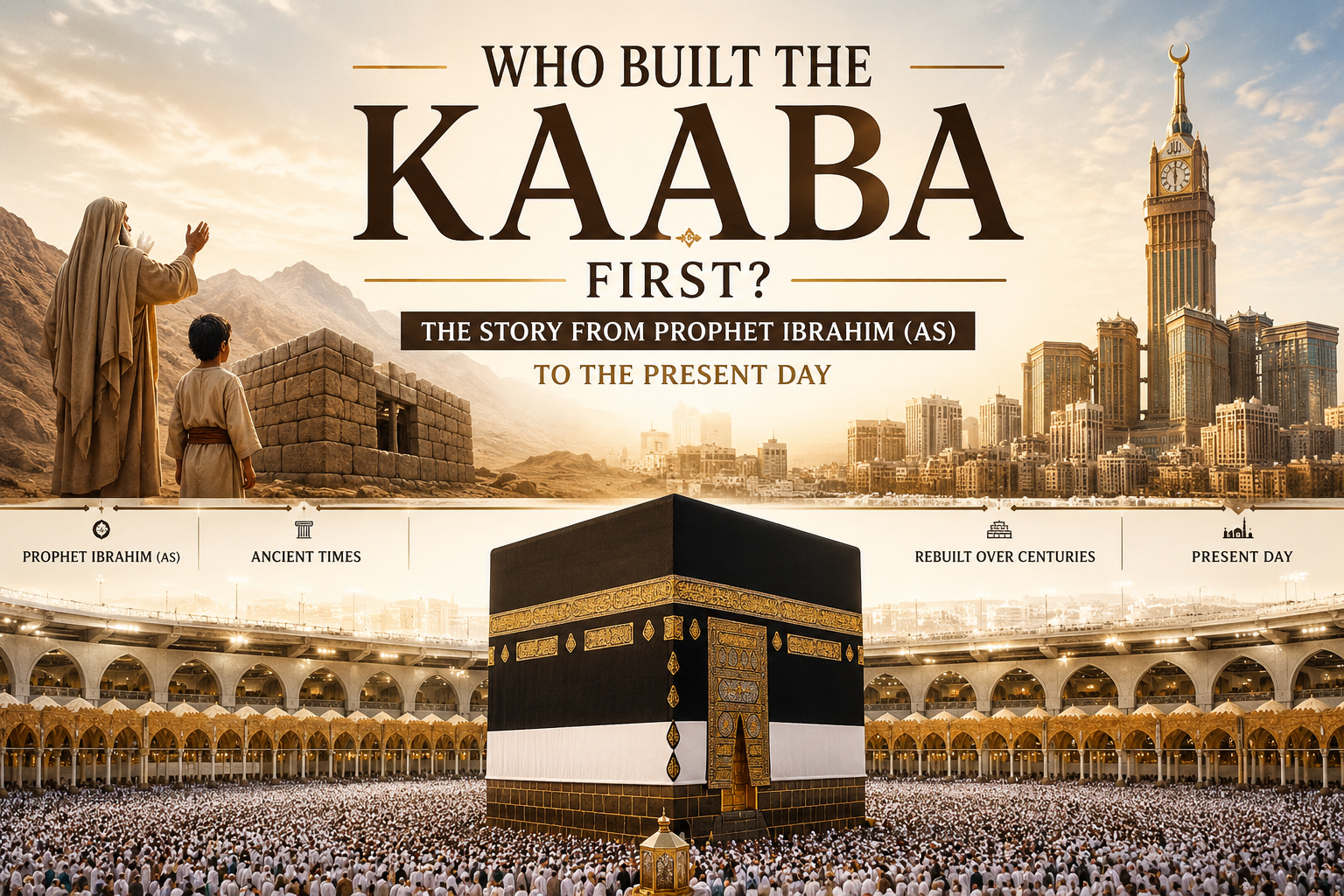
The Holy Kaaba is the most sacred site in Islam and the direction Muslims face during every prayer. Located at the centre of Masjid al-Haram in Makkah, it has united believers across generations as the spiritual heart of the Muslim world. While millions of people recognise its black Kiswah and distinctive shape, many still ask an important historical question: who built the Kaaba first?
Many Muslims and history enthusiasts wonder who built the Kaaba first, as understanding its origins provides deeper insight into the sacred history of Islam.
The answer involves both Islamic tradition and centuries of preservation. From the earliest foundations to the rebuilding carried out by Prophet Ibrahim (AS) and later restorations, the Kaaba’s story reflects faith, devotion, and the determination to protect one of Islam’s greatest treasures.
In this article, we explore the history of Kaaba construction, discuss who built Kaaba before Prophet Ibrahim, answer whether Prophet Ibrahim built the Kaaba, and explain how this sacred legacy continues to be remembered through meaningful keepsakes such as a Kaaba Kiswa frame.
The Kaaba’s Place in Islamic History
Before learning who built the Kaaba first, it is important to understand why the Kaaba holds such an important place in Islam. It has remained the centre of worship for believers for centuries.
The Kaaba is more than an ancient building. It is known as Baytullah—the House of Allah—and serves as the Qiblah for Muslims worldwide. Every day, believers turn towards it during prayer, and every year millions perform Tawaf around it during Hajj and Umrah.
Its importance lies in its purpose as a place dedicated solely to the worship of Allah.
Who Built the Kaaba First?
The question who built the Kaaba first has been discussed by Islamic scholars for centuries.
According to many classical Islamic narrations, the first foundations of the Kaaba were established before Prophet Ibrahim (AS). Some scholars mention that the angels built or marked the original site by Allah’s command, while others relate that Prophet Adam (AS) established the first structure for worship after coming to earth.
Because these reports vary in authenticity, the Qur’an does not specifically identify the very first builder. What the Qur’an clearly confirms is that Prophet Ibrahim (AS) and his son Prophet Ismail (AS) raised the existing foundations of the Kaaba under Allah’s command.
Therefore, while different historical opinions exist regarding who built Kaaba before Prophet Ibrahim, the Qur’anic account firmly establishes Prophet Ibrahim (AS) as the one who rebuilt and restored the Sacred House upon its foundations.
Did Prophet Ibrahim Build the Kaaba?
A common question is did Prophet Ibrahim build the Kaaba?
The Qur’an explains that Prophet Ibrahim (AS), together with Prophet Ismail (AS), raised the foundations of the Kaaba while praying that Allah would accept their efforts.
This shows that Prophet Ibrahim (AS) did not choose the location himself. Instead, he restored and rebuilt the sacred structure on foundations that already existed by Allah’s will.
His work transformed the Kaaba into the centre of monotheistic worship and established its enduring role in Islamic history.
The History of Kaaba Construction
The history of Kaaba construction spans thousands of years and includes several important stages.
The Earliest Foundations
Islamic tradition describes the sacred site as a place chosen by Allah long before the time of Prophet Ibrahim (AS). Although scholars differ regarding the earliest construction, all agree that the location itself holds exceptional significance.
Reconstruction by Prophet Ibrahim (AS)
Under divine guidance, Prophet Ibrahim (AS) and Prophet Ismail (AS) rebuilt the Kaaba and dedicated it entirely to the worship of Allah.
This event remains one of the defining moments in Islamic history.
Rebuilding by the Quraysh
Centuries later, the Quraysh rebuilt the Kaaba after structural damage. During this reconstruction, Prophet Muhammad ﷺ took part in resolving a disagreement over who should place the Black Stone back in its position, demonstrating wisdom and fairness before his prophethood.
Preservation Through the Centuries
The Kaaba has since undergone repairs and restoration following floods, natural ageing, and maintenance requirements. Every restoration has respected its sacred character while preserving its historical identity.
Why Has the Kaaba Been Rebuilt?
Understanding who built the Kaaba first also explains why every later reconstruction focused on preserving the original sacred foundations rather than creating an entirely new building. The Kaaba has experienced heavy rainfall, floods, and natural wear over many centuries.
Rather than replacing the building for aesthetic reasons, each reconstruction focused on preserving its stability and ensuring that future generations could continue to worship at Islam’s holiest site.
Its appearance has remained remarkably consistent despite these maintenance efforts.
Lessons from the Kaaba’s Story
Learning who built the Kaaba first reminds Muslims that the House of Allah has always been connected to obedience, worship, and submission to Allah’s command. The history of the Kaaba teaches lessons that extend beyond architecture.
It reminds Muslims that:
- Worship belongs to Allah alone.
- Obedience to Allah is greater than worldly achievement.
- Faith is preserved through sincere effort.
- Sacred places should be protected with respect and care.
- Unity remains central to the Muslim Ummah.
These timeless values continue to inspire believers across the world.
Preserving the Memory of the Sacred House
Many pilgrims wish to keep a lasting reminder of their journey to Makkah or express their connection to the Holy Kaaba within their homes.
One meaningful way to do this is through a handcrafted Kaaba Kiswa frame containing certified Kiswah fabric. These beautifully presented pieces combine Islamic heritage with skilled craftsmanship, allowing families to preserve a tangible reminder of one of the world’s most sacred landmarks.
For collectors of Islamic heritage, a carefully prepared Kaaba Kiswa frame represents both spiritual significance and historical appreciation.
Conclusion
Understanding who built the Kaaba first provides a deeper appreciation of one of Islam’s most treasured landmarks. While Islamic scholars have different views regarding who built Kaaba before Prophet Ibrahim, the Qur’an clearly confirms that Prophet Ibrahim (AS) and Prophet Ismail (AS) raised the Kaaba upon its existing foundations and dedicated it to the worship of Allah.
The remarkable history of Kaaba construction reflects centuries of preservation, devotion, and faith. Whether studying its history or displaying a beautifully crafted Kaaba Kiswa frame, Muslims continue to honour the Sacred House and the legacy it represents for generations to come.