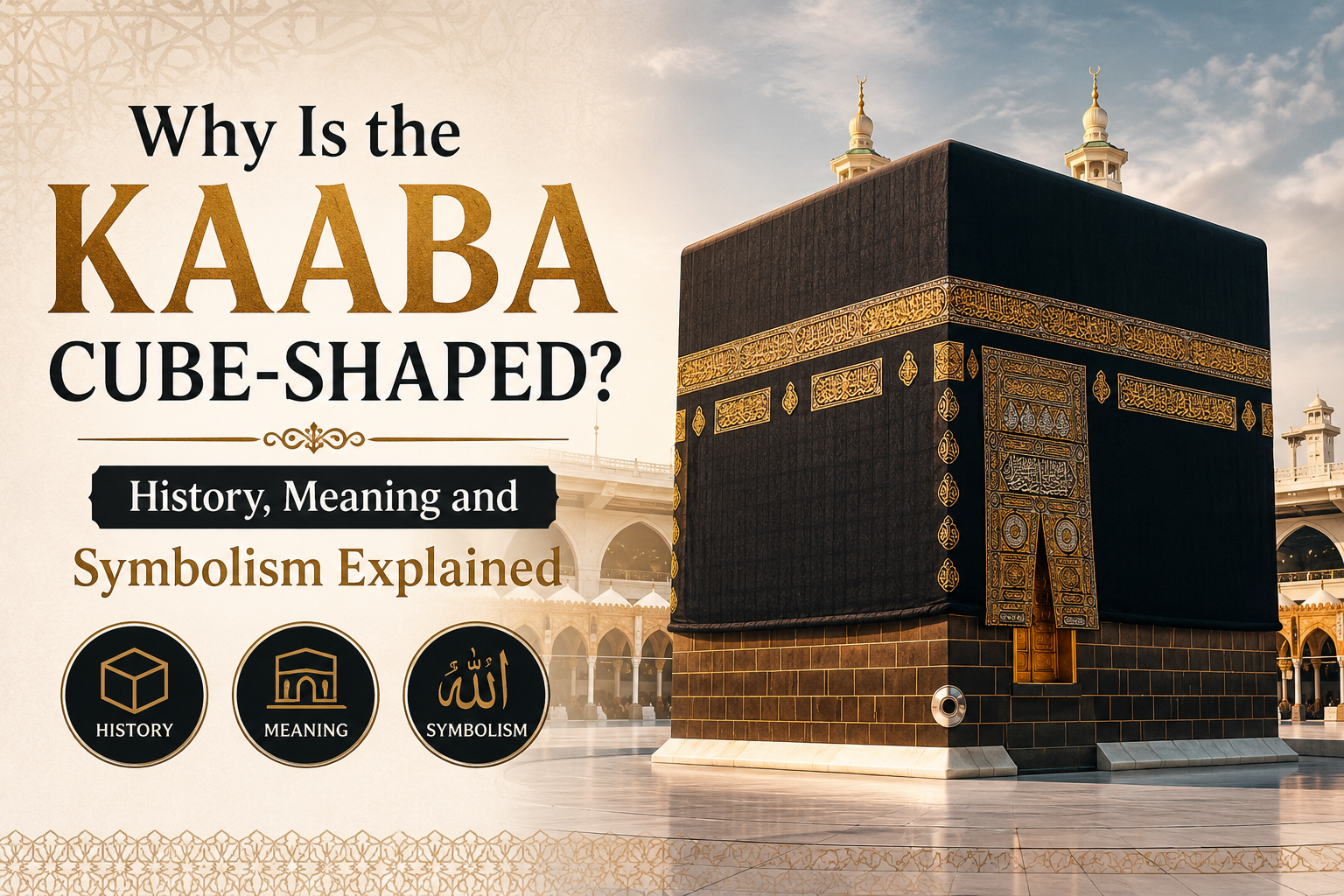
Why is the Kaaba cube shaped? It is one of the most frequently asked questions by Muslims and non-Muslims who visit or learn about Islam’s holiest sanctuary. Its simple yet powerful appearance is recognised globally, but one question continues to intrigue many believers and visitors alike: why is the Kaaba cube shaped?
Many visitors and researchers ask, why is the Kaaba cube shaped, because its simple structure is unlike many other famous religious buildings around the world.
Unlike many religious buildings known for towering domes or intricate architecture, the Kaaba has a remarkably simple geometric form. That simplicity is not accidental. It reflects a rich history, practical design, and profound spiritual symbolism that has endured through generations.
In this article, we’ll explore why the Kaaba is cube shaped, examine the original shape of Kaaba, understand the significance of the 4 corners of the Kaaba, and uncover the meaning of Kaaba in Arabic. We’ll also see how the Sacred House continues to inspire collectors of authentic Islamic artifacts around the world.
The Meaning of Kaaba in Arabic
To appreciate the Kaaba’s design, it helps to begin with its name.
The meaning of Kaaba in Arabic comes from the word “Ka’bah” (الكعبة), which refers to something that is cube-like, elevated, or square in form. The name reflects the building’s distinctive shape rather than serving as a symbolic title.
Although people commonly describe it as a perfect cube, the Kaaba is actually a near-cuboid structure. Its proportions have varied slightly throughout history due to reconstructions, but its overall form has remained recognisable for centuries.
Its straightforward design reflects humility and devotion, reminding Muslims that true worship is directed solely to Allah.
Why Is the Kaaba Cube Shaped?
Many people ask, why is the Kaaba cube shaped instead of being circular or built with elaborate architectural features?
To understand why is the Kaaba cube shaped, it is important to look at its historical foundations, practical construction, and spiritual significance in Islam.
Islamic historical sources indicate that the Kaaba’s design follows the foundation established by Prophet Ibrahim (AS) and Prophet Ismail (AS) under Allah’s command. The structure was intended to serve as a sacred place of worship rather than a display of worldly grandeur.
The cube-like form offers several practical and symbolic qualities:
- It provides structural strength.
- It creates clear and recognisable boundaries.
- It allows pilgrims to perform Tawaf easily around the building.
- Its simplicity keeps attention focused on worship instead of architecture.
The Kaaba’s beauty lies not in ornamentation but in the spiritual purpose it represents.
Understanding why is the Kaaba cube shaped also helps explain why its design has remained almost unchanged for centuries despite several restorations.
The Original Shape of Kaaba
Understanding the original shape of Kaaba requires looking back through Islamic history.
According to authentic historical narrations, Prophet Ibrahim (AS) and Prophet Ismail (AS) rebuilt the Kaaba upon foundations established by Allah. Over the centuries, natural disasters, floods, and rebuilding projects resulted in several restorations.
One of the most significant reconstructions took place before the Prophethood of Muhammad ﷺ, when the Quraysh rebuilt the Kaaba using lawful resources. Because their funds were limited, they could not reconstruct the building upon its entire original foundation.
This resulted in a portion of the original foundation remaining outside the present walls, now marked by the semi-circular area known as Hijr Ismail (Hateem).
Although dimensions have changed slightly throughout history, the Kaaba has retained its familiar cube-like appearance.
The Four Corners of the Kaaba
The 4 corners of the Kaaba each have their own historical identity and direction.
They are traditionally known as:
- Rukn al-Aswad – The corner containing the Black Stone.
- Rukn al-Iraqi – Facing Iraq.
- Rukn al-Shami – Facing the region of Greater Syria (Ash-Sham).
- Rukn al-Yamani – Facing Yemen.
These names reflect the historical directions of important regions within the Islamic world rather than decorative features.
Among these, the Black Stone corner holds particular significance because pilgrims begin and complete each circuit of Tawaf from this point.
The Simplicity of the Kaaba’s Design
One remarkable feature of the Kaaba is its deliberate simplicity.
Unlike monuments built to impress through luxury or complexity, the Kaaba reminds Muslims that faith is centred on submission to Allah rather than outward appearance.
Its plain geometry communicates timeless lessons:
- Humility before the Creator.
- Equality among believers.
- Unity of the Muslim Ummah.
- Devotion without distraction.
Every Muslim, regardless of nationality, language, or social status, faces the same Sacred House in prayer each day.
How the Kaaba Has Been Preserved
Although the Kaaba has been restored several times because of floods, weather, and maintenance needs, great care has always been taken to preserve its historical identity.
Modern restoration work focuses on strengthening the structure while respecting its traditional appearance.
The famous Kiswah, replaced annually, protects the exterior while reflecting centuries of exceptional Islamic craftsmanship.
These preservation efforts ensure that future generations continue to witness one of Islam’s most important sacred landmarks.
Common Misconceptions About the Kaaba’s Shape
Several misunderstandings frequently arise regarding the Kaaba.
The Kaaba Has Always Had Exactly the Same Dimensions
While its overall appearance has remained familiar, measurements have changed slightly following different reconstructions throughout history.
The Cube Shape Has Hidden Mystical Meanings
Islamic teachings emphasise worship of Allah rather than speculative symbolism. The Kaaba’s significance comes from its role as the House of Allah and the direction of prayer.
The Four Corners Represent Different Religions
The 4 corners of the Kaaba simply identify geographical directions and assist pilgrims during Tawaf. They are not associated with separate beliefs or sects.
The Kaaba’s Lasting Influence on Islamic Art
The elegant proportions of the Kaaba have inspired Muslim artists, architects, and craftsmen for centuries.
Today, its distinctive form appears in:
- Arabic calligraphy.
- Mosque architecture.
- Islamic manuscripts.
- Decorative wall art.
- Luxury home decor.
- Handcrafted Kaaba replicas.
These artistic expressions celebrate the Sacred House while reminding believers of their spiritual connection to Makkah.
Authentic Islamic Artifacts Inspired by the Kaaba
For many Muslims, bringing home a reminder of Makkah is a meaningful way to preserve the memories of Hajj or Umrah.
Beautiful authentic Islamic artifacts inspired by the Kaaba allow families to honour that connection in their homes.
Popular choices include:
- Certified Kaaba Kiswah pieces.
- Framed Kiswah displays.
- Arabic calligraphy artwork.
- Kaaba-inspired Islamic wall decor.
- Handcrafted heritage collections.
These carefully crafted pieces reflect the history, beauty, and spiritual significance of Islam’s holiest sanctuary.
For anyone wondering why is the Kaaba cube shaped, the answer lies in its sacred purpose, historical origins, and timeless simplicity rather than architectural complexity.
Conclusion
Understanding why is the Kaaba cube shaped reveals that its appearance is rooted in history, worship, and timeless simplicity rather than architectural extravagance. Learning about the original shape of Kaaba, the significance of the 4 corners of the Kaaba, and the meaning of Kaaba in Arabic allows Muslims to appreciate the Sacred House with greater knowledge and reverence.
Although the Kaaba’s design is simple, its message is profound. It reminds believers that true greatness lies in faith, obedience, and unity before Allah. Through its enduring architecture and the inspiration it provides for authentic Islamic artifacts, the Kaaba continues to connect generations of Muslims with one of the most sacred places on Earth.